
A balcony microclimate is your balcony’s small local weather
A weather forecast describes a city or region. A plant experiences the small area around it. A balcony microclimate is that local combination of morning sun, afternoon heat, reflected walls, direct wind, blocked rain, shade, humidity, and potting media drying speed.
Humidity is not an isolated number in that mix; how humidity affects plants explains its connections with transpiration, airflow, and drying rate.
This is why the same plant may grow well on a friend’s balcony but not behave the same way on yours. The plant is not responding only to the city’s temperature or rain forecast. It is responding to the exact corner where the pot sits.
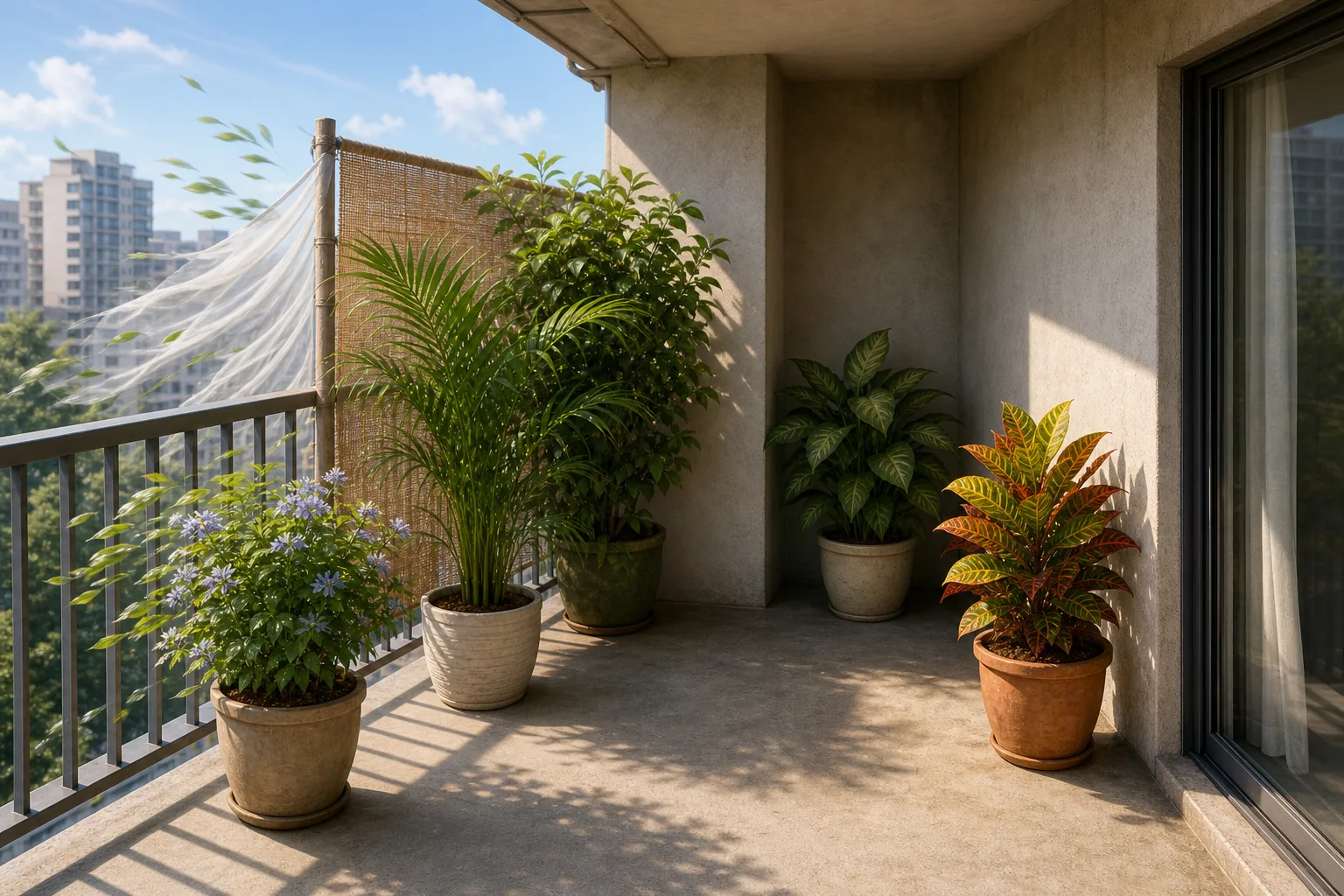
Why balconies vary so much
A balcony is affected by outdoor weather, building materials, and container limits. It does not have the buffering of a large garden soil volume, and it is not as stable as an indoor room.
The railing edge may receive more light, wind, and rain. A wall may reflect light and heat. An overhang may block rain and create shade. Concrete, tile, metal railings, and exterior walls can absorb heat and make nearby pots hotter than expected.
Pots amplify these differences. Their media volume is limited, so water and temperature can change quickly. Small pots, shallow pots, black pots, and pots exposed to strong afternoon sun may dry faster. Large pots or water-retentive media in a shaded corner may stay moist longer.
Divide the balcony into zones
Instead of asking “What plant is good for my balcony?” first divide the balcony into positions.
The railing side may be the brightest and windiest. Wall-side areas may be stable or hotter from reflected heat. Door or window areas connect to indoor light and air movement. Under a cover, rain may be blocked, but air and heat may also behave differently.
If an air-conditioner outdoor unit is nearby, plants may face a very local stream of hot dry air. The plant is not only receiving natural wind; it may be receiving building-generated airflow too.
Light, wind, and heat change pot moisture
The most visible result of a balcony microclimate is that pots dry at different speeds.
Strong light and heat increase evaporation. Wind removes moist air from leaf and media surfaces. Dry air increases water loss. Leaves also transpire, moving water from roots to leaves and then into the air.
This is why fixed watering intervals do not work well for every balcony. A pot at a windy west-facing railing and the same pot in an inner shaded corner can dry at very different speeds.
Wind is not always better, and shade is not always bad
Good airflow does not mean constant strong wind. Moderate air movement can reduce stuffiness, but strong continuous wind can increase water loss and physically stress leaves and stems.
Shade is not automatically bad. It can reduce heat stress for plants that do not tolerate strong direct sun. But a permanently dim, still corner may also lead to slow drying, weak growth, or leggy stems.
To avoid treating every shaded position as the same, compare direct sun, bright indirect light, and bright shade.
The practical goal is to understand the tradeoff in each position: where it is bright, hot, windy, dry, shaded, or stagnant.
A low-risk observation method
Observe your balcony like a small map for one week. Note where direct sun appears in the morning, noon, and afternoon. Mark where light is bright but indirect, and where it stays dim.
Then observe wind. Which leaves move often? Which corners are still? Which areas are near vents or outdoor equipment?
After watering, compare how quickly similar pots dry in different positions. You can also touch walls, tiles, and pot sides in the afternoon to see whether they become hot. This is not a precise experiment, but it teaches that “on the balcony” is not one condition.
Common confusions
- ✕ If the weather forecast is mild, balcony plants cannot be hot.
- ✓ Walls, tiles, railings, and shade structures can create local heat.
- ✕ Strong wind always means better ventilation.
- ✓ Moderate airflow can help, but strong wind also increases water loss.
- ✕ If it rained, covered balcony plants must have received water.
- ✓ Overhangs, walls, and roofs can block rain from pots.
- ✕ West-facing balconies cannot grow plants.
- ✓ Afternoon sun and heat are stronger, but suitability depends on shade, wind, pots, media, and plant tolerance.
Frequently Asked Questions
How is a balcony microclimate different from the weather forecast?
The forecast describes a broad area. A balcony microclimate describes the exact light, heat, wind, humidity, shade, and pot moisture around a plant.
Are all corners of one balcony the same?
No. Railing edges, wall corners, raised shelves, covered areas, and spots near outdoor equipment can all differ.
Is a west-facing balcony impossible for plants?
No. It often means stronger afternoon light and heat, but the actual result depends on shade, wind, pot, media, and plant type.
Is strong wind the same as good ventilation?
No. Moderate airflow can reduce stagnant humidity. Strong continuous wind may dry leaves and pots quickly.
Can balcony plants be watered on a fixed schedule?
It is risky to rely only on fixed days. Microclimate, pot size, media, season, light, and wind all change drying speed.
Does grouping plants improve the microclimate?
Sometimes it can create slight shade or local humidity, but it can also reduce airflow or light inside the group. Treat grouping as something to observe, not a guaranteed solution.
Related Terms
- Microclimate: a small local environment that differs from the broader weather.
- Transpiration: water loss from plant leaves to the air.
- Reflected heat: heat from walls, floors, railings, or other surfaces.
- Wind corridor: a position with especially strong airflow.
- Shade: reduced direct light, which may lower heat stress or limit growth depending on context.
Read Next
Evidence
References
These sources were used to check the plant-science concepts and gardening context in this article.