Water retention and drainage
Particles close together
Connected to an outlet below
Gravity-driven drainage and capillary retention.
Model conditions
An enlarged qualitative view of wettable particles with connected pores and an open outlet below. Film thickness and timing are not to scale. Retention also depends on pore shape, connectivity and surface properties. Not all retained water is available to roots.
Drainage is not about making plants drink less
Potting media needs drainage because roots cannot remain surrounded only by water for too long. Roots absorb water, but they also need oxygen for respiration. If all the pore spaces around roots stay filled with water, air exchange becomes difficult.
Think of potting media as a sponge with many spaces. A useful medium holds some water for roots while allowing extra water to leave. Good drainage does not mean “as dry as possible.” It means water and air both have places to be.
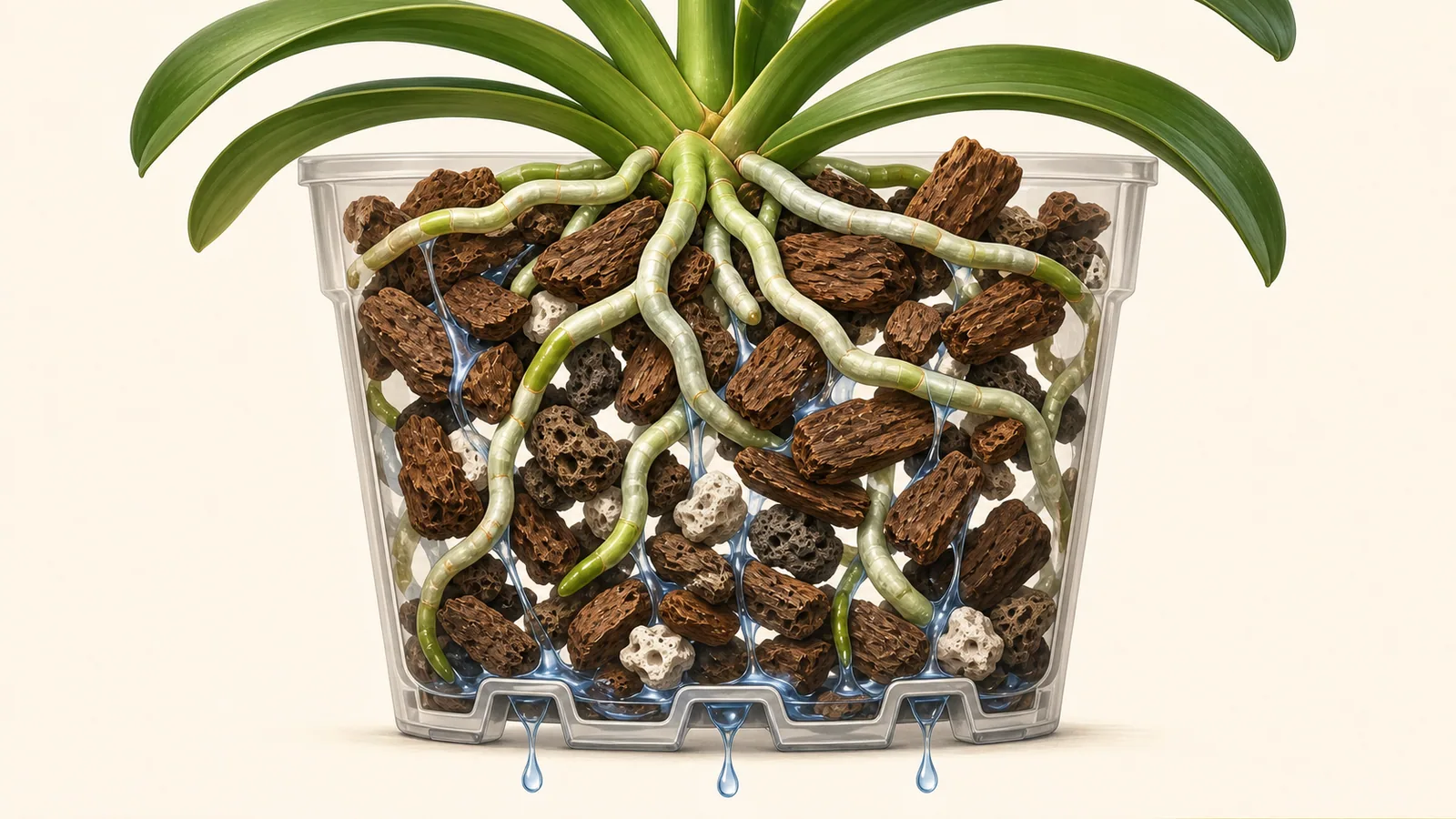
The key points are: the medium should not lose all water, pores should not stay filled with water, and roots need both water contact and oxygen.
Roots need oxygen
Root cells respire. This is not animal-style breathing with lungs, but the cellular use of oxygen to support life activities. Oxygen reaches roots through air spaces in soil or potting media.
If media remains water-filled for a long time, the amount of air around roots decreases. Drainage gives excess water a path out so some pore spaces can refill with air.
Drainage, water retention, and aeration therefore belong together. Drainage removes excess water. Water retention keeps some water available. Aeration lets roots exchange gases.
Select “Start watering” below to watch water enter the pores, then drain through the larger connected channel. Notice the water that remains in the narrow gap and on particle surfaces: drainage does not leave the medium completely dry.
Containers are limited environments
Potted plants need drainage attention because a pot is a limited container. Water cannot move downward and outward the way it can in a larger soil profile. Drainage holes, media particles, pot size, and roots all affect how long water stays.
Drainage holes matter, but they are not the whole answer. Fine compact media, blocked holes, a saucer full of standing water, or old broken-down media can still create poor water and air movement.
After watering, it is useful to see whether excess water has a route out. If water sits on the surface for a long time or the media becomes hard and compact, include drainage and aeration in your observations.
Different plants need different balances
Good drainage does not mean fast drying in every case. Some media dry too quickly and make water supply unstable. The better question is whether the medium can hold usable water, release excess water, and keep some air around roots.
Phalaenopsis orchids are useful examples because many are grown in bark or other coarse, airy media rather than dense soil. This connects to their epiphytic habit and fleshy roots that need air. But orchids, pothos, succulents, ferns, and herbs do not all need the same medium.
This article explains principles. It does not provide a fixed potting mix or watering schedule.
Common confusions
- ✕ Good drainage means the pot should dry as fast as possible.
- ✓ Good drainage removes excess water while still leaving usable moisture.
- ✕ A drainage hole means the pot cannot have drainage problems.
- ✓ Media can still be compact, holes can clog, and water can remain in saucers.
- ✕ Roots only need water.
- ✓ Roots need water and oxygen.
- ✕ Poor drainage automatically proves root rot.
- ✓ Poor drainage is a risk direction, but root condition and environment still need to be checked.
Frequently Asked Questions
Does good drainage mean the medium should dry quickly?
Not necessarily. Drainage means excess water can leave. The medium can still retain some water for roots.
Are drainage holes enough?
No. They provide an outlet, but media texture, compaction, clogged holes, and standing water under the pot also matter.
Why do roots need air?
Root cells use oxygen for respiration. Air spaces in the medium help provide that oxygen.
Can the surface be dry while the inside is wet?
Yes. The surface often dries faster than the center or bottom of the pot.
Why are orchids often grown in bark or coarse media?
Many Phalaenopsis orchids are epiphytic examples with roots that need more air space. Coarse media helps illustrate drainage and aeration, but it is not a universal rule for all plants.
Related Terms
- Drainage: the ability of excess water to leave a pot or medium.
- Water retention: the ability of a medium to hold some water for roots.
- Aeration: air space and gas exchange around roots.
- Potting medium: material that supports roots in a container.
- Pore: the space between media particles.
- Root respiration: oxygen use by root cells to support life activities.
Read Next
Evidence
References
These sources were used to check the plant-science concepts and gardening context in this article.