A flower is more than the colorful part you first notice
When people say “flower,” they often think first of colorful petals. In plant science, a flower is a reproductive structure made of several parts working together. Petals are only one part of the whole structure.
A typical flower is often introduced from the outside inward: sepals, petals, stamens, and the pistil/carpel structure. Sepals protect the developing flower bud. Petals often help attract pollinators or make the flower easier to notice. Stamens produce pollen. The pistil/carpel structure includes the parts that receive pollen and contain ovules.
Not every flower has every part, and not every flower looks like a neat textbook diagram. But this outside-to-inside order gives beginners a stable way to observe real flowers.
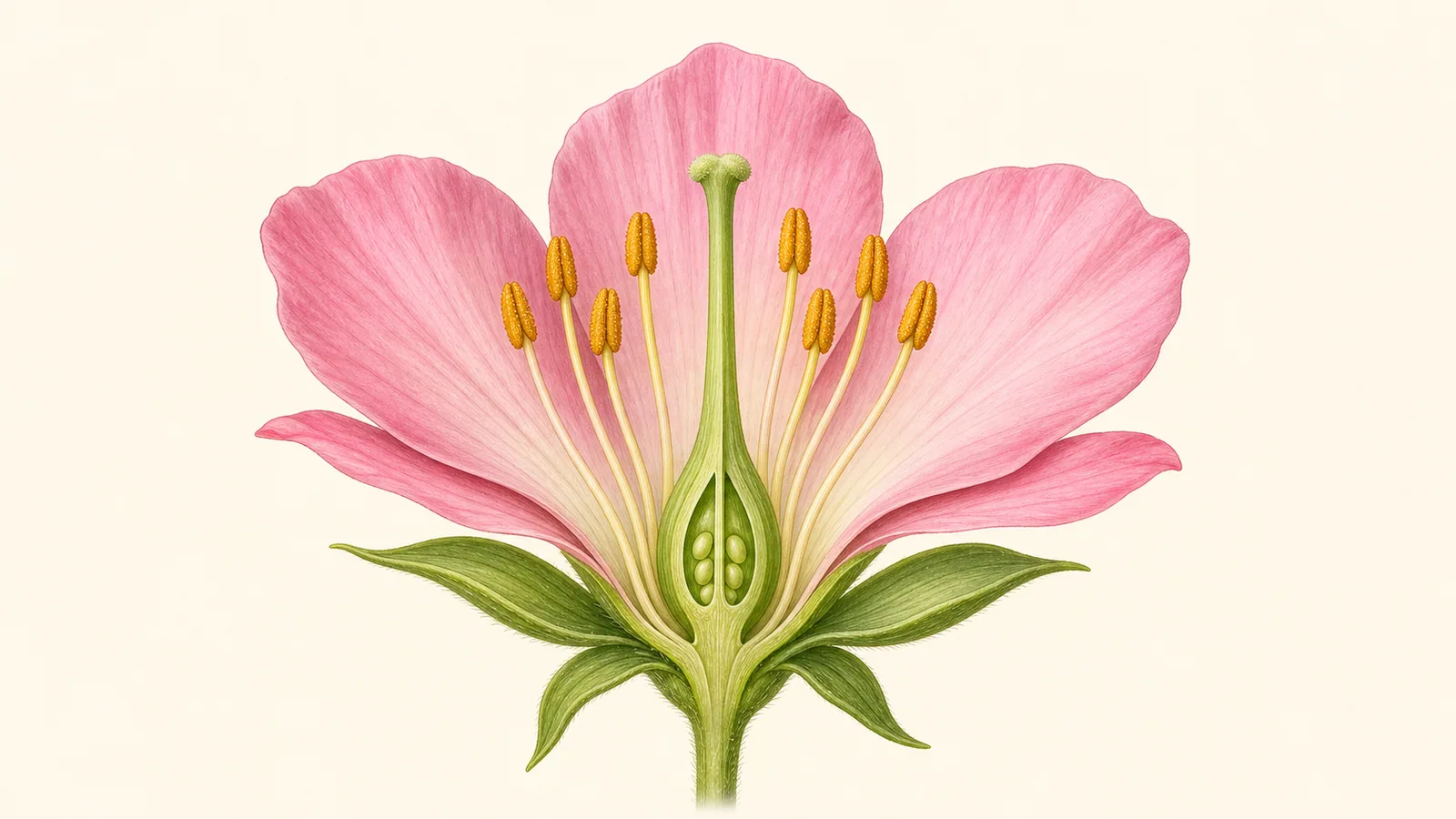 Sepal Petal Anther Filament Stigma Style Ovary Ovule
 Select a part name above to explore its role.
Protection around a developing flower bud
Sepals commonly surround the developing flower bud. Many are green, but some are as showy as petals.
Look at the green structures below the petals.
Petal shape and color often interact with pollinators
Petals may attract or guide pollinators through color, shape, and other features. They are one part of a flower; some flowers have small petals or none.
Look at the pink structures spreading around the flower.
Pollen forms in the anther
The anther is the pollen-producing part of a stamen. An anther and its supporting filament together form a stamen.
Look for the yellow elongated part, rather than the whole stamen.
The filament holds up the anther
The filament is the stalk-like part of a stamen, attached to its anther. Together they separate the pollen-producing role from the supporting role.
Follow the highlighted anther down along the pale-yellow stalk of the same stamen.
The stigma receives pollen
Pollen landing on a stigma may begin germination and pollen-tube growth. Pollen arrival does not mean fertilization has already occurred.
Look at the top of the central green structure.
The style connects the stigma and ovary
The style lies between the stigma and ovary. In many flowers, pollen tubes grow through this region toward the ovary. Styles vary in length and form.
Follow the stigma downward along the slender central green part.
The ovary contains the ovules
The ovary is the ovule-containing part at the base of a pistil. It can contribute to the fruit during later development; distinguish it from the ovules that may become seeds.
Look at the swollen green wall at the base of the central structure.
Ovules are inside the ovary and may develop into seeds
Ovules are structures inside the ovary. After fertilization and subsequent development, an ovule can form a seed. It is distinct from the surrounding ovary.
Look at the small pale-green structures inside the cut-open ovary.
Sepals and petals are the outer floral parts
Sepals are usually the outermost floral parts. In many flowers, they look green and leaf-like. Their common role is to protect the flower while it is still a bud. After the flower opens, sepals may remain under the petals, fold back, or become less noticeable.
Petals are usually the parts people notice first. They may be colorful, scented, patterned, or shaped in ways that help the flower interact with pollinators. Petals can also be small, plain, or absent in some plants. A flower does not need showy petals to be a flower.
Sometimes sepals and petals are hard to tell apart. In that case, the similar-looking parts may be called tepals. This is why some flowers do not fit neatly into a simple “green sepals plus colorful petals” picture.
If a showy, petal-like structure sits beside a flower or flower cluster, it may be a bract. Continue with how bracts differ from petals to compare where each structure attaches.
Stamens make pollen, and the pistil/carpel structure receives it
The stamen is the male reproductive part in a typical flower. A stamen usually has an anther and a filament. The anther is where pollen is produced, and the filament holds the anther in position.
The pistil is the central female structure in many teaching diagrams. It commonly includes the stigma, style, and ovary. The stigma is the surface that receives pollen. The style connects the stigma to the ovary. The ovary contains ovules, and after successful reproduction, ovules may develop into seeds.
Botany also uses the word carpel. A carpel is a basic female reproductive unit of a flower. A pistil may be one carpel or several carpels joined together. For beginners, it is enough to understand that the central female structure includes a pollen-receiving part and an ovary with ovules.
Complete and incomplete flowers are not quality scores
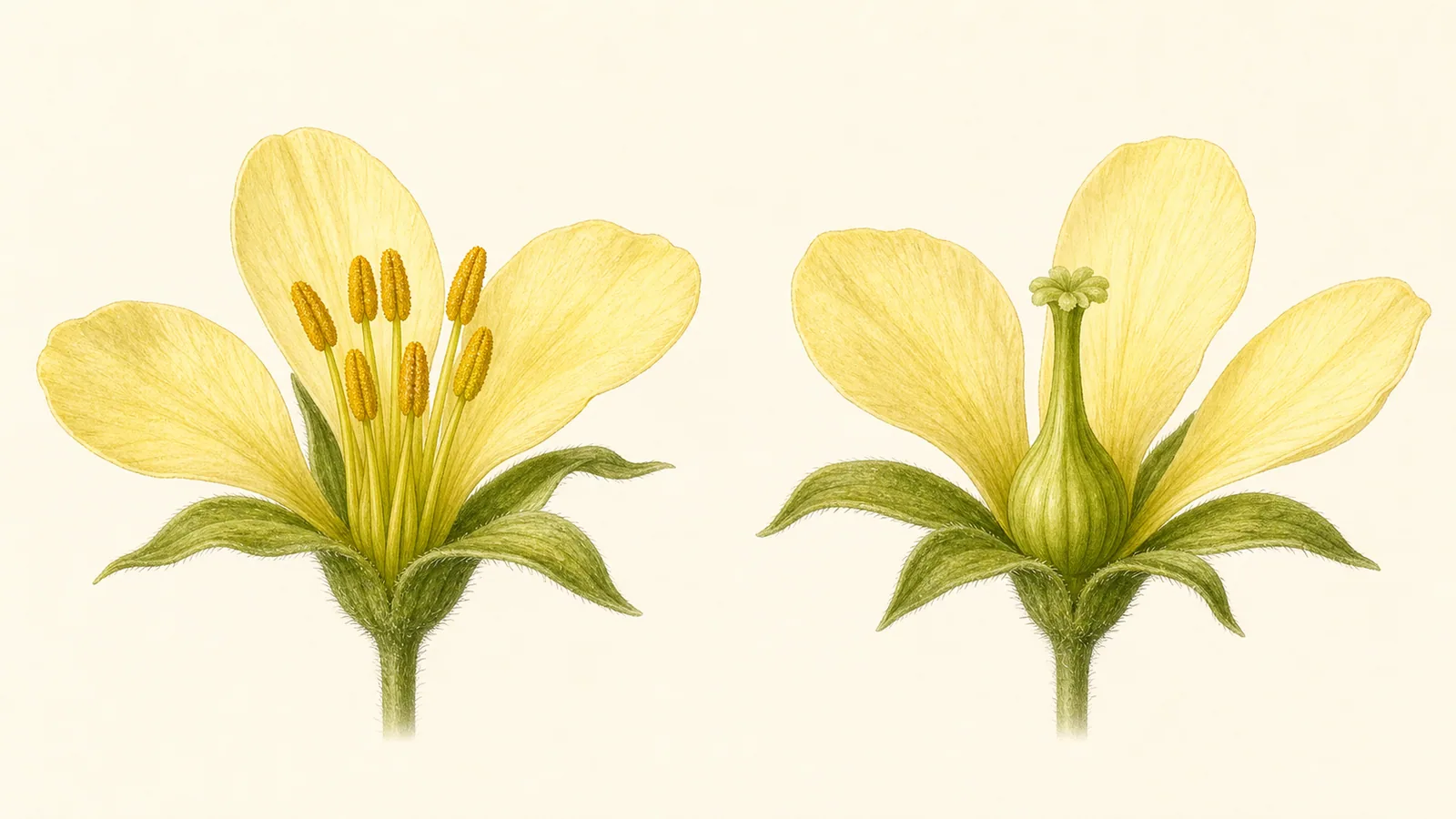
A complete flower has all four major floral parts: sepals, petals, stamens, and a pistil/carpel structure. An incomplete flower is missing at least one of these major parts.
This does not mean an incomplete flower is defective. Many plants naturally produce flowers that lack showy petals, lack one reproductive part, or separate male and female functions into different flowers. Corn tassels and ears, squash flowers, and many wind-pollinated flowers can help show that flowers may be structurally different while still functioning normally for that plant.
Orchids are a useful reminder that flowers can be specialized
Orchids are flowers, but their structure can look very different from a simple classroom diagram. In many orchids, the lip, column, and pollinia are important features. The reproductive parts are arranged in a more specialized way than in many common garden flowers.
This does not make orchids separate from basic flower biology. It means the basic ideas need to be applied with care. You can still ask: which structures attract or guide pollinators, where is pollen carried, and where are ovules located?
How to observe a real flower without overcomplicating it
Start with the parts you can see easily. Look for the flower stalk or pedicel, the base where the flower parts attach, the outer green or petal-like parts, and the central reproductive structures.
Then ask simple questions. Are the petal-like parts all similar, or can you separate sepals and petals? Can you see pollen-bearing anthers? Is there a central stigma or style? Can you find the swollen ovary at the base of the pistil?
You do not need to force every flower into one perfect diagram. A diagram gives you a map. A real flower teaches you variation.
Common confusions
- ✕ A flower means only petals.
- ✓ Petals are only one part. A flower can also include sepals, stamens, a pistil/carpel structure, ovaries, and ovules.
- ✕ A flower without obvious petals is not a flower.
- ✓ Some flowers are small, greenish, wind-pollinated, or structurally reduced.
- ✕ Complete flowers are better than incomplete flowers.
- ✓ Complete and incomplete describe structure, not plant quality.
- ✕ The pistil and stamen are decorative parts.
- ✓ They are reproductive structures: stamens produce pollen, and the pistil/carpel structure includes the pollen-receiving and ovule-containing parts.
Frequently Asked Questions
What is the easiest way to remember flower parts?
Use the outside-to-inside order: sepals, petals, stamens, and the pistil/carpel structure. Then remember the short functions: protection, attraction, pollen production, and ovule-containing reproductive structure.
Are sepals always green?
No. Many sepals are green and leaf-like, but some are colorful or look similar to petals. When sepals and petals look alike, the term tepal may be used.
Are all flowers both male and female?
No. Some flowers have both stamens and pistils, while others have only one reproductive function. Some plants have separate male and female flowers.
What is the difference between an ovary and an ovule?
The ovary is the structure at the base of the pistil or carpel that contains ovules. After successful reproduction, ovules may become seeds, and the ovary may become fruit.
Why do orchids look so different from common flower diagrams?
Orchids have specialized floral structures, such as the lip, column, and pollinia. They still fit the larger idea that flowers are reproductive structures, but their parts are arranged in a distinctive way.
Related Terms
- Sepal: an outer floral part that often protects the flower bud.
- Petal: a floral part often involved in attracting or guiding pollinators.
- Stamen: the pollen-producing part, usually made of an anther and filament.
- Anther: the part of the stamen where pollen is produced.
- Pistil: a female flower structure often including stigma, style, and ovary.
- Carpel: a basic female reproductive unit of a flower.
- Stigma: the pollen-receiving surface.
- Ovary: the structure that contains ovules.
- Ovule: the structure that can develop into a seed after successful reproduction.
Read Next
Evidence
References
These sources were used to check the plant-science concepts and gardening context in this article.