Leaf curl is a clue, not one answer
Leaf curl often reflects a mismatch between water loss and water supply, but it does not always mean dry soil. Wet, oxygen-poor roots, a sudden increase in heat or light, and distorted new growth are different observation paths. Start with the potting mix, leaf age, and whether the curl changes through the day.
A safer approach is to treat leaf curl as an observation starting point. Then look at water supply, root condition, light, heat, humidity, and recent changes.
Leaves curl when water balance changes
Leaves are living tissues. They exchange gases through stomata and lose water through transpiration. Transpiration helps pull water upward through the plant, but it also means leaves are constantly losing water.
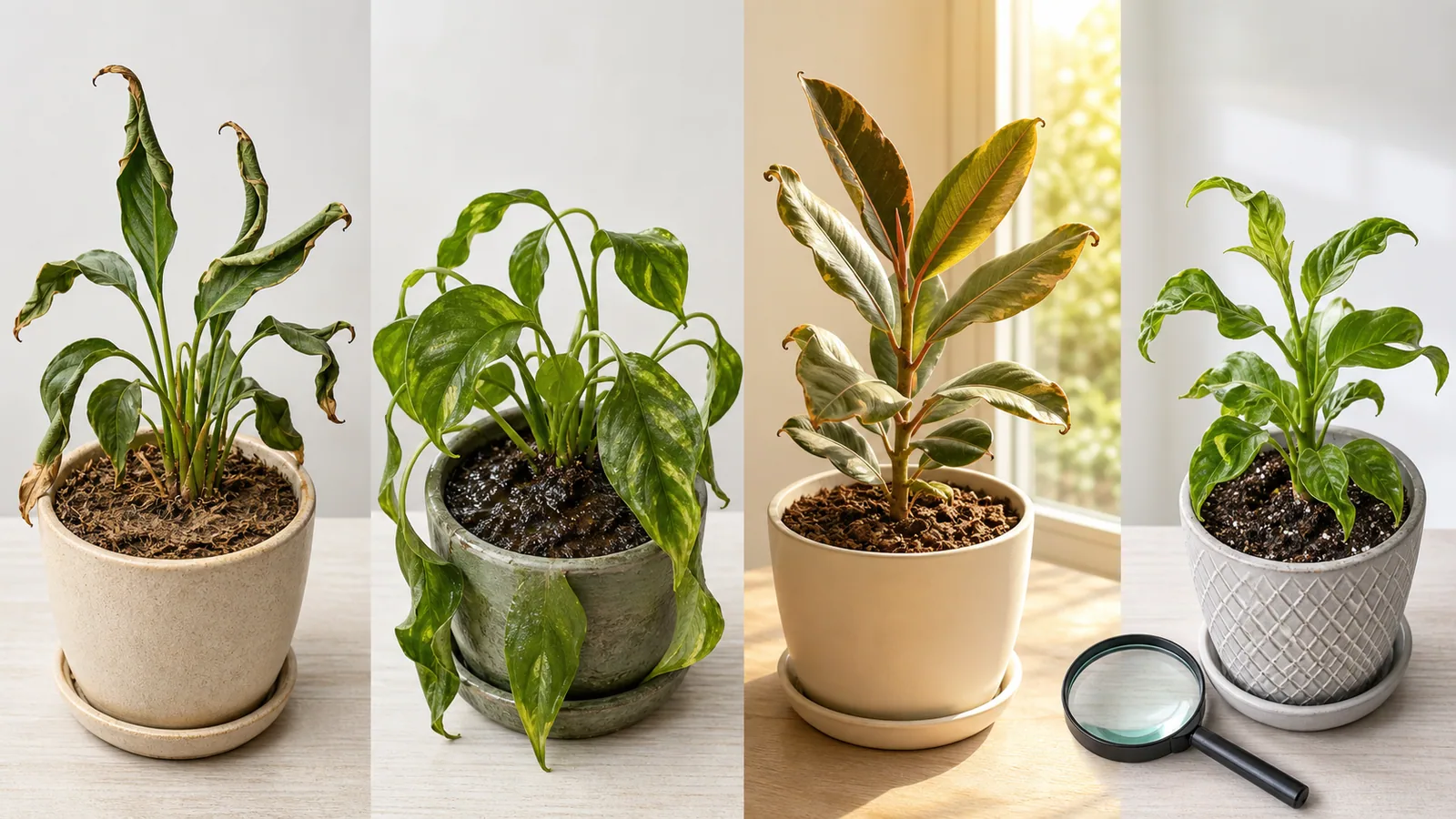
If roots cannot replace water as fast as leaves lose it, leaf cells lose turgor pressure. Turgor is the water pressure that helps keep tissues firm. When it drops, leaves may soften, droop, wrinkle, or curl.
Heat, strong light, dry wind, air-conditioning drafts, and dry media can all increase the gap between water loss and water supply. But the same leaf appearance can also happen when roots cannot take up water well.
Dry media and wet media can both look like water shortage
When potting media is too dry, roots may not have enough available water. Curling and drooping are intuitive results.
The harder case is over-wet media. If media stays saturated and air-poor, fine roots can be damaged or oxygen-limited. Even though water is present, roots may not absorb it effectively. Leaves may then wilt, curl, or yellow in a way that resembles drought.
So do not judge by the leaf alone. Check pot weight, drainage, whether the pot stays wet for many days, and whether the plant recently had root disturbance or repotting.
Strong light, heat, and dry air can intensify curling
Indoor plants can face both low light and excessive local heat. A plant moved suddenly to a hot sunny window may experience stronger light and heat than it was adapted to.
Strong light by itself is not always bad. The question is whether this plant, in this condition, was suddenly exposed to more light, heat, or dry airflow than it can handle. Leaves near the window may curl, fade, scorch, or dry at the edges.
Different plants tolerate different light. Do not reduce the problem to “sunlight causes curl.” Ask what changed and which leaves responded first.
New-leaf distortion is a different observation path
Some leaf curl appears as old leaves losing water. Other cases start when new leaves emerge already twisted, wrinkled, or distorted.
New leaves are developing tissues and can respond to environmental changes, mechanical injury, chemical injury, pests, diseases, or growth-point stress. Some ornamental plants also naturally have curled leaves.
If new leaves are severely distorted, or if there are insects, sticky residue, webbing, mottled patterns, or rapidly spreading spots, document the plant and seek a more specific diagnosis.
Upward curl and downward curl are not enough by themselves
Curl direction can be recorded, but it should not be treated as the answer. Some plants have typical curl patterns under heat or water stress, but these examples cannot be applied to all houseplants.
More useful questions are: are new leaves or old leaves affected, is the whole plant involved, is the media dry or wet, are there yellowing or scorched edges, and did anything change recently?
A low-risk observation order
Start with the media: is it dry, shrinking away from the pot edge, or wet and heavy for a long time?
Then look at leaf position: new leaves, old leaves, window-facing leaves, or the whole plant.
Next, check accompanying clues: wilting, yellowing, scorched edges, spots, leaf drop, or new-leaf distortion.
Finally, review recent changes: moving the plant, repotting, changing watering rhythm, heat waves, air-conditioning drafts, stronger direct sun, or root disturbance.
| Pattern | What to record next |
|---|---|
| Curled or drooping leaves with a lighter, drier pot | Compare pot weight with its weight after watering and note leaf changes |
| Similar leaves while the pot stays wet and heavy | Record standing water and how long the mix stays wet; water present does not prove normal uptake |
| Curl is stronger during heat and eases by evening | Record mix moisture too; temporary improvement does not identify one cause |
| New leaves emerge twisted or mottled | Photograph new and old leaves, undersides, and the growing point; note recent changes |
Dry brown tips are a separate feature to compare in brown leaf tips. If older lower leaves are also yellowing, yellow lower leaves helps organize leaf age and the spread of the change.
Common confusions
- ✕ Curled leaves always mean the plant needs water.
- ✓ Dryness is one possibility, but over-wet roots, root damage, heat, dry air, or new-leaf stress can also cause curling.
- ✕ Wet media means the plant cannot be short of water.
- ✓ Water may be present, but roots may not function well if oxygen is low.
- ✕ Upward or downward curl directly identifies the cause.
- ✓ Curl direction is only one clue and must be read with plant type, leaf age, media, light, heat, and recent changes.
- ✕ Curled leaves mean the plant needs pesticide immediately.
- ✓ Curling is not a pest diagnosis. Look for actual pest or disease evidence before taking that path.
Frequently Asked Questions
Do curled leaves always mean underwatering?
No. Dry media can cause curling, but wet air-poor media, damaged roots, heat, strong light, dry air, and new-leaf problems can also be involved.
Why are leaves curled when the soil is still wet?
If roots are oxygen-limited or damaged in wet media, they may not absorb water well. Leaves can then look water-stressed even though the pot is wet.
Does upward curl mean one cause and downward curl another?
Not reliably. Direction can be a clue in some plants, but it should be combined with species, leaf age, media condition, light, heat, and other symptoms.
Will curled leaves recover?
It depends. Temporary water imbalance may improve. Leaves that are scorched, dried, or severely deformed usually do not return fully to their old shape. Watch new growth too.
Should I treat new curled leaves differently from old curled leaves?
Yes. Old-leaf curling often starts with water balance and roots. New leaves that emerge distorted may require closer inspection of growth points, recent stress, pests, or other causes.
Why do leaves curl in the daytime but relax by evening?
In hot conditions, leaves can temporarily lose water faster than roots replace it. If enough moisture is available, they may regain firmness as conditions cool. Compare daytime and evening leaves alongside mix moisture and pot weight rather than assuming daytime curl always calls for more water.
Can an air-conditioned room contribute to leaf curl?
Air conditioning can change temperature, humidity, and air movement around a plant. Compare whether leaves near an outlet differ from other leaves, and record mix moisture and recent changes; a curled leaf alone does not establish the cause.
Related Terms
- Transpiration: loss of water vapor from plant surfaces, especially leaves.
- Stoma: a tiny pore involved in gas exchange and water loss.
- Turgor pressure: water pressure inside cells that helps keep tissues firm.
- Aeration: air space and air exchange around roots.
- Water stress: imbalance between water supply and water loss.
- New-leaf distortion: wrinkled, twisted, or abnormal new growth.
Read Next
Evidence
References
These sources were used to check the plant-science concepts and gardening context in this article.
View sources and further reading (6)
- planttalk.colostate.edu — 1317 houseplants temperature humidity
- extension.umd.edu — drought stress indoor plants
- extension.umd.edu — overwatered indoor plants
- openstax.org — 23 5 transport of water and solutes in plants
- extension.umd.edu — lighting indoor plants
- extension.umd.edu — leaf curling vegetables