Taller is not always healthier
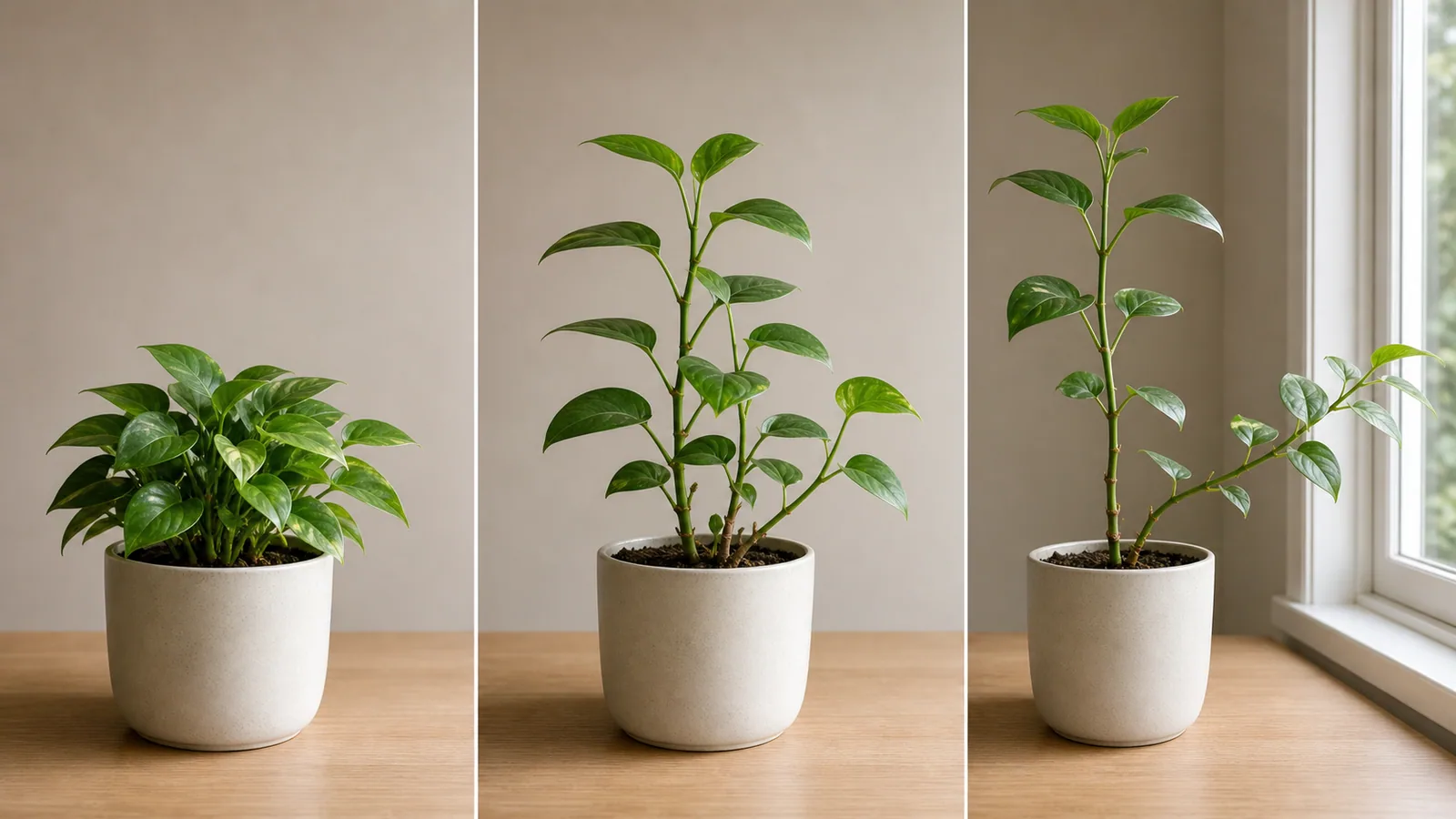
A leggy plant has stretched new growth, with longer gaps between leaves and often thinner stems. Too little light is a common cause. A shoot leaning toward a window is a separate clue about light direction; the two patterns can occur together.
Plants use light both for photosynthesis and as a signal that shapes growth. Stem spacing and the direction of bending tell you different parts of that response.
First look at nodes and internodes
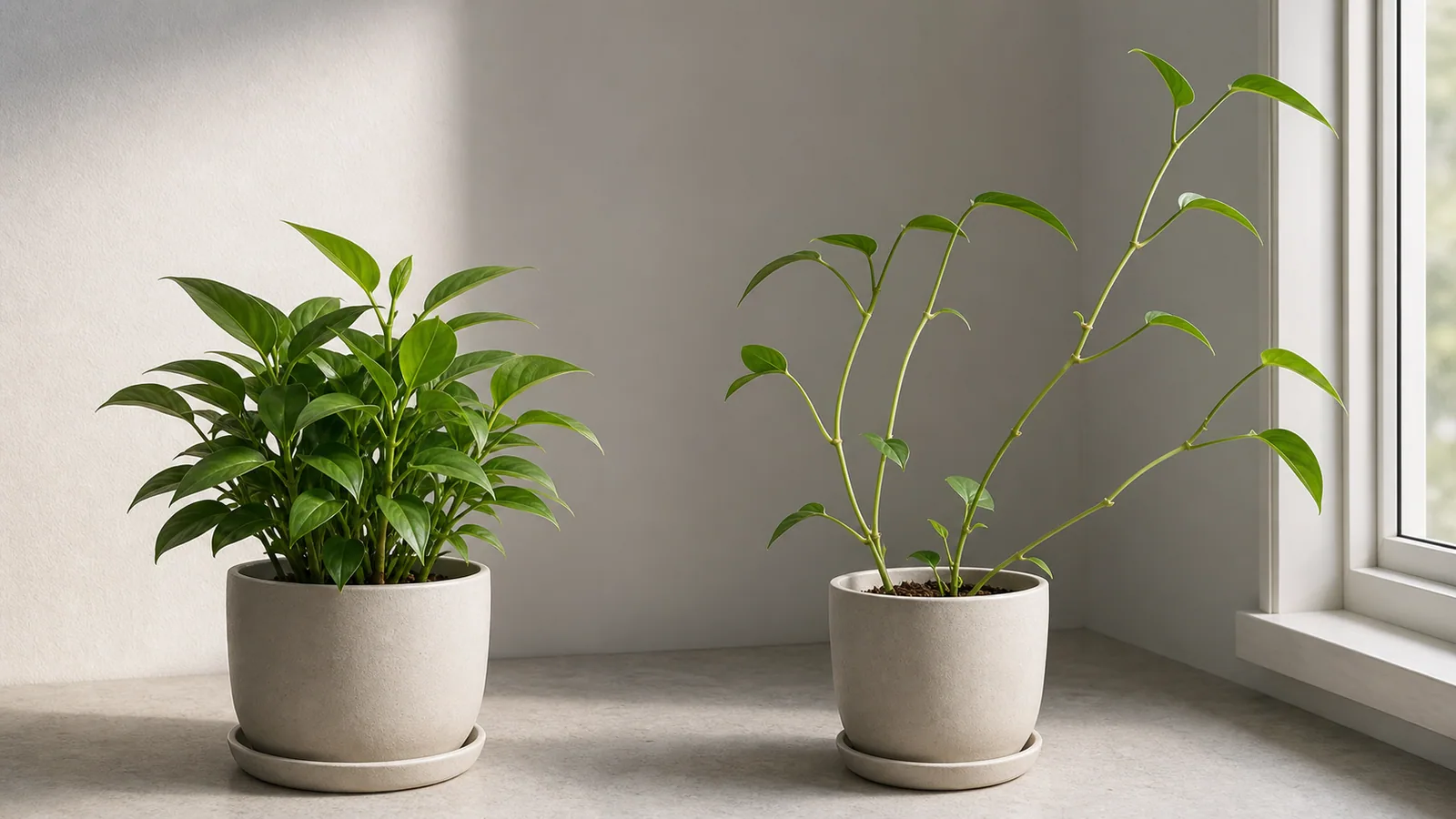
To read leggy growth, start with nodes and internodes. A node is a point on a stem where a leaf, bud, or side branch may arise. An internode is the section of stem between two nodes.
Compact growth often has shorter internodes and closer leaf spacing. Leggy growth has longer internodes, wider gaps between leaves, and stems that may be thinner or less able to support the plant.
In rosette-forming succulents, leaves spreading outward can also make a plant look more open; compare leaf position and internode length separately.
You do not need exact measurements. Compare the plant with itself: is the newest growth longer, thinner, and more widely spaced than older growth? If so, light and plant density are useful conditions to review.
| What you see | What to compare |
|---|---|
| Thinner new stems with wider gaps between leaves | Compare new and older internodes, then review light and crowding |
| Shoots bending mainly toward one side | Record light direction; a lean alone does not establish low total light |
| Longer branches without a clear change in spacing or support | Check the plant’s normal growth habit rather than judging by height |
If leaf spacing has barely changed but the plant leans to one side, compare the pattern in houseplants leaning toward a window.
Low light can make plants stretch
Low light is one common cause and a useful first direction to investigate. Indoors, a room that looks bright to people may still provide limited usable light for a plant. Window direction, glass, curtains, screens, building shade, distance from the window, and season can all change the light that reaches the leaves.
It also helps to separate four parts of the light environment: light intensity, or how much light reaches the plant; light duration, or how long it receives light each day; light quality, or the wavelengths in the light; and direction, or where the light comes from. These are different clues, not interchangeable labels.
When light comes mainly from one side, new shoots may bend toward the source. This directional growth response is called phototropism. A deeper explanation involves light receptors and growth signals such as auxin. Plants do not “see” light the way animals do; they detect light signals and adjust growth patterns. For observation, keep the distinction clear: overall low light can be associated with longer, more open growth, while one-sided light can be associated with a consistent lean. A plant can show both patterns at once.
Leggy seedlings are common when seed trays receive too little light or are too crowded. They may grow quickly upward but become thin, weak-looking, and easy to knock over. If supplemental lighting is used, the useful light reaching the seedlings still depends on the light source, its distance, and the daily duration.
If successive leaves also stay smaller after they finish expanding, smaller new leaves explains why leaf age, roots, and recent conditions belong in the comparison.
Crowding and direction matter too
Legginess does not always have a single cause. Along with total light, observe:
- Light direction: Does the plant receive light mainly from one side, so new growth consistently leans toward a window or lamp?
- Crowding: Are seedlings, cuttings, or potted plants close enough to shade one another?
- Light duration: Is the plant receiving light for too little time each day? This is a separate question from photoperiodic responses, which vary by plant type.
- Growth pace: If new growth became noticeably faster after excessive fertilization while light remained limited, record that as one possible contributing condition. Fertilizer is not a substitute for light.
- Plant type: Some foliage plants tolerate lower-light conditions, while many succulents, herbs, and seedlings need much brighter light. One standard cannot fit every plant.
These clues help organize observations; they do not form a diagnosis table.
Already-stretched parts usually do not shrink back
Once internodes have stretched, they usually do not shorten back into compact growth. A more realistic observation is whether future new growth becomes tighter after conditions change.
Some plants can be pruned, pinched, or restarted, but the appropriate response depends on plant type and growth habit. Seedlings, herbs, succulents, vines, and woody plants do not all respond the same way.
Common misunderstandings
- ✕ Leggy growth means the plant is growing very well.
- ✓ Healthy growth also depends on stem strength, normal leaves, and a stable form.
- ✕ A longer internode always means legginess.
- ✓ Internode length varies with plant type, season, growth stage, and growth habit. Compare new and older growth on the same plant.
- ✕ Phototropism and legginess are the same thing.
- ✓ Phototropism describes directional growth toward or away from light. Legginess describes a looser form with long internodes; the two can occur together.
- ✕ One-sided light means the plant is receiving too little light overall.
- ✓ One-sided light describes direction, while low light describes the amount available. A plant may experience one, the other, or both.
- ✕ Rotating the pot fixes low light.
- ✓ Rotation can reduce one-sided leaning, but it cannot increase the total light available to the plant.
- ✕ A window position always prevents legginess.
- ✓ Window direction, shade, distance, glass, curtains, and season all affect actual light.
- ✕ A short light period is a universal cause of legginess.
- ✓ Daily usable light and a plant’s photoperiodic response are different questions. Do not apply one rule to every plant.
- ✕ Leggy plants always need fertilizer.
- ✓ First compare light and crowding. Fertilizer is not light, and excessive fertilizer is only one possible contributing condition.
Frequently Asked Questions
Is legginess a sign of good health?
Not necessarily. It may look like fast growth, but it often comes with thin stems, long internodes, sparse leaves, and weaker-looking structure. A taller plant is not automatically a healthier plant.
Does a longer internode always mean legginess?
No. Internode length varies with plant type, season, growth stage, and growth habit. Compare new and older growth on the same plant rather than using one fixed length for every species.
Why can a plant near a window still get leggy?
The window may not provide enough usable light, or the light may arrive mainly from one side. Glass, curtains, screens, shade, season, window direction, and distance all matter. “Near a window” is not a fixed light measurement.
Is leaning toward a window the same as legginess?
Not exactly. A consistent lean in new growth can be a phototropic response to one-sided light. Legginess refers more broadly to long internodes, sparse leaves, and a loose form. The same plant can show both.
Does crowding make seedlings leggy?
It can. When seedlings are close enough to shade or compete with one another for light, they may become tall and thin. Treat crowding as an observation clue rather than a universal explanation for every leggy plant.
Is a short light period the same as a cause of legginess?
Not automatically. The amount of usable light received each day is different from photoperiodic responses, which vary by plant type. Observe light intensity, duration, direction, plant type, and growth stage together.
Can rotating the pot solve legginess?
Rotation can help balance one-sided light and reduce a directional lean, but it does not solve insufficient light overall. It makes the plant face different directions; it does not create more light.
Can leggy plants be pruned?
Some plants can be pruned or pinched to shape later growth, but the appropriate approach depends on the plant type, growth points, and growth habit. Seedlings, herbs, succulents, vines, and woody plants do not all respond the same way.
Can fertilizer contribute to leggy growth?
Excessive fertilizer can be one possible contributor to excessive, stretchy growth, but low light remains an important condition to check. If new growth became noticeably faster after heavy feeding while light stayed limited, record that as a clue; do not treat fertilizer as a replacement for adequate light.
Will already-stretched stems become short again?
Already-stretched internodes usually do not shorten. Watch whether new growth becomes more compact after conditions change. The response still depends on the plant type and its growth habit.
Are leggy seedlings different from leggy mature plants?
Seedlings may become thin and floppy quickly, especially when light is insufficient or seedlings are crowded. Mature plants may show longer branches, larger gaps between leaves, and a looser form. Both call for careful comparison of light, spacing, plant type, and new growth.
Can I move a leggy plant straight into direct sun?
A sudden move from low light to strong direct sun can scorch leaves. Check the plant’s usual light needs and change exposure gradually. Judge the response in new growth rather than expecting old stretched stems to shorten.
Related Terms
- Leggy growth: Thin, stretched growth with long internodes, wider leaf spacing, and a loose form.
- Leggy seedlings: Young plants that become unusually tall, thin, and weak-looking; “etiolated” is a narrower technical term and should not be used as a synonym for every mature leggy plant.
- Node: A point on a stem where a leaf, bud, or branch may arise.
- Internode: The section of stem between two nodes.
- Phototropism: A directional growth response toward or away from light.
- One-sided light: Light that arrives mainly from one direction; it describes direction, not total light amount.
- Crowding: Plants growing close enough to shade or compete with one another for light.
- Photosynthesis: The process by which plants use light, water, and carbon dioxide to make sugars and other organic compounds.
- Light intensity: The amount of light reaching the plant.
- Light duration: How long the plant receives light during a day.
- Light quality: The wavelength composition of light, such as blue, red, and far-red light.
- Photoperiod: The pattern of light and darkness over a day; it is different from the total amount of light used in photosynthesis.
Read Next
Evidence
References
These sources were used to check the plant-science concepts and gardening context in this article.
View sources and further reading (8)
- extension.umd.edu — leaf yellowing problems flowers
- extension.umd.edu — lighting indoor plants
- extension.umn.edu — lighting indoor plants
- extension.illinois.edu — 2022 02 25 whats wrong my seedlings troubleshooting seed starting problems
- openstax.org — 30 6 plant sensory systems and responses
- organismalbio.biosci.gatech.edu — plant hormones and sensory systems
- openstax.org — 30 chapter summary
- yardandgarden.extension.iastate.edu — common problems and issues succulents