
Photosynthesis makes sugars, but sugars are not the whole plant
Plants can make sugars through photosynthesis, but that does not mean they need only sunlight and water. Sugars provide carbon-based building material and energy storage, but plants also need mineral nutrients to build proteins, DNA, membranes, chlorophyll, enzymes, cell walls, and many other structures.
This is why “fertilizer is plant food” is an imprecise phrase. Plants make their own organic food through photosynthesis. Fertilizer supplies mineral nutrients, not ready-made food in the animal sense.
Mineral nutrition is one part of plant growth. It works together with light, water, air, temperature, root health, and growing medium conditions.
Carbon, hydrogen, and oxygen mainly come from air and water
Much of a plant’s dry mass comes from carbon, hydrogen, and oxygen. Carbon comes from carbon dioxide in the air. Hydrogen and oxygen are connected to water and other molecules.
This surprises many beginners because they imagine plant mass mostly coming from soil. Soil and potting media matter, but not because the plant is simply “eating dirt.”
Photosynthesis uses carbon dioxide and water to make sugars. Those sugars are then used, moved, stored, and converted into many plant materials.
Mineral nutrients are absorbed mainly as dissolved ions
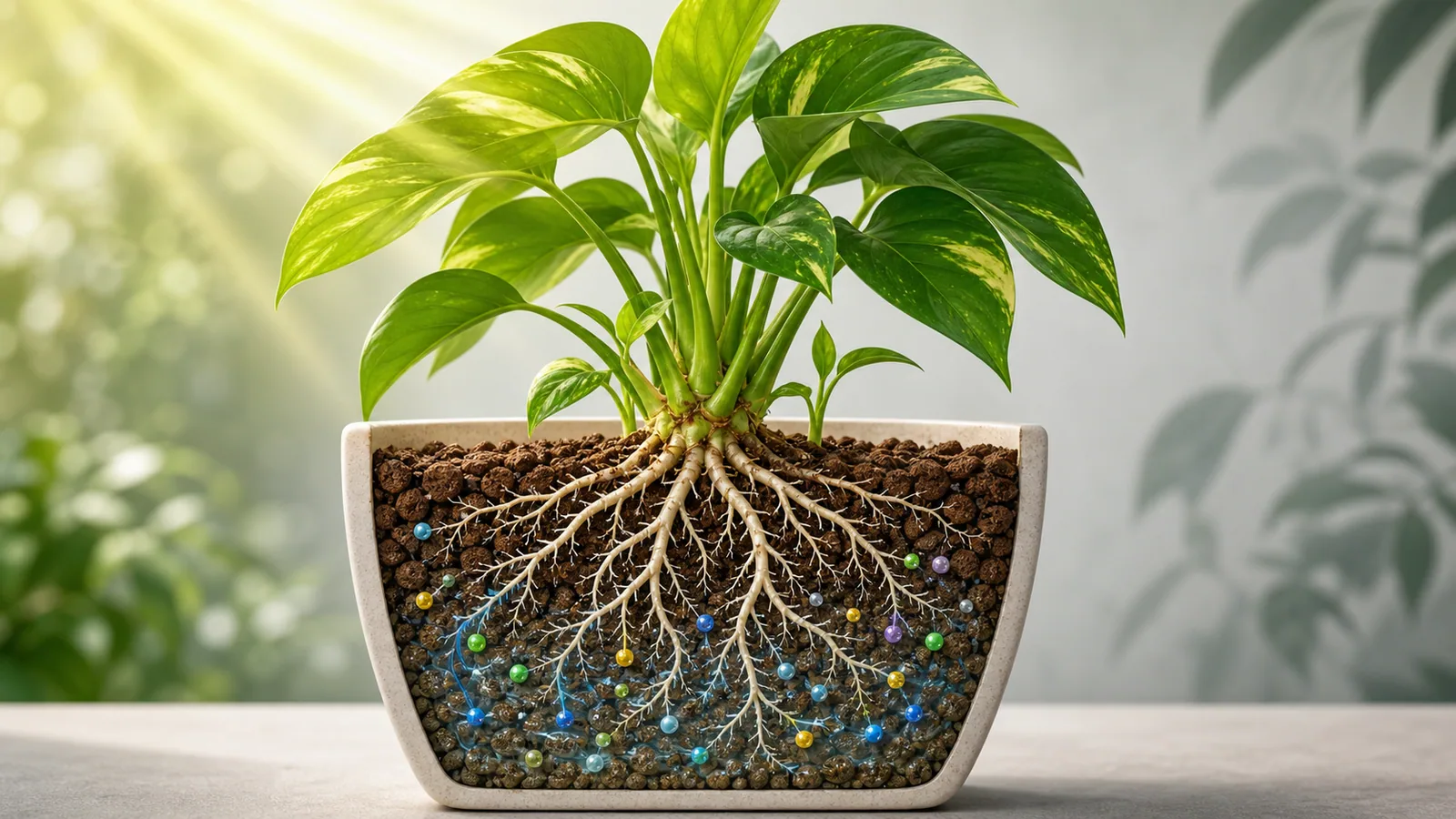
Mineral nutrients are taken up mostly through roots as dissolved ions in water. The root system does not absorb a solid chunk of fertilizer and turn it directly into leaves.
Fine roots and root hairs—small extensions of root epidermal cells, not separate roots—are important contact zones. After uptake, those ions enter the plant’s nutrient-transport system, where xylem provides the main upward route for water and many dissolved mineral nutrients toward stems, leaf veins, and young growth. This is a main route for many nutrients, not a claim that every element moves only through xylem; whole-plant redistribution depends on the element and tissue.

Availability also depends on the root zone. When the medium is too dry, nutrients may move less readily; when it remains waterlogged, roots may have less oxygen for normal function.
Common macronutrients include nitrogen, phosphorus, potassium, calcium, magnesium, and sulfur. Plants need these in larger amounts than micronutrients, but “larger” does not mean unlimited.
Micronutrients include elements such as iron, manganese, zinc, copper, boron, molybdenum, chlorine, and nickel. Plants need them in smaller amounts, but small does not mean unimportant.
Many introductory horticulture frameworks use 17 essential elements as a starting point, although textbooks and research contexts may count or classify elements differently. The useful point here is the difference in required amount, not a universal number.
N-P-K is only an entry point
Fertilizer labels often emphasize N-P-K: nitrogen, phosphorus, and potassium. These are important, but they are not the whole nutrition story.
Nitrogen is important for many proteins and chlorophyll-related growth. Phosphorus is involved in energy transfer and genetic material. Potassium helps with enzyme activity, water relations, and stomatal regulation. But plant health cannot be reduced to three numbers.
Calcium, magnesium, sulfur, and micronutrients also matter. So do pH, salinity, root oxygen, water availability, and whether the plant can actually absorb what is present.
Deficiency symptoms are not simple labels
Yellow leaves, slow growth, spots, or weak stems can have many causes. A nutrient deficiency is only one possibility. Low light, root damage, water stress, cold, pests, natural aging, and media problems can create similar-looking symptoms.
These overlapping possibilities are why visual symptoms cannot by themselves determine a fertilizer rate or schedule. Mineral nutrition needs to be considered together with the whole growing system.
For container plants, the whole system matters: light level, watering, aeration, pot size, media age, drainage, and fertilizer use all interact.
Too much mineral supply can also be a problem
More fertilizer is not automatically better. Excess soluble salts can make water uptake harder and may damage roots. Some nutrients can interfere with the uptake of others when greatly imbalanced.
In pots, minerals can accumulate when water evaporates and salts remain behind, especially if drainage is poor or fertilizer is overused. This is another reason to avoid treating fertilizer as a simple growth button.
Common confusions
- ✕ Fertilizer is plant food in the same way food feeds animals.
- ✓ Fertilizer supplies mineral nutrients. Plants make sugars through photosynthesis.
- ✕ If a plant is weak, it must need more fertilizer.
- ✓ Weak growth can result from low light, root problems, water stress, temperature, pests, or nutrients.
- ✕ N-P-K covers everything plants need.
- ✓ N-P-K is important but incomplete. Calcium, magnesium, sulfur, and micronutrients also matter.
- ✕ Micronutrients are optional because plants need only tiny amounts.
- ✓ Micronutrients are needed in small amounts but still essential.
Frequently Asked Questions
Is fertilizer plant food?
Not exactly. It is more accurate to say fertilizer supplies mineral nutrients. Plants make their own sugars through photosynthesis.
What do plants get from air?
Plants use carbon dioxide from air as a carbon source during photosynthesis. Oxygen is also involved in respiration.
Which mineral nutrients do plants need?
Plants need multiple essential elements. Introductory horticulture frameworks often use 17 essential elements as a starting point, while textbooks and research contexts may classify or count elements differently. This is a concept map, not a fertilizer formula.
What do N-P-K mean?
N-P-K stands for nitrogen, phosphorus, and potassium. They are common macronutrients and useful entry points, but the three numbers do not cover all nutrients or diagnose a plant problem.
Why are micronutrients important if plants need so little?
Micronutrients are needed in smaller amounts, but they can still be essential for enzymes, chlorophyll formation, and other processes. A small required quantity does not mean optional, and more is not automatically better.
What do roots absorb from soil or potting media?
Roots absorb water and dissolved mineral ions. Fine roots and root hairs are important contact zones; xylem then carries water and many dissolved mineral nutrients toward shoots. The exact availability depends on the medium, pH, moisture, oxygen, and nutrient concentration.
Can too much fertilizer hurt plants?
Yes. Excess salts or nutrient imbalance can stress roots and interfere with water and nutrient uptake. More is not automatically better.
Are yellow leaves always a nitrogen deficiency?
No. Yellow leaves can have many causes, including natural aging, low light, water stress, root problems, temperature stress, or nutrient issues.
Related Terms
- Mineral nutrient: an inorganic element a plant needs for growth and function.
- Macronutrient: a nutrient needed in relatively larger amounts.
- Micronutrient: a nutrient needed in small amounts but still essential.
- Nitrogen: a macronutrient important in proteins and many growth processes.
- Phosphorus: a macronutrient involved in energy transfer and genetic material.
- Potassium: a macronutrient involved in enzyme activity and water relations.
- Ion: an electrically charged form of an element or molecule.
- Root hair: a small extension of a root epidermal cell that increases contact with the surrounding water; it is not a separate root.
- Xylem: the plant tissue that provides the main route for water and many dissolved mineral nutrients from roots toward shoots; this does not mean every element moves only through xylem, because redistribution depends on the element and tissue.
- Salinity: accumulation of soluble salts that can affect water uptake and root health.
Read Next
Evidence
References
These sources were used to check the plant-science concepts and gardening context in this article.
View sources and further reading (8)
- openstax.org — 31 1 nutritional requirements of plants
- openstax.org — 30 1 the plant body
- openstax.org — 8 1 overview of photosynthesis
- extension.umn.edu — quick guide fertilizing plants
- ucanr.edu — SCGarden Lesson 9 to 12 Water Mgt 2021.01.07.pdf
- ars.usda.gov — soil water and air resources
- vegetableipmupdates.arizona.edu — A VIPM JCS Vegetable Crop Root Systems 3oct23.pdf
- ipm.ucanr.edu — salinity