A pot is the root system’s small environment
Pot size affects roots, but the answer is not “bigger is always better.” A pot defines where roots can grow, how much media surrounds them, how much water that media can hold, how fast it dries, and how much air remains around roots.
A pot that is too small can restrict root space, reduce media volume, and dry quickly. A pot that is too large for a small root system can hold a lot of unused wet media. The goal is not the biggest pot, but a reasonable match between roots, media, water, and air.
Small pots can crowd roots and reduce usable media
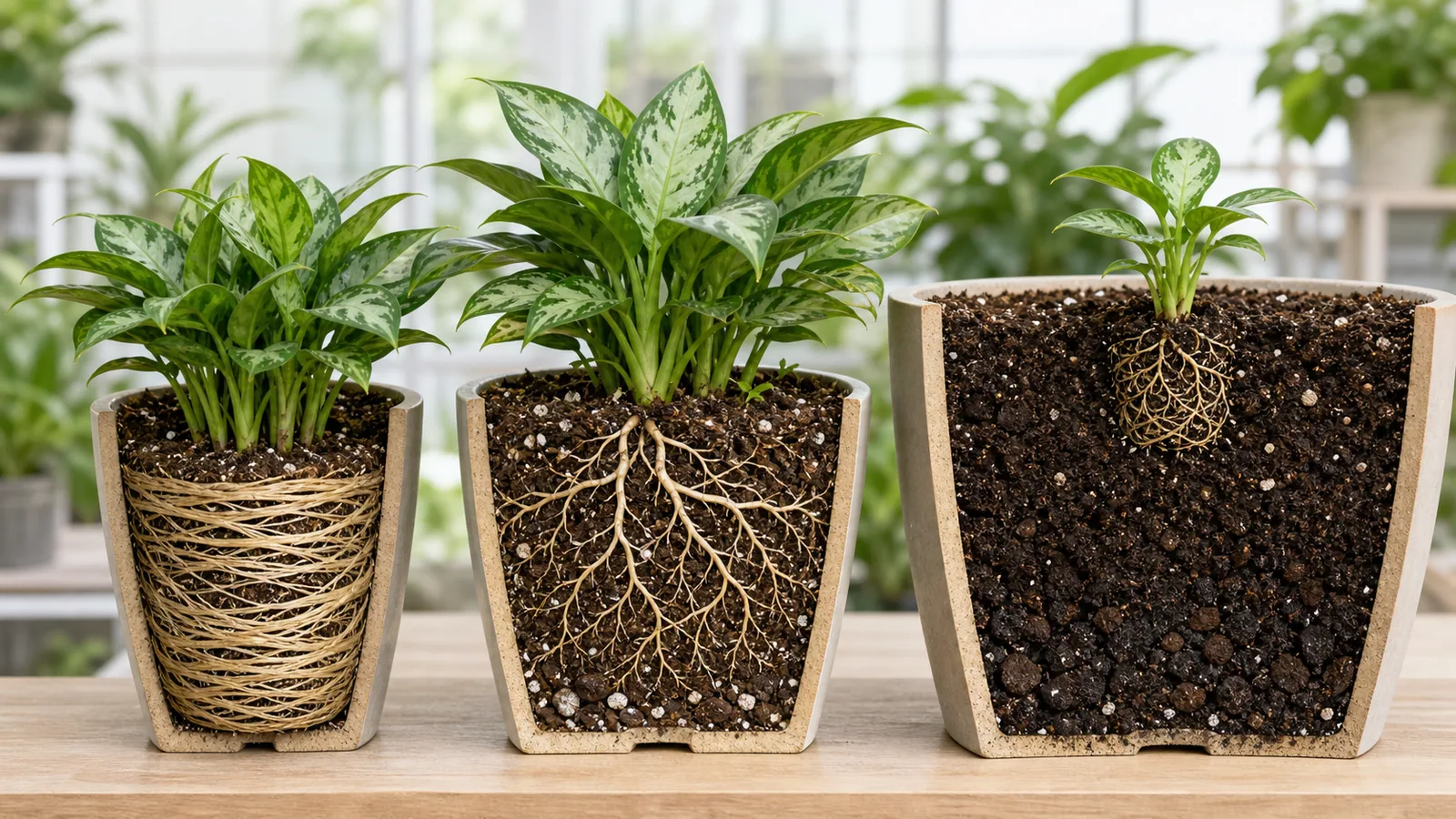
When a pot is too small, roots have limited room. Roots may circle the pot wall or bottom. Over time, the root ball may contain many roots and little remaining media.
This can make the pot dry quickly and make water supply less stable. Smaller new leaves, very fast drying, or a dense circling root mass can all be clues to inspect the root ball and pot-media ratio.
Large pots can keep unused media wet too long
Putting a small plant directly into a very large pot may look generous, but the roots cannot use all that media immediately. The outer and lower parts may remain wet long after the surface looks dry.
This is why a large pot is not automatically safer. Root size, drainage holes, media particle size, indoor light, season, and airflow all influence drying speed.
Pot size changes watering judgment
The same plant in different pot sizes can behave very differently after watering. A small pot may become light and dry quickly. A large pot may have a dry surface while the center or bottom remains moist.
Better questions are: are roots and media roughly balanced, how long does the pot stay heavy after watering, could the center still be wet after the surface dries, and does excess water have a clear path out?
These clues do not create a fixed watering schedule. They explain why pot size changes the whole root environment.
Roots showing at the bottom are only one clue
Roots coming out of a drainage hole may mean active growth, or it may suggest limited space. Look further: is the root ball tightly circling, is the pot nearly all roots and little media, does the pot dry unusually fast, and is the plant still producing normal new growth?
Different plants have different root habits. Some tolerate slightly tight pots, while others need more stable water and root space. This article explains common principles, not one pot-size rule for all plants.
Common confusions
- ✕ A bigger pot always makes a plant grow better.
- ✓ Pot size must match roots, media, water, and aeration.
- ✕ Roots coming out of the drainage hole always means repot immediately.
- ✓ It is a reason to inspect, not an automatic diagnosis.
- ✕ A full root ball is the same as root rot.
- ✓ Crowded roots and rotten roots are different issues, though they can overlap.
- ✕ Small pots are always safer.
- ✓ Small pots can dry too quickly and restrict root growth.
Frequently Asked Questions
Do bigger pots make plants grow faster?
Not necessarily. More space can help some roots, but too much media around a small root system can stay wet too long.
Why can a small plant struggle in a large pot?
The root system may not use the full media volume. After watering, unused media may remain wet, making air and water balance harder to manage.
Do roots coming out of the bottom mean I must repot?
Not automatically. Check root crowding, media amount, drying speed, and plant growth before deciding.
Is being root-bound the same as root rot?
No. Root-bound describes crowding and circling. Root rot involves damaged, decaying, or nonfunctioning roots.
Does pot size affect watering frequency?
Yes, but it cannot be converted into a fixed number of days. Pot size, media, light, airflow, season, root mass, and plant size all matter.
Are clear pots better?
Clear pots can make roots and media easier to observe for some plants, especially Phalaenopsis orchids. They are not required for every plant and do not replace drainage and aeration.
Related Terms
- Pot: the container that limits root space and media volume.
- Root ball: the combined mass of roots and media.
- Root-bound: roots crowded or circling inside a container.
- Potting medium: material that supports roots in a pot.
- Pore: space between media particles.
- Aeration: air movement and oxygen availability around roots.
Read Next
Evidence
References
These sources were used to check the plant-science concepts and gardening context in this article.