
Roots need oxygen because root cells are alive
Roots are not just straws. Root cells are living cells, and living cells need energy. In the usual oxygen-rich pathway, root cells use oxygen during cellular respiration to release usable energy from sugars.
This is why roots need access to air. In soil or potting media, air is held in pore spaces between particles. When the pore spaces contain enough air and water, roots can both absorb water and respire.
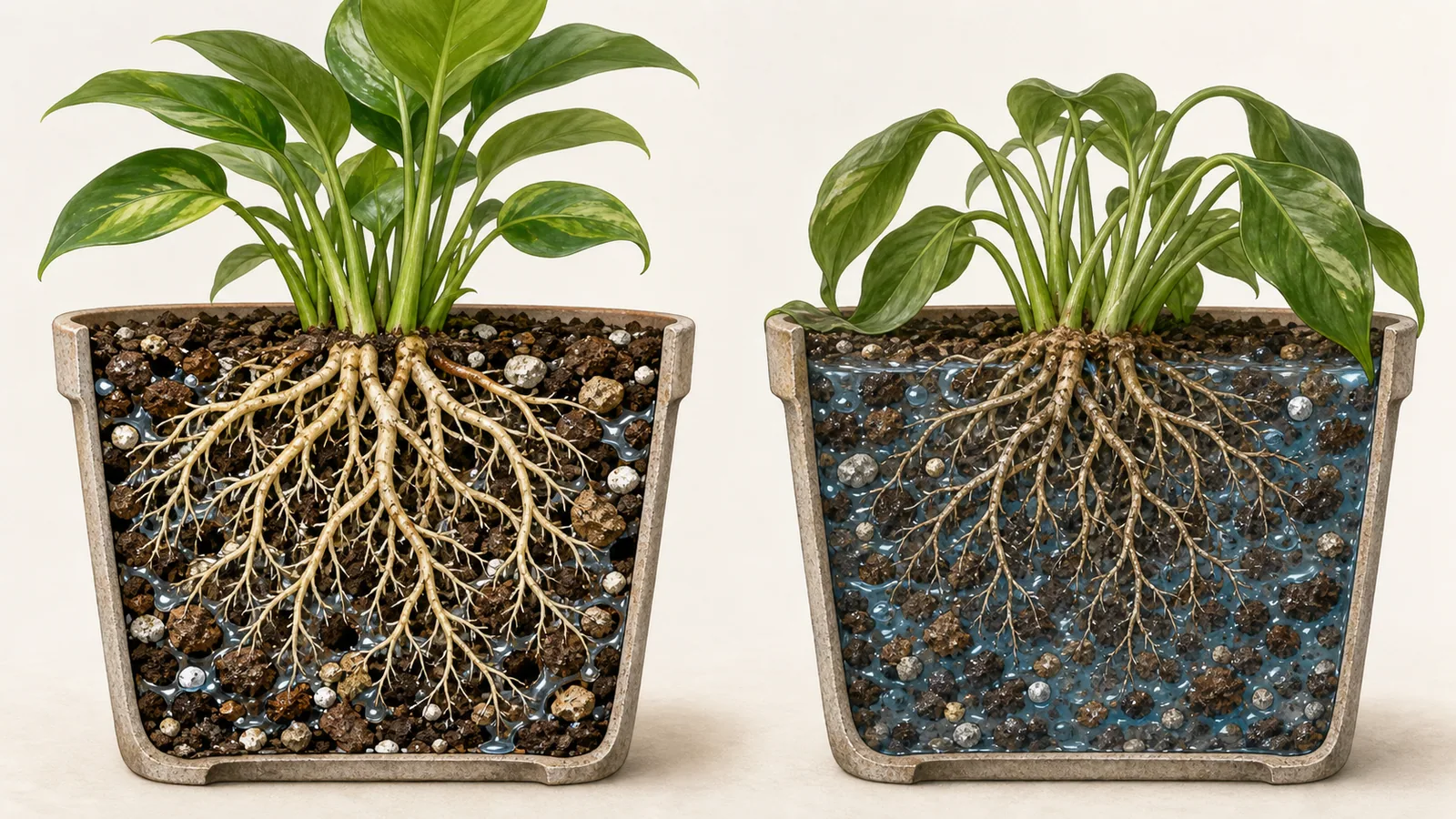
If pore spaces stay filled with water for too long, oxygen supply can drop. Oxygen moves far more slowly through water than through connected air-filled pores, so the root zone may be wet while oxygen replenishment and root function slow.
Pore spaces hold both water and air
Soil and potting media are made of particles and spaces. Different pore sizes, their connections, and the structure of the medium influence how much water remains and how readily air can return after drainage.
After watering, many pore spaces fill with water. As excess water drains and roots use water, some spaces refill with air. This air-water balance is one reason drainage holes and suitable media structure matter in pots.
When media becomes compacted or broken down, pore spaces can become smaller or blocked. That can reduce air movement and make the root zone stay wet longer.
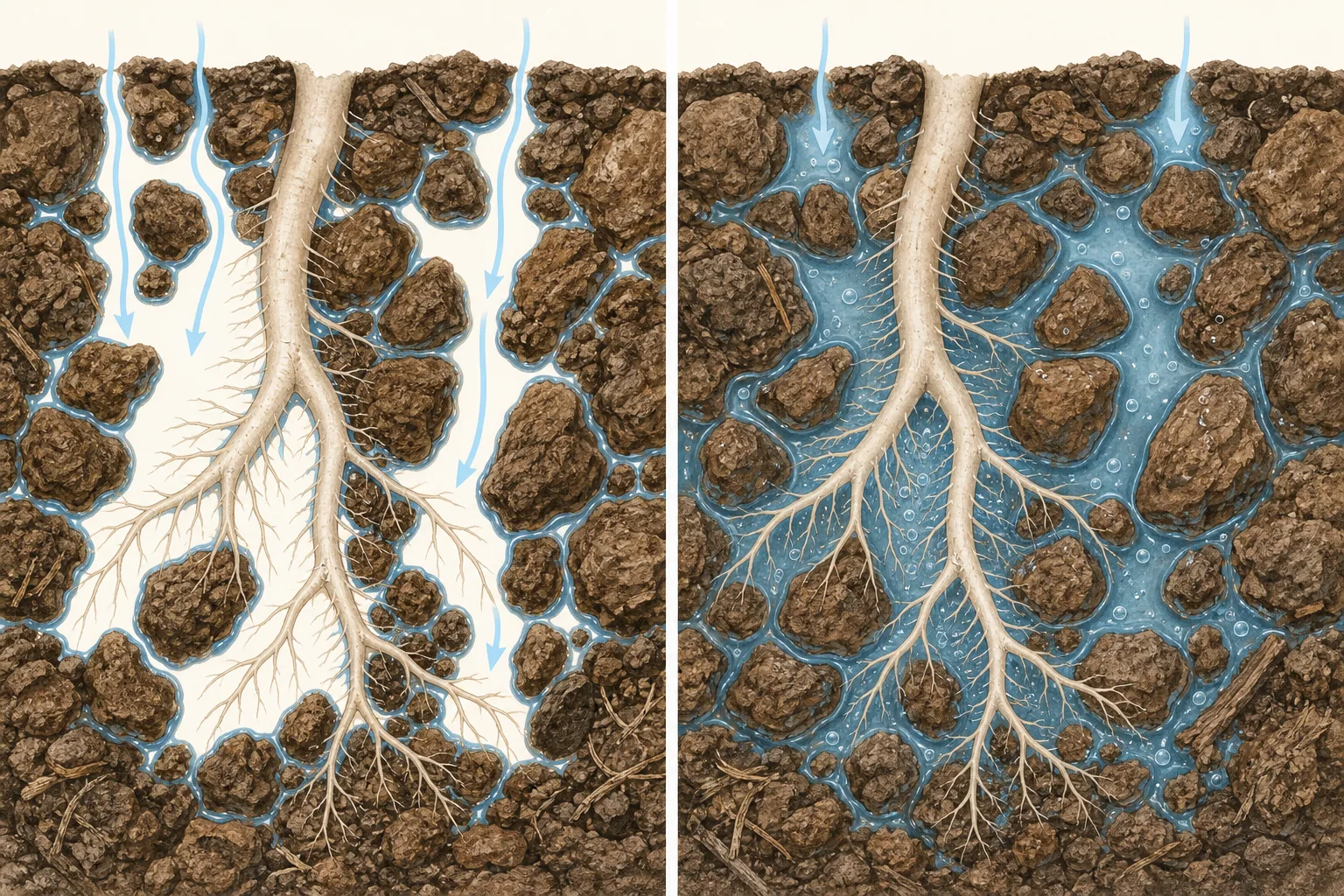
Drainage and aeration are related, but they are not identical. Drainage describes excess water leaving the container; aeration describes gases remaining and exchanging through the pore network. Water leaving gives some pores a chance to refill with air.
Wet does not always mean safe for roots
Root problems are often associated with dryness, but constant saturation can also stress roots by limiting oxygen.
If roots cannot respire well, they may absorb water and minerals less effectively. Leaves may wilt, yellow, or stop growing even though the pot feels wet. Those symptoms are not unique, so they should be treated as clues rather than a diagnosis.
This is why “water more” is not always the right answer. Sometimes the problem is the balance between water and air.
Photosynthesis does not remove the need for root oxygen
Leaves can produce oxygen during photosynthesis when light is available. But roots still need oxygen in their own environment. Oxygen made in leaves does not automatically solve low oxygen around roots in saturated media.
Roots, stems, leaves, and growing tissues each have living cells that respire. A plant is one connected organism, but local conditions still matter.
Roots in water do not all work the same way
Hydroponic systems, wetland plants, and ordinary potted plants involve different oxygen pathways and adaptations, so they should not be treated as one identical situation.
For many common container plants, the useful general principle is that roots need access to water while pore spaces still allow oxygen to be replenished.
What you can observe in the root zone
Look at the whole situation, not one symptom. Does the pot stay wet for many days? Is the medium dense, old, or compacted? Are drainage holes blocked? Is the plant in low light where water use is slow? Does the pot feel heavy even when the leaves look weak?
These clues do not prove a single cause, but they help you understand why root-zone aeration matters. Root health depends on media structure, watering rhythm, light, temperature, pot size, and plant species.
Common confusions
- ✕ Roots only need water, not air.
- ✓ Roots need water and oxygen. Air spaces in the root zone support respiration.
- ✕ If the pot is wet, the plant cannot be short of water.
- ✓ Wet media can still limit root function if oxygen is low.
- ✕ Photosynthesis means roots do not need oxygen.
- ✓ Root cells respire and need oxygen in their own environment.
- ✕ All plants tolerate waterlogged media if they are watered consistently.
- ✓ Tolerance varies widely. Many potted plants need better aeration than constantly saturated media provides.
Frequently Asked Questions
Where does the air around roots come from?
Air occupies pore spaces between soil or potting-medium particles. When those pores are not filled with water for long periods, they can retain air and exchange gases with the surroundings.
If leaves produce oxygen, why do roots still need it?
Photosynthesis mainly occurs in illuminated tissues that contain chloroplasts. Root cells still carry out respiration and depend on oxygen reaching their own environment.
Why can a plant struggle even when the potting medium is wet?
Long-lasting saturation replaces much of the connected air space with water. Oxygen is then replenished more slowly, and root growth, water uptake, and mineral uptake may decline.
Are good drainage and good aeration the same thing?
Not exactly. Drainage is the movement of excess water out of a container. Aeration is the presence and exchange of gases in pore spaces. They are connected because drainage can allow some pores to refill with air.
Why can roots grow in hydroponic systems without always rotting?
Hydroponic systems and wetland-adapted plants can supply or move oxygen differently from an ordinary saturated potting mix. They should not be used as proof that every potted plant tolerates water-filled pores.
Can you tell immediately when a potted root zone is low in oxygen?
Not reliably. Slow growth, wilting, or yellow leaves may occur with root-zone stress, but they have many possible causes. Pot weight, drainage speed, medium structure, light, temperature, and season need to be considered together.
Related Terms
- Aeration: the presence of air spaces in soil or potting media.
- Respiration: the cellular process that releases usable energy from sugars.
- Pore space: the open space between soil or media particles.
- Saturation: a condition where pore spaces are filled with water.
- Root zone: the area around roots where water, air, and minerals interact.
- Drainage: movement of excess water out of soil, media, or a container.
Read Next
Evidence
References
These sources were used to check the plant-science concepts and gardening context in this article.
View sources and further reading (10)
- openstax.org — 6 1 energy and metabolism
- openstax.org — 31 1 nutritional requirements of plants
- rhs.org.uk — how plants breathe
- extension.oregonstate.edu — em 9544 soil plant water relationships
- extension.oregonstate.edu — em 9301 soil moisture
- extension.colostate.edu — understanding tree roots
- extension.usu.edu — solutions to soil problems iv soil structure compaction
- extension.umn.edu — reducing tillage intensity
- extension.psu.edu — managing soil health concepts and practices
- frontiersin.org — full