Seed dispersal is how the next generation leaves the parent plant
After seeds form, the next question is where they will begin the next life cycle. If every seed falls directly under the parent plant, seedlings may compete with the parent and with one another for light, water, space, and minerals.
Seed dispersal is the movement of seeds away from the parent plant. Seeds do not have feet. They are moved by wind, water, animals, fruit structures, gravity, or a combination of routes.
In many flowering plants, fruits are part of the dispersal story. Some fruits become light, winged, hairy, buoyant, hooked, fleshy, or dry and splitting. These traits can help seeds move.
Wind carries light seeds and winged fruits
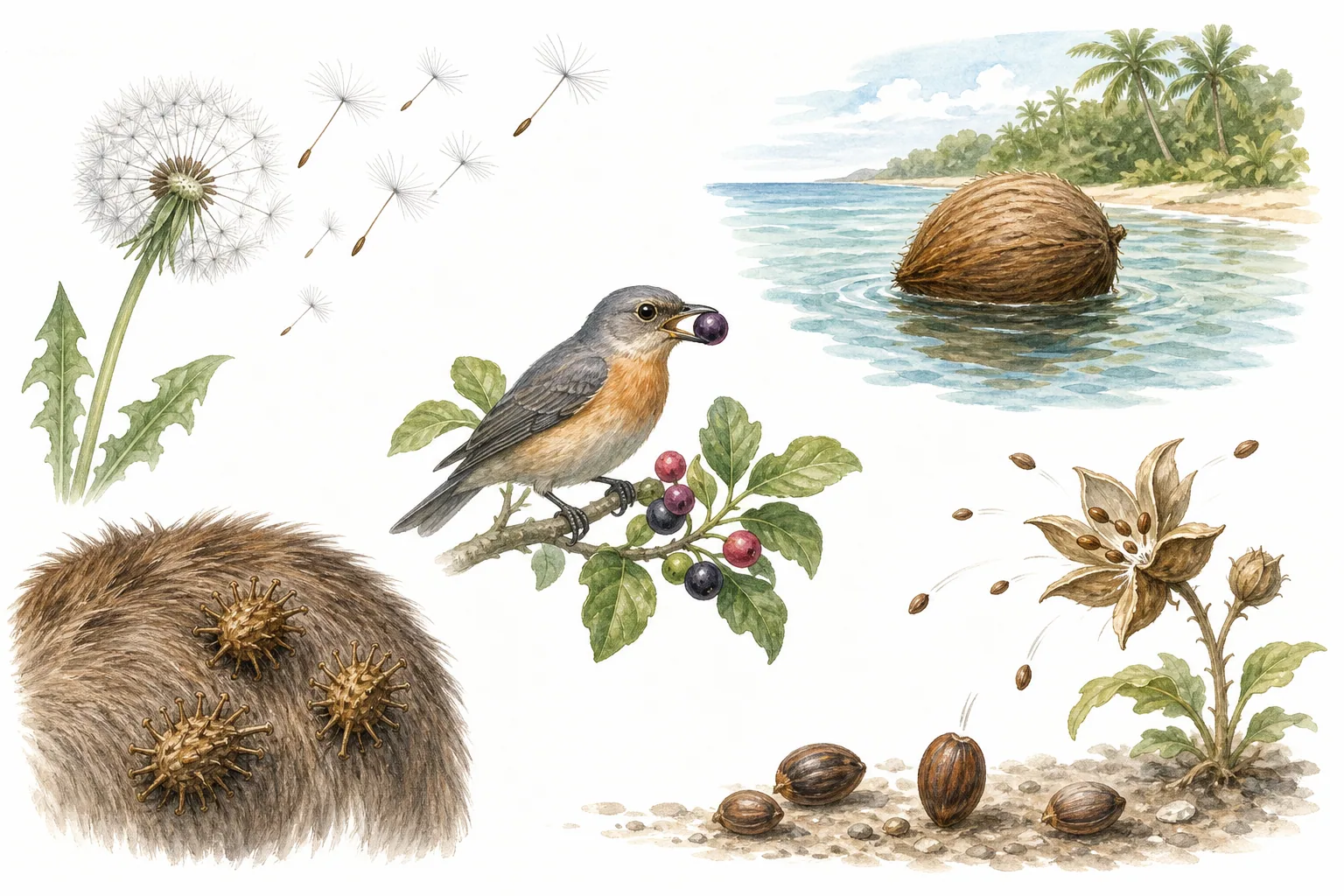
Wind dispersal is easy to imagine with dandelion-like fruits that have a fluffy pappus. A breeze can lift them like tiny parachutes. Maple samaras are another common example: a wing-like structure lets the fruit spin or glide as it falls.
The point is not that wind always carries seeds far. The point is that the seed or fruit has structures that make wind movement more likely: hairs, wings, small size, light weight, or increased surface area.
Wind does not choose good landing places. Seeds may land in suitable soil, on pavement, in deep shade, or in dry areas. Many wind-dispersed plants produce many seeds, increasing the chance that some land well.
Water moves buoyant fruits or seeds
Water dispersal is common in water-side, aquatic, wetland, or coastal environments. Seeds or fruits need to float long enough to be moved by streams, floods, tides, or ocean currents.
Coconut-like fruits are often used to explain the idea because their thick fibrous outer layers help buoyancy. Water dispersal can also occur along rivers, wetlands, and flood-prone areas.
Being moved by water does not guarantee growth. The seed or fruit must arrive somewhere suitable, remain viable, and later encounter conditions that allow germination.
Animals eat, carry, bury, or pick up seeds
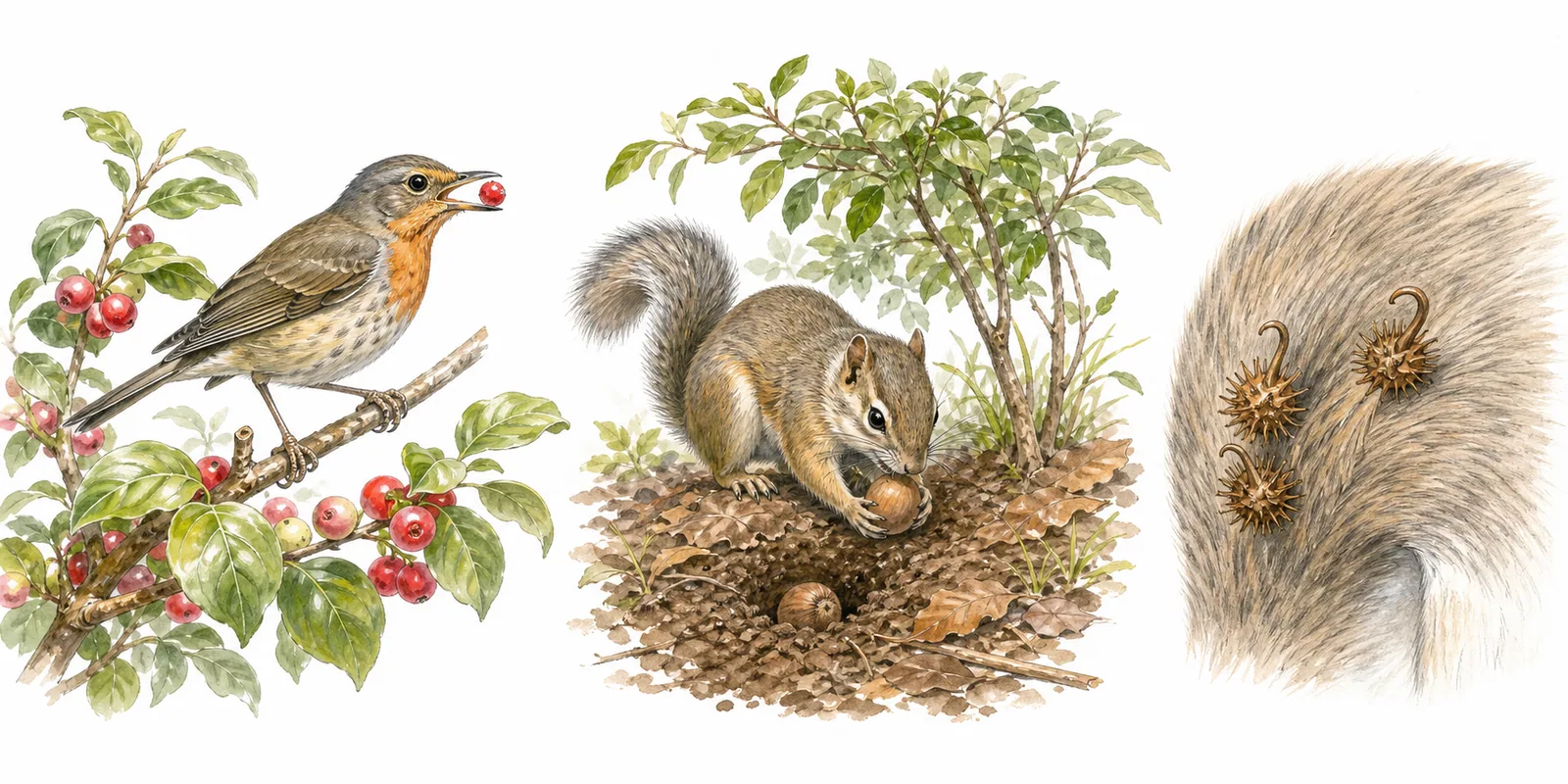
Animal dispersal has several forms. First, animals may eat fleshy fruits and move seeds to a new place. Many berries and fleshy fruits use color, smell, or texture to attract animals; the plant’s reproductive target is often the seed inside.
Second, animals may carry or store seeds. Some animals move seeds or nuts and bury them. If not all are recovered, some may remain in a new location.
Third, fruits with hooks or barbs can attach to fur, feathers, or clothing and later fall off elsewhere.
Do not assume every seed germinates better after being eaten. Some plants have that pattern, while others do not. For beginners, the key idea is movement, not a guaranteed germination benefit.
Fruits can eject seeds, and gravity can move them
Some dry fruits split open when mature and use tension to throw seeds outward. Touch-me-not and some legumes are useful examples for explosive or ballistic dispersal.
Gravity is simpler but still important. Mature seeds or fruits may fall, roll, slide, or tumble to a new location. A round fruit on a slope may move farther than one that simply drops.
These routes remind us that dispersal does not always need wind or animals. Fruit maturation, drying, splitting, dropping, and rolling can all help seeds leave the parent plant.
Seed dispersal is not pollination or germination
Seed dispersal belongs later in the plant life cycle. Pollination happens when pollen reaches a stigma. After fertilization, ovules may become seeds and the ovary may become fruit. Only after seeds or fruits mature does dispersal become the main topic.
After dispersal, a seed may germinate if conditions are suitable. Dispersal moves the seed; germination begins the next plant.
Everyday observation
When you see fruits or seeds around a school, street, garden, or balcony, avoid starting with “Can I eat it?” or “How do I grow it?” A safer plant-science question is: how might this structure move?
Light seeds with hairs or wings may be wind-related. Hooked fruits may attach to animals or clothing. Fleshy fruits may involve animal feeding. Dry fruits that split may release seeds by opening. These are clues, not absolute diagnoses.
Common confusions
- ✕ Seed dispersal means seeds can walk.
- ✓ Seeds are usually moved by wind, water, animals, fruit structures, or gravity.
- ✕ Farther dispersal is always better.
- ✓ Landing in a suitable place matters too.
- ✕ Pollination, fruiting, and seed dispersal are the same event.
- ✓ Pollination comes before seed formation; dispersal happens after seeds or fruits mature.
- ✕ Seeds eaten by animals always germinate better.
- ✓ That varies by plant. Animal movement does not guarantee germination.
Frequently Asked Questions
Why do seeds need to move away from the parent plant?
They do not always need to, but dispersal can reduce competition with the parent and sibling seedlings and increase the chance of reaching new spaces.
How is seed dispersal different from pollination?
Pollination is pollen reaching the stigma. Seed dispersal happens later, after seeds or fruits have formed and matured.
How do dandelion-like seeds disperse?
They have a pappus or similar lightweight structure that can catch wind. Not all wind-dispersed seeds look exactly like dandelions.
Why are coconuts used to explain water dispersal?
Coconut-like fruits have thick fibrous tissues that help them float, making them useful for explaining buoyancy and water movement.
Does dispersal guarantee germination?
No. Germination still depends on water, oxygen, temperature, light conditions, landing site, and seed condition.
Related Terms
- Seed dispersal: movement of seeds or fruits away from the parent plant.
- Fruit: a seed-associated structure that often protects or helps move seeds.
- Wind dispersal: movement by air, often involving small, light, winged, or hairy structures.
- Water dispersal: movement by water, often involving buoyancy.
- Animal dispersal: movement by eating, carrying, storing, or attachment.
- Explosive dispersal: release of seeds by fruit splitting or tension.
- Gravity dispersal: movement by falling, rolling, or sliding.
Read Next
Evidence
References
These sources were used to check the plant-science concepts and gardening context in this article.