Germination is not just “add water”
Most seeds need water, oxygen, and a suitable temperature to germinate. Some seeds are also affected by light or darkness, dormancy, seed coat conditions, and seed viability.
Water starts the seed’s restart process, but water alone is not a guarantee. A seed can swell and still fail to produce a radicle. A seed can also remain dormant even when the environment seems friendly.
The clearest beginner idea is this: germination happens when a viable seed receives the right combination of signals and conditions for that plant.
Water allows the seed to restart activity
A dry seed is often in a low-activity state. When it takes up water, the seed swells, tissues rehydrate, and internal activity can restart. This water uptake is called imbibition.
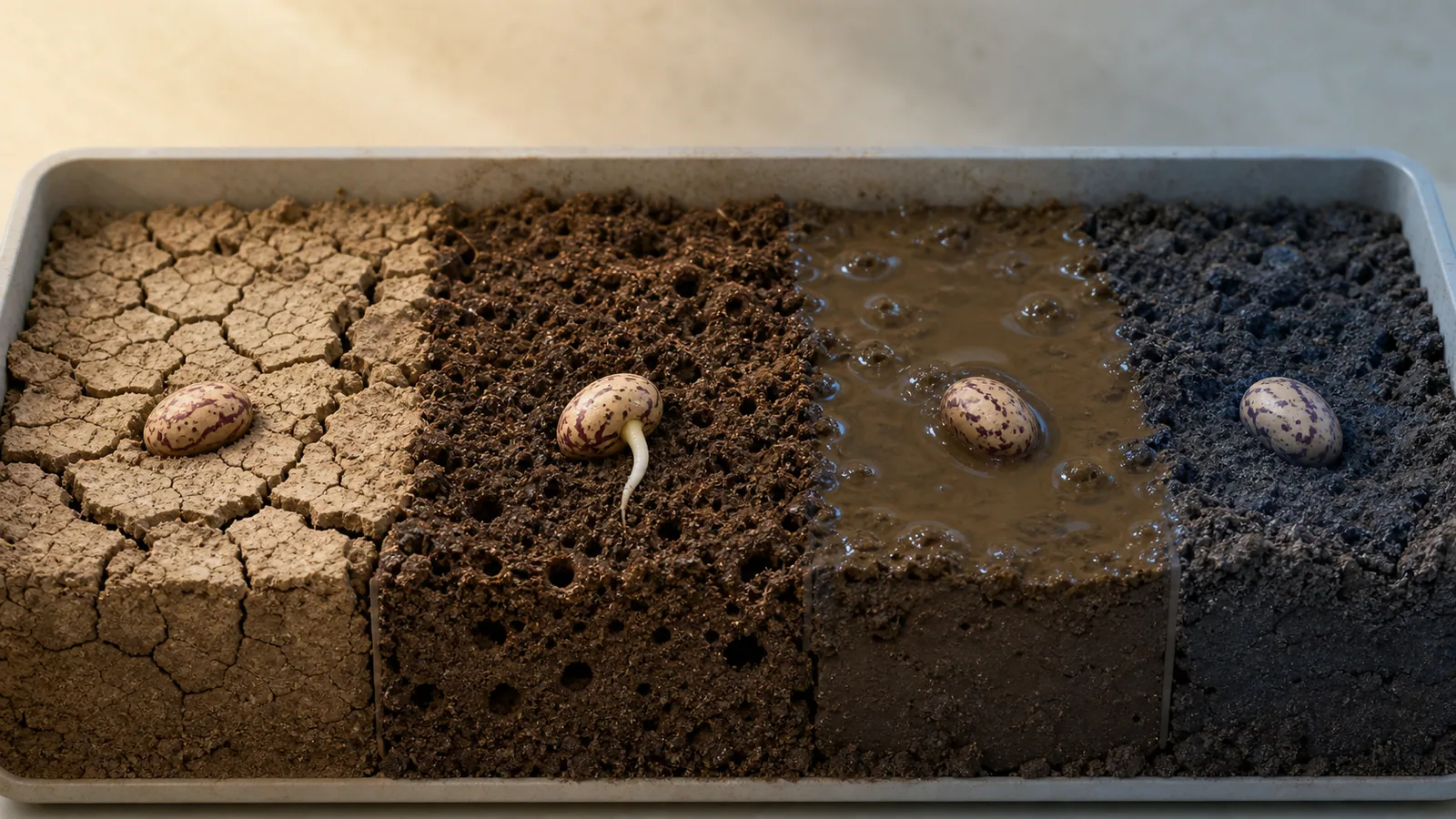
However, swelling is not the same as successful germination. A clearer sign is radicle emergence, when the embryonic root breaks through the seed coat.
Too little water can prevent the seed from restarting. Too much water can reduce oxygen around the seed if the medium becomes saturated. Both extremes can be a problem.
Oxygen is needed for respiration
Germinating seeds need energy. Before the seedling has working leaves, it relies on stored resources inside the seed. To use those resources effectively, seed cells carry out respiration, which commonly requires oxygen.
This is why a seed tray can fail even when it is wet. If the medium stays waterlogged, air spaces can be filled with water, and oxygen may become limited.
Good germination conditions usually include moisture without long-term suffocation. The exact balance depends on the seed, medium, container, and environment.
Temperature affects germination speed and success
Seeds have temperature ranges in which germination is more likely. Some germinate well in cooler conditions. Others need warmer conditions. Some fail or become very slow if conditions are too cold or too hot.
This is one reason the same seed packet may behave differently in different seasons or rooms. Temperature affects enzyme activity, respiration, and the pace of early growth.
There is no single perfect germination temperature for all plants. Species and even varieties can differ.
Light requirements vary by seed
Some seeds germinate better with light. Some germinate better in darkness. Many are not strongly dependent on light once moisture and temperature are suitable.
Seed size often gives a clue but not an absolute rule. Very small seeds may need to remain near the surface, where they can receive light and avoid being buried too deeply. Larger seeds may tolerate deeper covering. But plant-specific instructions still matter.
The key is not to assume all seeds need sunlight to germinate. Germination light response is species-dependent.
Dormancy and viability can block germination
Viability means the seed is alive and capable of germinating under suitable conditions. Old, damaged, poorly stored, or immature seeds may have low viability.
Dormancy means a viable seed does not germinate yet, even when some conditions seem suitable. Dormancy can help seeds avoid sprouting at the wrong time. Some seeds need cold, warmth, scarification, after-ripening, light changes, or other cues before dormancy is released.
This is why failure to germinate is not always a grower mistake. The seed’s internal condition matters.
How to observe germination without jumping to conclusions
First, ask whether the seed absorbed water. Second, look for radicle emergence. Third, observe the medium: is it evenly moist, too dry, or saturated? Fourth, consider temperature, seed age, planting depth, and light requirement.
If only one or two seeds fail, the issue may be seed viability. If all seeds fail in the same tray, environment or handling may be involved. But even then, avoid single-cause certainty without evidence.
Common confusions
- ✕ Water alone makes every seed germinate.
- ✓ Most seeds also need oxygen, suitable temperature, and viable internal condition.
- ✕ A swollen seed has definitely germinated.
- ✓ Swelling is water uptake. Radicle emergence is a clearer germination sign.
- ✕ All seeds need sunlight to germinate.
- ✓ Light requirements vary. Some seeds prefer light, some darkness, and many are not strongly light-dependent.
- ✕ If seeds fail, the person growing them must have done something wrong.
- ✓ Seed age, dormancy, viability, temperature, moisture, oxygen, and planting depth can all matter.
Frequently Asked Questions
What are the basic conditions for germination?
For many seeds, the basic conditions are water, oxygen, and a suitable temperature. Some seeds also have light, darkness, dormancy, or seed coat requirements.
What is imbibition?
Imbibition is water uptake by a dry seed. It causes the seed to swell and helps internal activity restart.
Why do seeds rot or fail in wet media?
Overly wet media can reduce oxygen around seeds and roots. Some seeds may also be damaged by pathogens or poor conditions. Wet is not always the same as suitable.
Do seeds need fertilizer to germinate?
Most seeds begin germination using stored resources. Mineral nutrients become more important as the seedling grows, but fertilizer is not the basic trigger for germination.
Why do some seeds take much longer than others?
Species differences, dormancy, seed coat structure, temperature, moisture, and seed viability can all affect germination speed.
Related Terms
- Germination: the process in which a seed restarts growth, often marked by radicle emergence.
- Imbibition: water uptake by a dry seed.
- Radicle: the embryonic root that emerges during germination.
- Viability: the ability of a seed to germinate under suitable conditions.
- Dormancy: a state that prevents germination until additional cues or time occur.
- Seed coat: the protective outer covering of a seed.
- Respiration: the process by which cells release usable energy from stored resources.
Read Next
Evidence
References
These sources were used to check the plant-science concepts and gardening context in this article.