Start by asking where the pollen came from
The difference between self-pollination and cross-pollination is not flower size or color. It is pollen source.
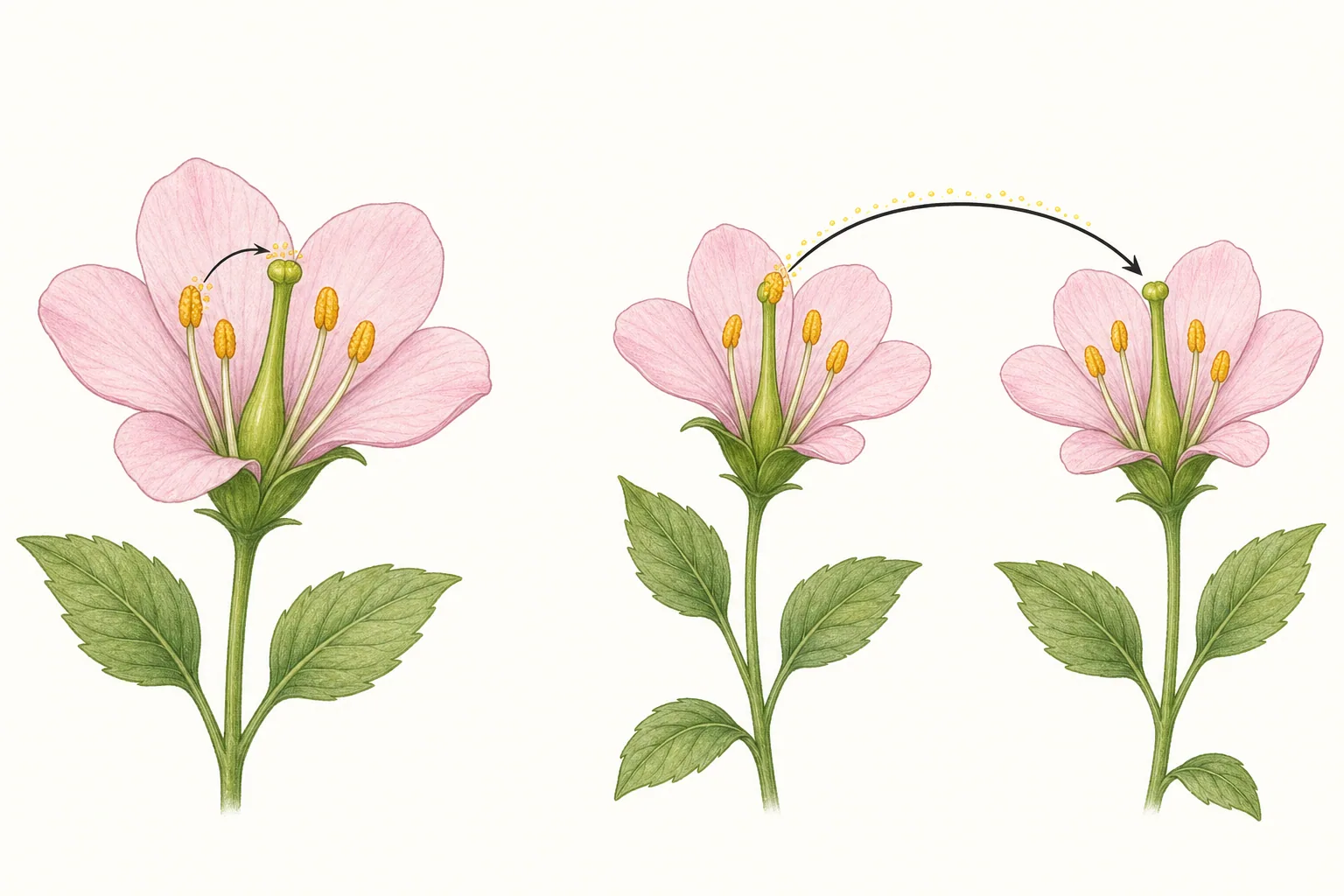
Pollination is the transfer of pollen to a stigma. If pollen comes from the same flower or another flower on the same plant, it can be understood as self-pollination in an entry-level sense. If pollen comes from another individual plant of the same species, it is cross-pollination.
Self-pollination happens within the same plant
The easiest self-pollination example is pollen from one flower reaching the stigma of that same flower. A broader beginner explanation also includes pollen moving between flowers on the same plant.
The key point is that pollen and stigma belong to the same plant. Some flowers have anthers and stigmas close together, or mature in ways that make self-pollination more likely. Some plants can reproduce even when pollinators are scarce or no nearby plant of the same species is present.
Still, self-pollination does not guarantee seeds or fruit. Pollination is only the transfer of pollen to the stigma. Pollen germination, pollen tube growth, fertilization, and early development still need to succeed.
Cross-pollination happens between plants of the same species
Cross-pollination means pollen moves from one plant to another plant of the same species. The “another plant” part matters. Two flowers looking different is not the point; the pollen must move between different individuals.
Pollen can move in many ways. Insects, birds, bats, and other animals can carry pollen while visiting flowers. Wind can move pollen in crops such as corn. Some systems may also involve water or other routes.
Cross-pollination often increases genetic diversity because the next generation receives genetic material from different individuals. In plain language, offspring may show more variation than if pollen came only from the same plant.
Neither system is simply better
Self-pollination and cross-pollination each have tradeoffs. Self-pollination can be useful when pollinators are limited or same-species neighbors are far away. But offspring variation may be lower over time.
Cross-pollination can increase variation, but it depends more on pollen movement, distance, timing, and compatibility. Flowers do not automatically complete reproduction just because they open.
Some plants reduce self-pollination through timing, flower structure, or self-incompatibility. Self-incompatibility means a plant’s own pollen may be prevented from continuing even if it lands on the stigma.
Crop examples help, but they are not formulas
Tomato, pea, and many bean examples are often used to explain self-pollination. They commonly have flowers with both male and female parts, and their anthers and stigmas may be close enough for pollen transfer within the same flower or plant.
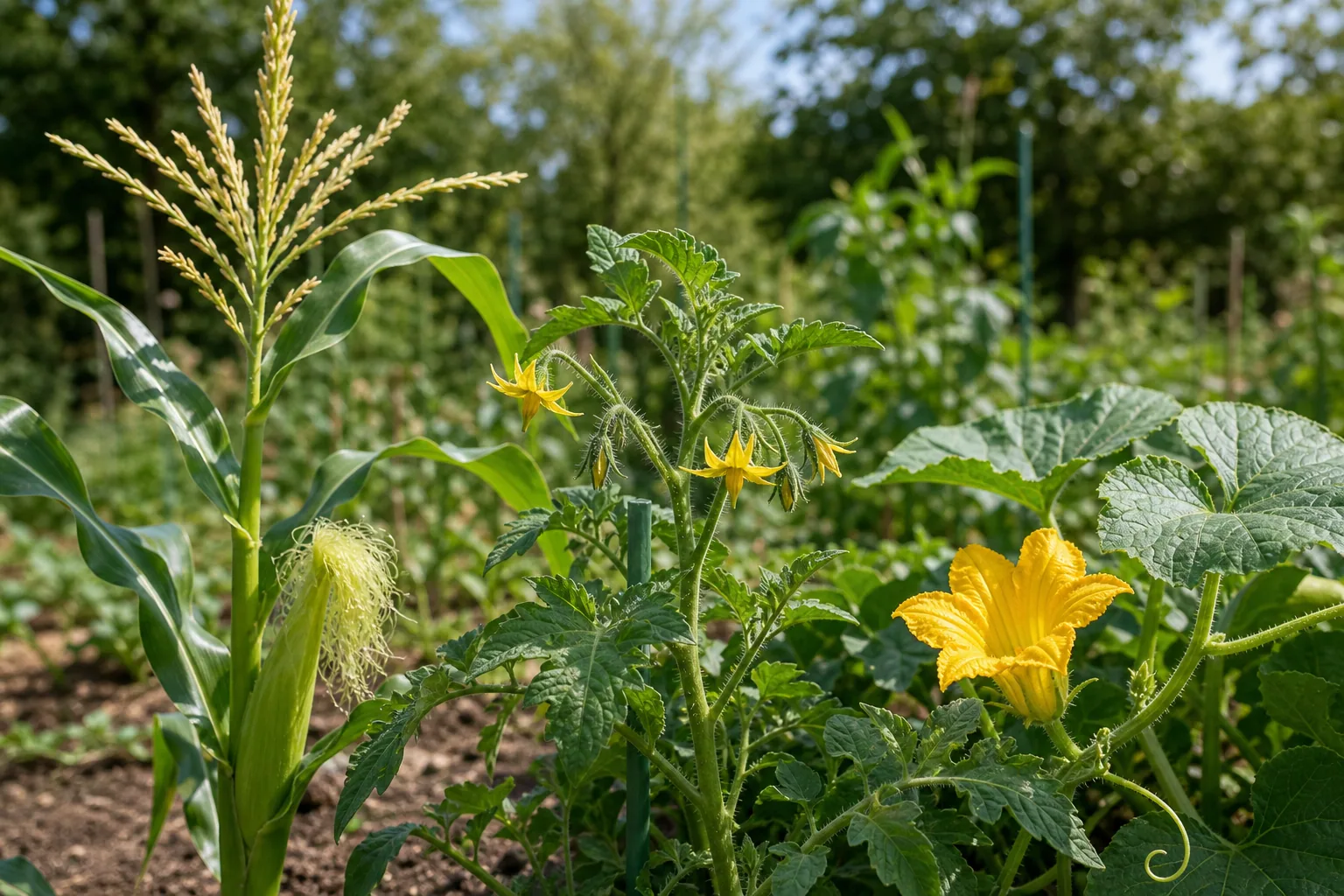
Corn, squash, cucumber, and many apple cultivars are often useful for understanding cross-pollination. Corn pollen is moved by wind from tassels to silks. Cucurbits often have separate male and female flowers and rely heavily on insects. Many apple cultivars have compatibility limits, so having both stamens and pistils in a flower does not guarantee good fruit set with their own pollen.
How to observe in pots and gardens
When a plant flowers, ask three questions: where is pollen produced, where is the stigma, and is pollen moving within one plant or between different plants of the same species?
Many flowers on one potted plant do not automatically mean cross-pollination. If pollen stays within the same plant, it still belongs in the self-pollination range for beginner learning.
This article explains the concept. It does not provide hand-pollination, cultivar-placement, fruit-set, or yield-management instructions.
Common confusions
- ✕ Self-pollination only ever happens inside one flower.
- ✓ Same-flower pollination is the easiest example; pollen movement between flowers on the same plant is often included in beginner explanations.
- ✕ Cross-pollination means any two different flowers exchange pollen.
- ✓ Cross-pollination means pollen moves between different plants of the same species.
- ✕ Cross-pollination always requires bees.
- ✓ Bees are common pollinators, but wind, other insects, birds, bats, and other routes can also move pollen.
- ✕ Self-pollination is bad and cross-pollination is always good.
- ✓ They are different reproductive strategies with different tradeoffs.
Frequently Asked Questions
Is self-pollination always within one flower?
Not always. The most typical example is within one flower, but pollen movement between flowers on the same plant is also often included in entry-level explanations.
If two flowers on the same plant pollinate each other, is that self- or cross-pollination?
For beginner learning, treat it as self-pollination because pollen and stigma still belong to the same individual plant. More precise terms may separate same-flower and same-plant cases.
Does cross-pollination require insects?
No. Insects are common, but wind, birds, bats, and other routes may move pollen depending on the plant.
Is self-pollination worse?
Not simply. It may reduce genetic variation, but it can help reproduction when pollinators or same-species neighbors are limited.
Why can a plant flower but still not form seed or fruit?
Flowering is only the opportunity. Pollen must reach a compatible stigma, germinate, grow a pollen tube, and complete fertilization and early development.
Related Terms
- Self-pollination: pollen reaching a stigma on the same flower or same plant.
- Cross-pollination: pollen moving from one plant to another plant of the same species.
- Anther: the pollen-producing part of a stamen.
- Stigma: the pollen-receiving surface.
- Pollinator: an animal that moves pollen.
- Genetic diversity: genetic variation among offspring or within a population.
- Self-incompatibility: a mechanism that limits successful reproduction with a plant’s own pollen.
Read Next
Evidence
References
These sources were used to check the plant-science concepts and gardening context in this article.
View sources and further reading (9)
- bio.libretexts.org — 32.2: Pollination and Fertilization
- fs.usda.gov — what is pollination
- fs.usda.gov — birds bees
- web.extension.illinois.edu — c1facts2d.html
- gardens.si.edu — why what when where who how pollination
- extension.umd.edu — problems pollination high tunnel tomatoes
- crops.extension.iastate.edu — birds and bees corn pollination
- extensionpubs.unl.edu — view
- treefruit.wsu.edu — cross compatibility of apple cultivars and pollinizers