Stamens and pistils do different jobs in a flower
The simplest difference is this: stamens produce pollen, while the pistil/carpel structure includes the parts that receive pollen and contain ovules.
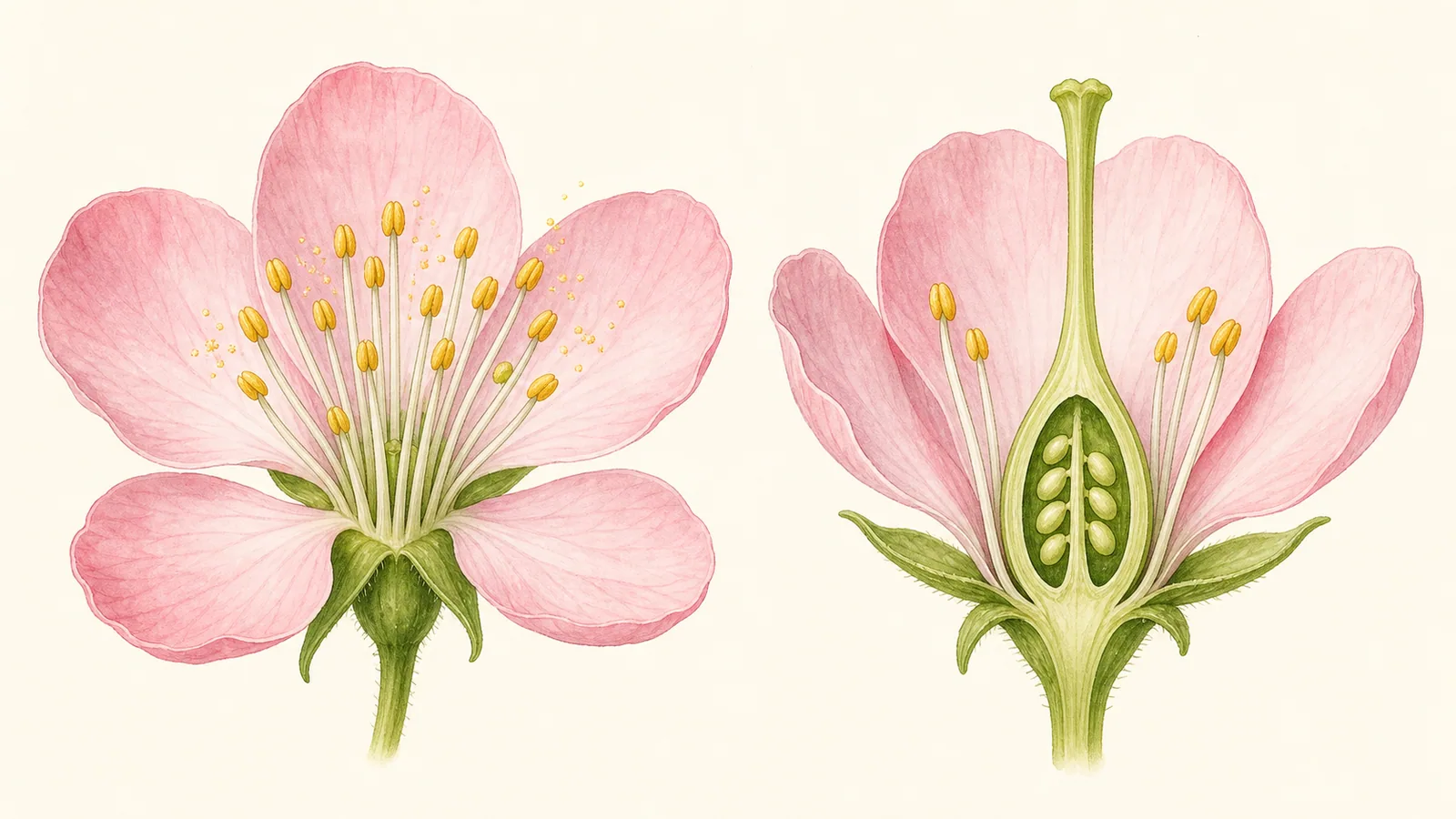
In a typical flower, stamens are often arranged around the center. Each stamen usually has a filament and an anther. The anther is the part that produces pollen.
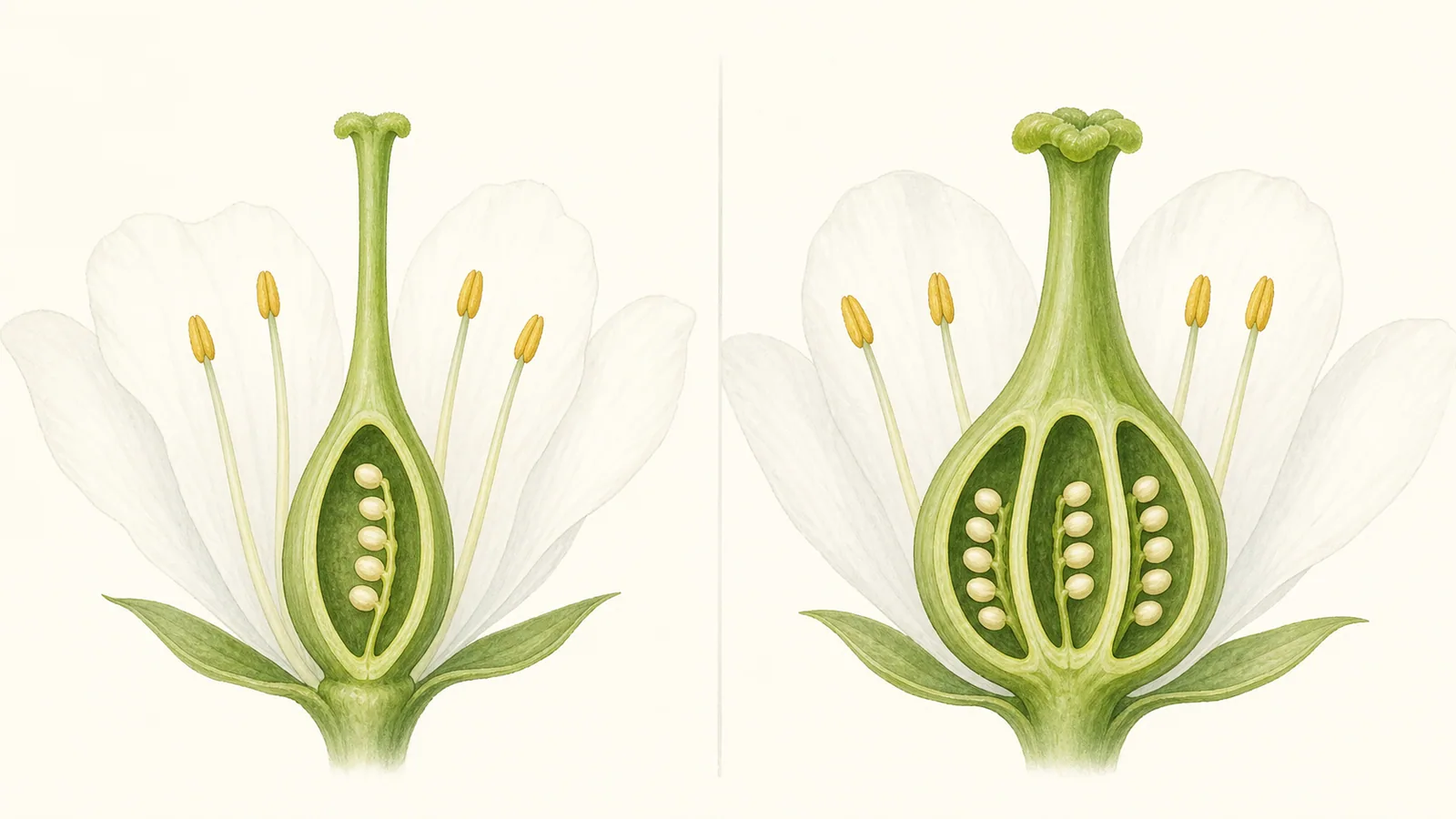
The pistil is often in the center of the flower. It commonly has a stigma, style, and ovary. The stigma receives pollen, the style connects downward, and the ovary contains ovules. If reproduction succeeds, ovules may become seeds.
A stamen is usually made of an anther and a filament
The anther is the pollen-producing part. In many flowers, anthers look like small sacs or pads at the tips of thin stalks. When mature, they may release pollen grains.
The filament is the stalk-like part that holds the anther in position. Its job is not to make pollen, but to place the anther where pollen can be exposed, collected, shaken loose, or transferred.
In real flowers, stamens may be long, short, hidden, fused, or reduced. The basic idea still helps: when you are trying to identify the pollen-producing part, look for the anthers.
A pistil commonly includes stigma, style, and ovary
The stigma is the surface that receives pollen. It may be sticky, feathery, lobed, or shaped in another way depending on the plant.
The style is the part between stigma and ovary. It can be long, short, or nearly absent. Its exact form differs among plants, but it connects the pollen-receiving region to the ovary.
The ovary is the lower part that contains ovules. After successful fertilization, ovules may develop into seeds. In many flowering plants, the ovary or related floral tissues later contribute to fruit formation.
Pistil and carpel are related but not always identical
Many beginner diagrams use the word pistil for the female structure in the flower center. Botany also uses the word carpel. A carpel is a basic female reproductive unit.
A pistil may consist of one carpel, or it may be formed by several carpels joined together. This is why advanced texts can sound more complicated than school diagrams.
For everyday learning, the main point is not to memorize every possible arrangement. First understand the functional path: pollen lands on a receptive surface, the ovary contains ovules, and successful reproduction can lead to seeds.
Pollination connects stamens and pistils, but it is not the same as seed formation
Pollination is the transfer of pollen to a receptive stigma or similar structure. It can happen by insects, wind, water, self-pollination, human handling, or other routes depending on the plant.
Pollination is important, but it is not a guarantee that seeds or fruits will form. Pollen compatibility, timing, ovule condition, plant health, temperature, and species-specific biology can all affect what happens next.
This distinction matters in gardening. Seeing pollen or seeing a flower does not automatically mean fruit or seed development will follow.
Flowers can be structurally different
Some flowers have both stamens and pistils. Some flowers have stamens but no functional pistil. Some have pistils but no functional stamens. Some plants separate male and female flowers on the same plant or on different plants.
Orchids again remind us that flower structure can be highly specialized. Many orchids have a column where reproductive structures are fused, and pollen may be packaged into pollinia. The same broad ideas still apply, but the visible parts are not arranged like a simple rose or lily diagram.
How to observe a flower
If the flower is large enough, gently look near the center. Search for pollen-bearing anthers. They may look dusty, yellow, cream, brown, or another color. Then look for a central stigma, style, or swollen ovary region.
Do not pull apart unknown or protected plants. Use common garden flowers, fallen flowers, classroom material, or safe purchased flowers for observation. The goal is to understand structure, not to damage living plants.
Common confusions
- ✕ Stamens and pistils are just decorative structures.
- ✓ Stamens produce pollen, and the pistil/carpel structure includes pollen-receiving and ovule-containing parts.
- ✕ Pollen is the same as seed.
- ✓ Pollen is part of the reproductive process. Seeds develop from ovules after successful fertilization.
- ✕ Every flower has both stamens and pistils.
- ✓ Some flowers are male, female, or structurally incomplete.
- ✕ Pollination always means fruit or seed will form.
- ✓ Pollination is one step. Compatibility, timing, and plant condition still matter.
Frequently Asked Questions
Which part of the flower makes pollen?
The anther makes pollen. The anther is part of the stamen. The filament holds the anther in position.
Which part receives pollen?
The stigma receives pollen in many flowers. It is part of the pistil or carpel structure.
Is the ovary the same as the fruit?
Not exactly. The ovary is part of the flower. After successful reproduction, the ovary may develop into fruit, and ovules may develop into seeds.
Can a flower have stamens but no pistil?
Yes. Some flowers are functionally male and have stamens but no functional pistil. Other flowers may be functionally female and have pistils but no functional stamens.
Why do some flowers not match the diagram?
Flower structures vary widely. Some parts may be fused, reduced, hidden, or modified. A diagram is a learning map, not a promise that every flower will look identical.
Related Terms
- Stamen: the pollen-producing floral structure.
- Anther: the part of the stamen where pollen is produced.
- Filament: the stalk that holds an anther.
- Pistil: a female flower structure often including stigma, style, and ovary.
- Carpel: a basic female reproductive unit of a flower.
- Stigma: a pollen-receiving surface.
- Style: the part connecting stigma and ovary.
- Ovary: the ovule-containing part of the flower.
- Ovule: the structure that may become a seed.
- Pollination: transfer of pollen to a receptive structure.
Read Next
Evidence
References
These sources were used to check the plant-science concepts and gardening context in this article.