Model of stomatal opening and closing
SolutesWater
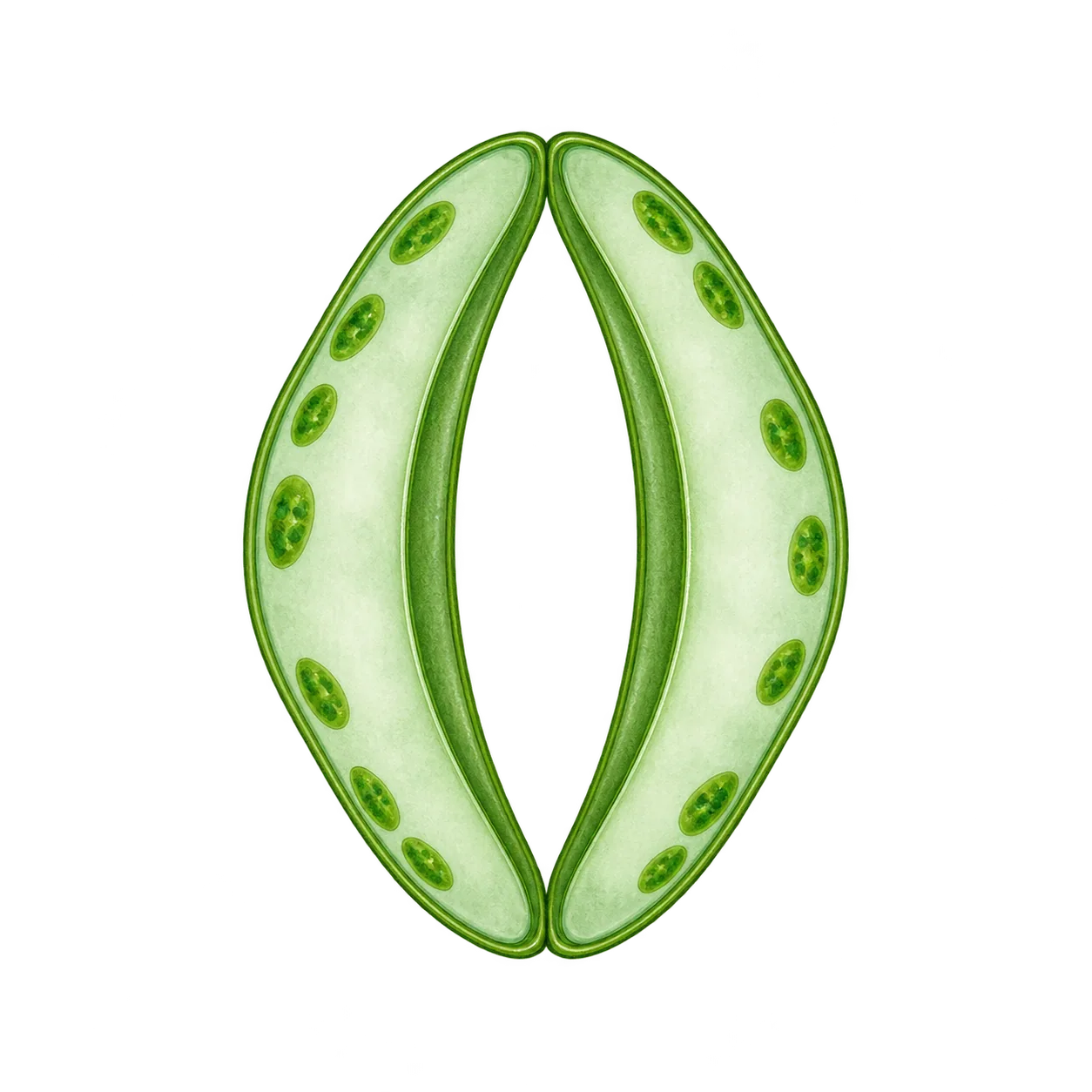
Mechanism: osmosis and guard-cell mechanics. Schematic kidney-shaped cells; dots indicate solute and water movement.
How does water vapor leave a leaf?
Follow one leaf section: water evaporates inside, then vapor escapes through a stoma.
Leaf-to-air vapor conditions, leaf temperature and wind stay fixed; only pore width changes.
Vapor in this example: more inside → less outside
- 1Water evaporates from wet walls
Solid blue dots represent liquid water. Water evaporates from wet mesophyll cell walls; open circles represent water vapor.
- 2Vapor diffuses through airspaces
Vapor spreads through airspaces between cells, rather than traveling inside a pipe.
- 3Vapor escapes through the pore
When the leaf interior is more humid, net movement is outward. With other conditions fixed, a narrower pore increases resistance to escape.
A local lower-surface section of a general broadleaf plant. Symbols show physical state and movement; counts, speed and aperture proportions are not measurements.
Transpiration is plant water loss as vapor
Transpiration is the loss of water from a plant as water vapor, mainly through leaf stomata. Roots take up replacement water, and xylem carries it toward the leaves. Evaporation at the leaf end helps create the tension that pulls this water upward.
A simple path is: water enters through roots, moves upward through xylem, reaches the leaves, evaporates from wet internal leaf surfaces, and diffuses out through stomata into the air.
This is not just “the plant sweating.” Plants do not sweat the way animals do. Transpiration is tied to gas exchange, water movement, leaf temperature, and the surrounding air.
To place that pathway alongside cell support, transport, and photosynthesis, see what water does in plants.

Stomata create a tradeoff
Stomata are tiny pores on plant surfaces, especially leaves. Pairs of guard cells adjust how open or closed each pore is. When stomata open, carbon dioxide can enter the leaf for photosynthesis. At the same time, water vapor can leave.
This creates a tradeoff. Open stomata support carbon dioxide entry, but they also increase water loss. Closing stomata can reduce water loss, but it may also limit carbon dioxide entry and slow photosynthesis.
Plants regulate stomata in response to light, water status, carbon dioxide, temperature, humidity, and other conditions. This is why leaf behavior changes across a day.
How does the pore change size? Choose “Show opening,” then compare “Show closing.” Changes in guard-cell solutes and water alter turgor, the pressure of fluid inside a cell against its wall. The cells change shape, adjusting the pore. Blue dots show liquid water moving into or out of guard cells; transpiration is water vapor leaving the leaf through the pore.
Transpiration helps pull water upward
Water loss from leaves helps create a pull in the plant’s water-transport system. As water evaporates from moist internal leaf surfaces, more water is drawn upward through the xylem from stems and roots.
This does not mean leaves simply “suck water” like a pump. Water molecules tend to hold together through cohesion, and they also adhere to xylem walls through adhesion. Together with xylem structure and differences in water potential from soil to plant to air, these properties help maintain a continuous water column.
The useful idea is that leaf water loss and root water uptake are connected. The roots take up water, xylem transports water and dissolved minerals, and leaves are one of the main places where water can leave the plant. Transpiration can support water movement, mineral transport, leaf cooling, and the water pressure that helps cells stay firm. That pressure is called turgor pressure, and these functions still come with a water-loss cost.
Now look inside the leaf. Water evaporates from the moist walls of the mesophyll, the photosynthetic tissue inside a leaf. Vapor then diffuses through airspaces between cells and out through a stoma. Compare pore widths in the same section below: solid blue dots represent liquid water, while open circles represent water vapor.
Air conditions strongly affect transpiration
Transpiration often responds to warm, dry, and moving air. Heat can increase evaporation. Dry air increases the difference between moist leaf interiors and outside air. Wind can remove humid air near the leaf surface. The exact response still depends on stomata, plant type, leaf temperature, and water supply.
How humidity affects plants adds the wider environmental context behind that leaf-to-air difference.

In indoor gardening, this is why plants near sunny windows, heaters, fans, or air-conditioning drafts may lose water faster than expected. The pot may dry more quickly even if the plant did not “drink” more in a simple sense.
Low light, high humidity, still air, or cooler conditions may reduce transpiration. But low transpiration is not always better. Plants still need gas exchange and healthy root conditions.
Transpiration is not the same as evaporation from soil
A pot can lose water in several ways. The form and source of the water help distinguish the processes.
| Process | Form of water leaving | Example |
|---|---|---|
| Transpiration | Water vapor | Water inside a plant leaves through plant surfaces |
| Surface evaporation | Water vapor | Water evaporates from potting mix or a rain-wet leaf |
| Guttation | Liquid droplets | Some plants release liquid through pores called hydathodes at leaf tips or margins |
This difference matters because watering decisions should not be based on a single clue. Leaf condition, pot weight, media aeration, root condition, light, temperature, and airflow all interact.
Gardening observations
On hot days, a plant may wilt temporarily if transpiration is faster than water uptake. Some plants recover in the evening when light and heat decrease. Others may remain stressed if roots cannot supply enough water.
In containers, poor aeration can make roots less able to function, even if the pot is wet. A wet pot does not always mean the plant is safely hydrated. Roots need both water and air.
Treat these conditions as observation clues: leaf condition, media moisture, root aeration, light, temperature, and airflow can interact, so one visible symptom does not identify a single cause. For another example of reading plant changes as clues rather than conclusions, see why plant leaves turn yellow.
Common confusions
- ✕ Transpiration means that the plant is sweating like an animal.
- ✓ “Like sweating” can be a temporary comparison, but transpiration more precisely means water leaving plant tissues as water vapor, especially through stomata.
- ✕ Transpiration means the plant is wasting water.
- ✓ Transpiration is linked to gas exchange, water movement, mineral transport, cooling, and cell water status. It has functions as well as a water-loss cost.
- ✕ If leaves wilt, the plant always needs more water.
- ✓ Wilting can involve water loss, root limits, heat, damaged roots, or other causes.
- ✕ Wet soil means transpiration cannot be a problem.
- ✓ Wet, poorly aerated media can still limit root function.
- ✕ Transpiration and soil evaporation are the same.
- ✓ Transpiration is water loss through the plant; evaporation can happen from wet surfaces.
- ✕ The wider the stomata open, the better it is for the plant.
- ✓ More open stomata can help carbon dioxide enter, but they can also increase water loss. Narrower stomata can conserve water while limiting carbon dioxide entry.
Frequently Asked Questions
What is the difference between transpiration and evaporation?
Evaporation is water changing directly from soil, potting media, a water surface, or another wet surface into water vapor. Transpiration is water that entered the plant and then leaves through plant surfaces, especially leaf stomata. Together, the two processes can be described as evapotranspiration.
Where does most transpiration happen?
Much transpiration happens through stomata on leaves. Some water can also be lost through other surfaces, but stomata are the major entry point for understanding the process.
Why does wind make plants dry faster?
Wind removes humid air near the leaf surface, keeping the air around the leaf drier. This can increase water vapor loss from the leaf.
Is closing the stomata more water-efficient?
Closing or narrowing the stomata usually reduces water loss, but it also reduces carbon dioxide entry. Photosynthesis may therefore be limited. Plants balance carbon-dioxide uptake with conserving water; neither fully open nor fully closed stomata are automatically best in every condition.
Why can warm, dry, or windy air make leaves lose water faster?
Warm conditions can increase evaporation, dry air increases the difference between moist leaf interiors and the outside air, and moving air can remove humid air next to the leaf. These conditions often increase evaporative demand. If root water uptake cannot keep up, turgor pressure may fall and a leaf may wilt, but wilting still has more than one possible cause.
Does transpiration happen at night?
It can, but it is often lower at night because many stomata close or partly close, and temperatures may be lower. The exact pattern depends on the plant and environment.
Is transpiration good or bad?
It is a normal plant process. It helps connect water movement and gas exchange, but excessive water loss can stress a plant if roots cannot replace the water.
Why can a wet plant still wilt?
If roots are damaged, cold, oxygen-limited, or in poorly aerated media, they may not supply water well. The issue is not only how much water is present, but whether roots can function.
What does fogging inside a plastic bag around a leaf mean?
It can be a simple observation that water vapor released by the leaf has condensed on the inside of the bag. Do not leave a whole plant enclosed for a long time or place it in strong sun, because the enclosure can overheat or become excessively stagnant. The fog shows that water vapor was present; it does not measure the plant’s overall health or prove that transpiration is the only process involved.
Is transpiration the same as a plant sweating?
“Like sweating” can be a temporary beginner-friendly comparison, but it is not precise. Transpiration mainly involves water leaving plant tissues as water vapor, especially through stomata, and it is connected to gas exchange, water transport, and the balance between obtaining carbon dioxide and conserving water.
Do droplets on leaf tips mean transpiration is high?
No. Transpiration releases water as vapor, which is usually invisible. Liquid droplets at some leaf tips or margins can instead come from guttation; condensation or leftover rain can also wet leaves. Their position and timing are useful clues. See why water droplets appear on plant leaves.
Related Terms
- Transpiration: loss of water vapor from a plant, especially through stomata.
- Stoma: a tiny pore that allows gas exchange; the plural is stomata.
- Guard cells: cells around a stoma that help regulate whether the pore is more open or more closed.
- Xylem: vascular tissue that transports water and dissolved minerals.
- Water potential: a concept describing the tendency of water to move from one place to another.
- Water-vapor gradient: the difference in water-vapor conditions between the inside of a leaf and the surrounding air.
- Turgor pressure: water pressure inside cells that helps them remain firm.
- Humidity: the amount of water vapor in the air.
- Evaporation: water changing from liquid to vapor from a surface.
- Evapotranspiration: evaporation from surfaces plus water loss from plants through transpiration.
Read Next
Evidence
References
These sources were used to check the plant-science concepts and gardening context in this article.
View sources and further reading (13)
- ipm.missouri.edu — index.cfm
- extension.oregonstate.edu — em 9544 soil plant water relationships
- extension.oregonstate.edu — environmental factors affecting plant growth
- extension.oregonstate.edu — plant growth development
- openstax.org — 30 5 transport of water and solutes in plants
- openstax.org — 5 2 passive transport
- usgs.gov — glossary water cycle terms
- usgs.gov — experiment shows result plant transpiration
- hort.extension.wisc.edu — gardening in extreme heat and drought
- openstax.org — 30 4 leaves
- passel2.unl.edu — 6
- ucanr.edu — print
- pressbooks.lib.vt.edu — 5