Water retention and drainage
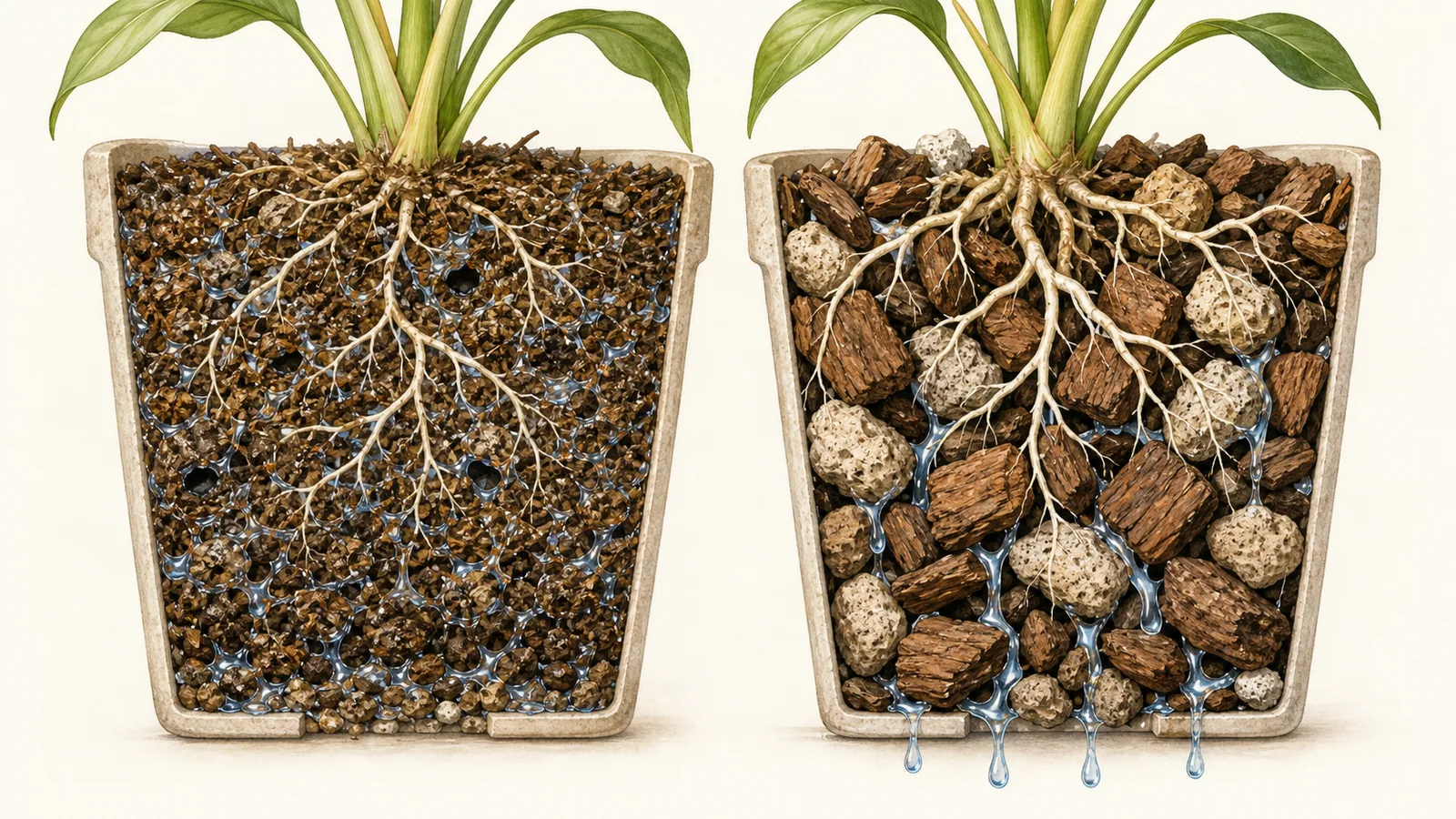
Particles close together
Connected to an outlet below
Gravity-driven drainage and capillary retention.
Model conditions
An enlarged qualitative view of wettable particles with connected pores and an open outlet below. Film thickness and timing are not to scale. Retention also depends on pore shape, connectivity and surface properties. Not all retained water is available to roots.
One holds water, the other lets excess water leave
Water retention and drainage sound like opposites, but both describe the same root environment: where water and air sit around roots.
Water retention means the medium holds water, some of which roots can use. Drainage means excess water can leave instead of filling all pores for too long. A useful potting medium is not always wet and not instantly dry. It is more like a squeezed sponge: still moist, but not dripping and not airless.
Roots need both water and air
Roots absorb water, but root cells also need oxygen. Pore spaces between media particles may contain water or air. Right after watering, many pores hold water. After excess water drains, some pores refill with air.
This is why “too wet” or “too dry” is not enough. The important questions are how long water stays, whether pores still contain air, whether the medium has become compact, and whether roots can function.
Poor water retention can leave roots without available water too quickly. Poor drainage can leave pores filled with water too long. Both create unstable root conditions.
Particle size affects water and air movement
Fine media and small pores usually hold water longer. Coarser particles and larger pores usually allow water and air to move more easily.
But coarse is not always better and fine is not always worse. Very fine media can slow drainage and aeration. Very coarse media may dry too quickly or fail to support roots. A useful medium balances water retention, drainage, aeration, and physical support. To apply these ideas to specific materials, compare perlite, vermiculite, and akadama.
A potting medium also changes over time. Materials can break down, become powdery, or compact. Large pores decrease, and water and air movement can slow even if your watering habit stays the same.
Why is the medium still wet after water drains?
Drainage does not remove every drop. Gravity draws water down larger connected pores, and air enters the space it leaves. Capillary forces retain some water in fine gaps and on particle surfaces. The same medium can drain excess water and still hold moisture.
The animation below enlarges the spaces between particles. Let water enter, then stop watering to see where it drains and where it stays.
Pots create a small contained environment
A pot limits root space and media volume. Drainage holes, media particles, pot size, light, airflow, and season all affect how long water stays.
Useful observations include: does water have a path out after watering, does the pot stay heavy for a long time, is the surface dry while the center may still be wet, and has the medium become fine or compact?
These questions do not tell you exactly how many days to wait between watering. They help you understand how water and air behave in the root zone.
Different plants need different balances
Pothos, succulents, ferns, flowering annuals, herbs, and woody plants do not all need the same root environment. Water retention asks whether water remains, drainage asks whether excess water can leave, and aeration asks whether roots still have access to air. Both the amount retained and how much of it roots can use affect the plant’s water supply.
Common confusions
- ✕ Good water retention means always wet.
- ✓ It means holding water, some of which roots can use; it does not require every pore to stay water-filled.
- ✕ Good drainage means no water retention.
- ✓ Excess water leaves, but some water can still remain.
- ✕ Coarse particles are always best.
- ✓ Coarse media may improve drainage and aeration but can also hold too little water.
- ✕ A dry surface means the whole pot is dry.
- ✓ The center or bottom may still be moist.
Frequently Asked Questions
Are water retention and drainage opposites?
No. Retention holds water, and drainage lets excess water leave. Only part of the retained water is available to roots, and a useful medium often needs both retention and drainage.
Does good drainage mean the pot dries very fast?
Not always. Drainage concerns excess water leaving. Some water can remain in small pores or on particle surfaces.
Does good water retention mean the medium stays wet?
No. Retention means holding water; it does not require every pore to stay water-filled. If pores remain water-filled for too long, oxygen around roots becomes limited.
Why does water remain in fine gaps after drainage?
Adhesion between water and particle surfaces, together with cohesion between water molecules, creates capillary retention. Smaller pores generally resist gravity-driven drainage more strongly. Fine gaps and surfaces can therefore retain water after excess water leaves; some of it is held too tightly for roots to use.
Why do roots need both water and air?
Roots need water for uptake and transport, and oxygen for respiration. Both water and air occupy pore spaces in the medium.
Does a dry surface mean the whole pot is dry?
No. Light, airflow, and dry indoor air may dry the surface faster than the rest of the medium. The center or bottom can still be moist.
Is a coarser medium always better?
No. Coarse media can improve drainage and aeration but may retain too little water or provide poor support. Consider water retention, drainage, aeration, physical support, and the plant together.
Does potting media change over time?
Yes. Breakdown, powdering, and compaction can change pore structure and slow water and air movement.
Related Terms
- Water retention: the ability of a medium to hold water, only part of which is available to roots.
- Drainage: the ability of excess water to leave.
- Aeration: air space and air exchange around roots.
- Pore: space between media particles.
- Potting medium: material that supports roots in containers.
Read Next
Evidence
References
These sources were used to check the plant-science concepts and gardening context in this article.
View sources and further reading (7)
- content.ces.ncsu.edu — 18 plants grown in containers
- content.ces.ncsu.edu — 1 soils and plant nutrients
- extension.illinois.edu — soil
- extension.umn.edu — soil compaction
- aggie-horticulture.tamu.edu — air water and media putting them all together
- purdue.edu — CEA8.pdf
- yardandgarden.extension.iastate.edu — potting media components and handling