
FOLLOW THE WATER
What keeps water moving upward?
Explore leaf water loss, xylem tension and root uptake, then connect the whole pathway.
The views follow an explanation order. In the plant, uptake, transport and water loss are continuously connected.
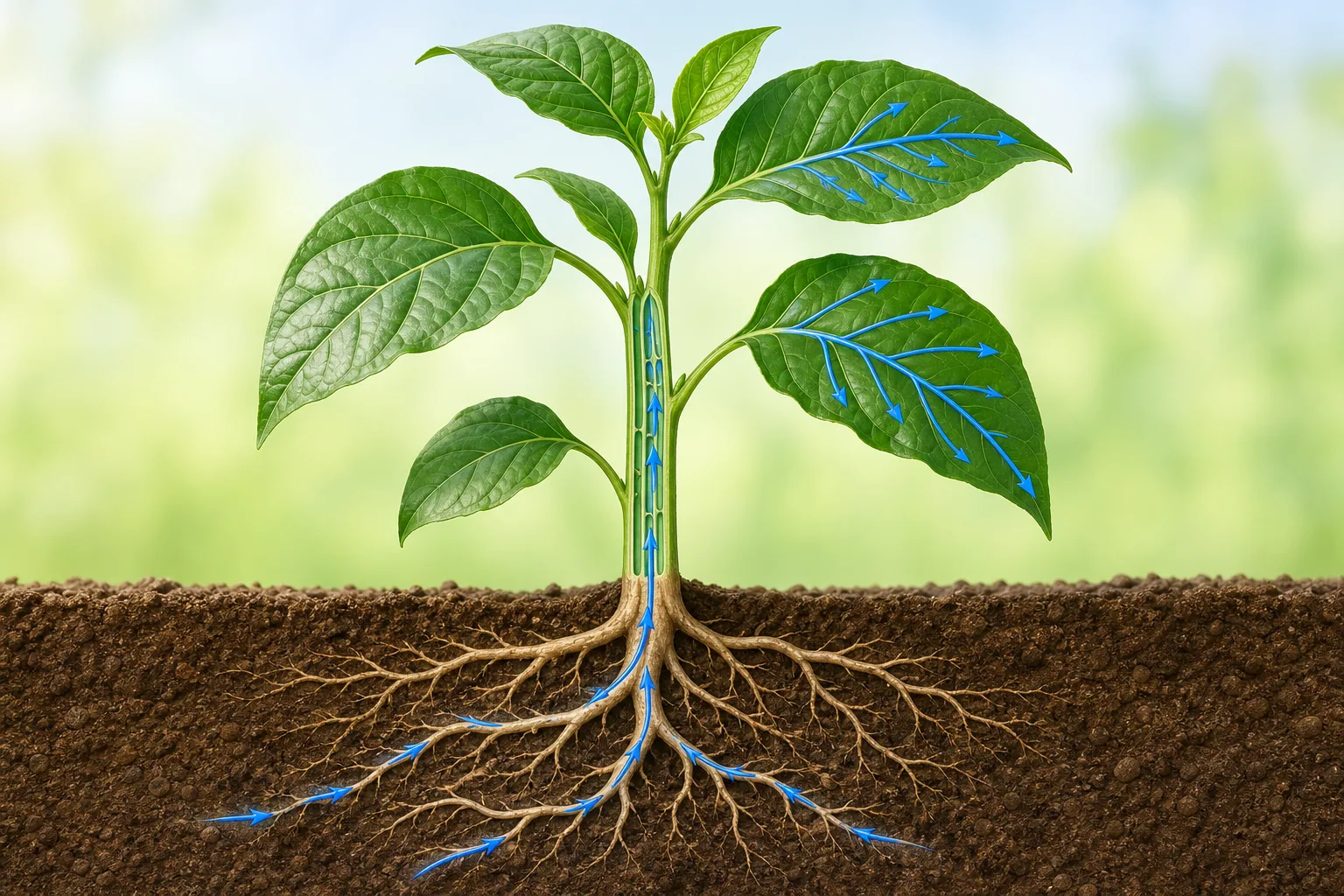 Water vapor → air
 Reduced motion is enabled. Choose a view below to read without animation.
Water evaporates inside the leaf
Water evaporates from moist cell walls into the leaf’s air spaces, then diffuses out mainly through stomata. This lowers water potential at the leaf end.
A connected water column transmits the pull
Water loss at the leaf end creates tension in the xylem. Attraction between water molecules helps transmit this pull through the continuous water column.
Water enters roots along a water-potential gradient
With water available in the surrounding medium and a suitable water-potential gradient, water moves across root tissues into the xylem, replenishing the connected pathway.
Roots, xylem and leaves work together
During transpiration, uptake, transport and leaf water loss are coupled. The numbered views guide your attention; these processes do not wait for one another to finish.
This shows the main transpiration-driven pathway in many land plants. Root pressure can contribute in some conditions; capillary rise alone cannot explain transport to the top of a tall tree.
Water moves through a connected root-to-leaf pathway
Water enters through roots and travels through xylem in the stem and leaf veins to reach the leaves. In many terrestrial plants, transpiration creates the tension that drives this upward flow. Cohesion—the attraction between water molecules—helps maintain the connected water column.
The basic route is:
root surface → root interior → xylem → stem → leaf veins → leaf tissues → stomata → air
This is not a single pump pushing water up like an elevator. It is a connected pathway shaped by plant structure, water properties, water-potential differences, and the conditions around both the roots and the leaves.
This section explains movement; what water does in plants covers its roles in cell support, transport, photosynthesis, and cooling.
The first step is at the roots: water enters through fine roots
Roots do more than anchor a plant. They also take up water and dissolved minerals from the surrounding soil or potting medium.
Fine roots and root hairs increase the surface area in contact with the thin water films around soil or potting-medium particles. A root hair is not a separate root; it is a small extension of a root epidermal cell.
After water enters the root, it passes through several root tissues before reaching the xylem inside the root. You do not need to memorize every cell layer to understand the pathway. The useful starting point is that a root is an organized entry region, not a straw inserted directly into the stem.
Water does not enter simply because a plant “wants a drink.” Movement across root tissues depends on water-potential differences and the condition of root cells. Root cells can influence uptake through solute regulation and membrane transport, but this does not mean that roots act like a heart-like pump for the whole plant.
Xylem is the main long-distance route for water
Xylem is one of the plant’s vascular tissues. It mainly carries water and dissolved minerals from roots toward stems and leaves. The other major vascular tissue, phloem, mainly transports sugars and other organic products made or redistributed by the plant. The two should not be treated as the same pathway; a closer comparison is available in What Is the Difference Between Xylem and Phloem?.
In many vascular plants, mature water-conducting cells form elongated, hollow, or tube-like conduits. These conduits connect the root to the stem and continue into the leaf veins, so a leaf is not absorbing water in isolation. It is connected to the plant’s wider water-transport pathway.
Leaf veins are therefore more than decorative lines. They contain vascular tissues, including xylem, that distribute water through the leaf and connect it with the stem. Plants differ in vein patterns and stem structures, but the broad root-to-leaf principle remains the same.
Xylem is plant vascular tissue with specialized conducting cells, not a uniform plastic pipe. Water movement through it also depends on the attraction between water molecules, interactions between water and xylem walls, and water loss at the leaf end.
Water loss from leaves helps pull water upward
The surprising part is that water leaving the leaves is one of the important reasons water can keep moving upward.
Leaves have stomata, tiny openings involved in gas exchange. When stomata open, carbon dioxide can enter to support photosynthesis, while some water inside the leaf can leave as water vapor. This loss is called transpiration.
When water leaves at the leaf end, the leaf needs replacement water. That change creates tension in the xylem and helps pull the connected water column upward from below.
Water molecules attract one another; this is called cohesion. Water also interacts with and adheres to xylem walls; this is called adhesion. Together with xylem structure and water-potential differences, these properties help the water column remain continuous enough for movement from roots toward leaves.
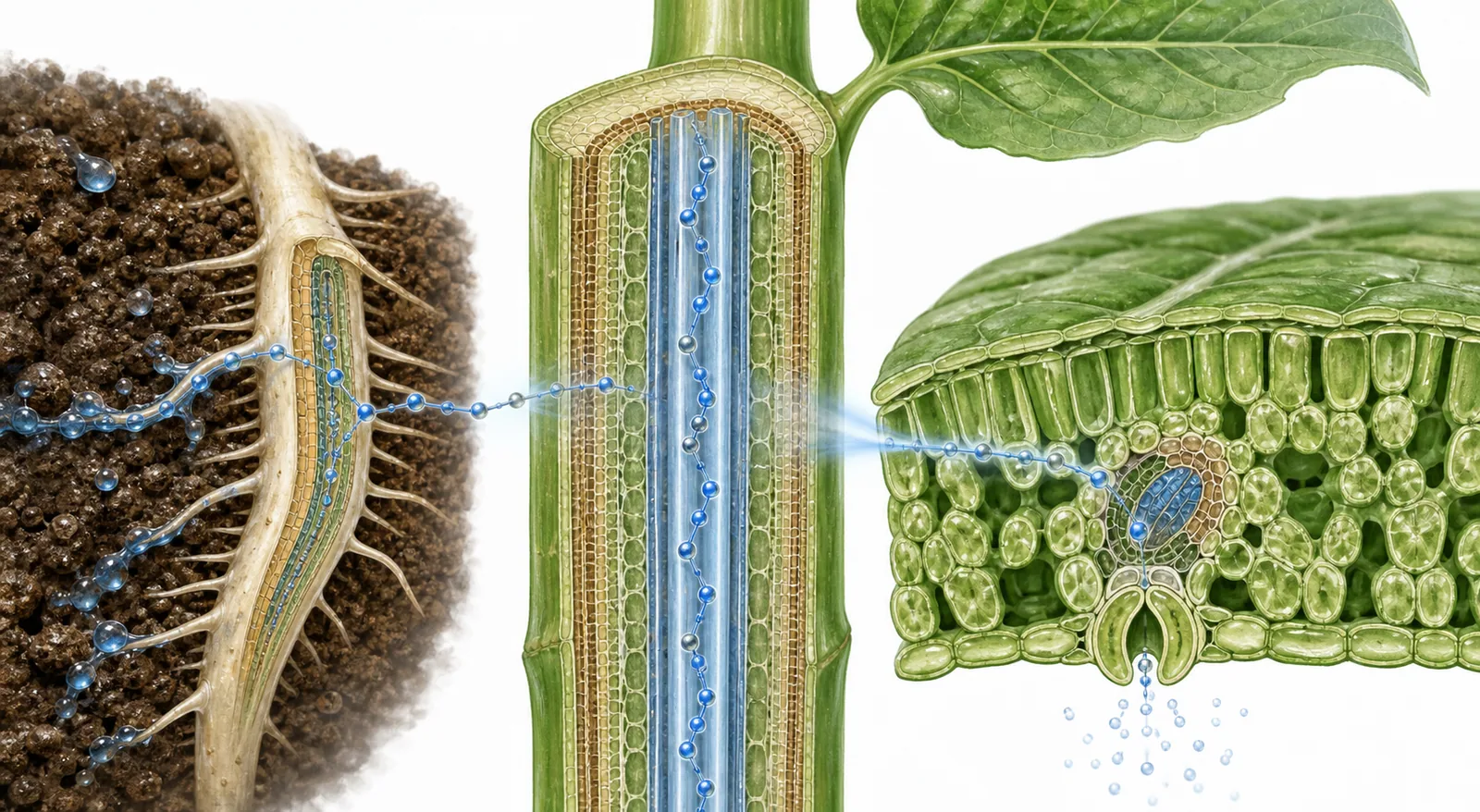
What each part contributes to water transport
Fine roots and root hairs increase contact with nearby water and connect uptake at the root surface to the plant’s internal transport tissues.
In the root-to-leaf pathway, xylem is the main long-distance tissue carrying water and dissolved minerals toward stems and leaves.
When water leaves the leaf as vapor, the leaf end needs replacement water, helping pull water upward through the xylem.
Root pressure can push water upward in some situations. Capillary action helps explain water movement in narrow conduits, but neither is usually the main explanation for water reaching the top of a tall plant.
More than one process is involved
People sometimes summarize plant water transport by saying that “leaves pull water up.” That captures an important part of transpiration pull, but it is not the whole explanation.
Water moves along a water-potential gradient. Water potential is a way to describe where water has a greater tendency to move; it is not simply a measurement of how much water is present. In a connected soil–plant–air pathway, water may move from the surrounding medium through roots, stems, and leaves toward the air. As transpiration lowers water potential at the leaf end, water tends to move toward that end.
Root pressure and capillary action also belong in the picture, but they have more limited and context-dependent roles. Root pressure is positive pressure that can develop near the bottom of the xylem after roots take up ions and water follows. In some plants, especially when transpiration is weak at night or in the early morning, root pressure may help push water upward or contribute to guttation, the appearance of water droplets at leaf edges.
Capillary action is related to water adhering to narrow walls and moving through small spaces. The fine structure of xylem makes capillarity useful for understanding part of the pathway, but capillarity alone cannot explain how tall plants move water to great heights.
For most terrestrial plants, the main storyline is still: water enters through roots, moves upward through xylem, and continues toward the leaves because water loss at the leaf end creates a water-potential difference and transpiration pull. Root pressure and capillary action provide support in particular conditions rather than acting as equally strong, always-on pumps.
Water crossing a living cell membrane is different from water flowing along xylem. Osmosis is water movement across a selectively permeable membrane. Bulk flow moves water together along a pressure gradient.
| Part of the route | Process to distinguish |
|---|---|
| Across a living root-cell membrane | Osmosis, governed by the total water-potential difference |
| Along xylem over a long distance | Pressure-driven bulk flow, often sustained by transpiration tension |
| From inside a leaf to the air | Evaporation followed by water-vapor diffusion |
In potted plants, root-zone conditions also matter
When this concept is brought back to a potted plant, the question is not only what happens at the leaves. The root-zone environment also affects the starting point of water uptake.
If the potting medium is too dry, less water is available around the roots. If the medium stays saturated and poorly aerated for a long time, water can fill the pore spaces and reduce the supply of oxygen around the roots. Oxygen diffuses more slowly through water than through air, and roots need oxygen for respiration and the energy required to maintain ion uptake, membrane transport, and growth. This is why root-zone aeration and root condition can influence what you observe in the leaves.
The air around the leaves matters too. Hot, dry, windy conditions on a balcony can increase the demand for water loss at the leaf end. Air conditioning or dehumidification indoors can also change the difference in water vapor between a leaf and its surroundings. These are useful observation clues, not single-cause diagnoses.
Wilting, browned leaf edges, or yellowing can have multiple causes. One symptom alone cannot show that a plant is simply underwatered or that water has stopped moving upward. The ideas here help explain a connected water-transport pathway; they are not a direct watering schedule or a diagnosis for a particular pot.
Common confusions
- ✕ Plant water transport depends on one force only.
- ✓ Roots, xylem, leaf transpiration, root pressure, capillary action, and the properties of water all contribute. Their relative importance changes with the plant and the conditions.
- ✕ Roots only push water upward.
- ✓ Roots are an important entry point for water and can generate root pressure in some situations, but transpiration pull at the leaf end is usually central to upward xylem transport in terrestrial plants.
- ✕ Xylem and phloem are the same thing.
- ✓ Xylem mainly transports water and dissolved minerals, while phloem mainly transports sugars and other organic products. Phloem transport should not be reduced to “always downward.”
- ✕ A wilted leaf always means the plant is short of water.
- ✓ Wilting is an observation clue. It can be associated with dry media, root injury, low root-zone oxygen, short-term heat stress, transplant stress, or other environmental changes.
- ✕ Wet potting medium means the roots must be taking up water normally.
- ✓ Roots also need oxygen and healthy tissues. Saturated, poorly aerated medium, damaged roots, or other root-zone problems can affect uptake even when water is present.
Frequently Asked Questions
How does water move from roots to leaves?
Water enters through the root surface, passes through root tissues, and reaches xylem. It then moves through xylem in the roots and stems, continues into leaf veins and leaf tissues, and eventually leaves through stomata as water vapor. The main upward driver in many terrestrial plants is the water-potential difference and tension associated with transpiration; cohesion, adhesion, root pressure, and capillary action also influence the pathway.
Do roots push water up, or do leaves pull it up?
Both descriptions capture part of the process. Roots allow water to enter and can generate root pressure in some conditions. In many terrestrial plants, however, water loss from leaves creates transpiration pull, which is a major driver of long-distance water movement through xylem.
What is the difference between xylem and phloem?
Xylem mainly transports water and dissolved minerals from roots toward stems and leaves. Phloem mainly transports sugars and other organic products made or redistributed by the plant. Phloem movement depends on source and sink relationships, so it should not be simplified as a pathway that always moves downward.
Why are root hairs important for water uptake?
Root hairs increase the surface area where fine roots contact water and dissolved minerals around soil or potting-medium particles. They are small extensions of root epidermal cells, not separate roots, and are especially important near actively growing root regions.
How is transpiration related to water transport?
Transpiration is the loss of water vapor from leaves and other plant surfaces. When water leaves at the leaf end, the xylem water column is pulled toward the leaf, helping maintain a continuous flow from roots through stems and leaf veins. The related transpiration article continues with the leaf-side process.
Do plants still move water at night?
Yes, water can still move at night, but the pattern may differ from a day with active transpiration. Stomata are often less active, so transpiration pull may weaken. Root pressure and capillary action can be useful supporting ideas, but actual movement depends on plant species, temperature, humidity, and root-zone conditions. It should not be generalized as identical for every plant.
Does wilting always mean water is not reaching the leaves?
No. Wilting is related to reduced cell turgor, but it can have many possible causes, including dry medium, damaged roots, low root-zone oxygen, short-term high heat, transplant stress, or other environmental changes. It is an observation clue rather than a diagnosis.
Why can a potted plant look thirsty when the potting medium is wet?
If the medium remains saturated and poorly aerated, water can fill pore spaces and reduce oxygen around the roots. Roots need oxygen for respiration and for the energy required to maintain uptake and cell transport, so water nearby does not guarantee that roots are functioning normally. This observation alone does not prove root rot or determine that the plant needs repotting; the root-zone conditions and leaf symptoms need to be considered together.
Does osmosis move water all the way from roots to leaves?
No. Osmosis describes water crossing a selectively permeable membrane. Long-distance flow through xylem is mainly bulk flow driven by pressure differences. Both involve water potential, but they describe different processes. Diffusion and osmosis in plants explains the distinction at a smaller scale.
Related Terms
- Xylem: Vascular tissue that mainly transports water and dissolved minerals.
- Phloem: Vascular tissue that mainly transports sugars and other organic products.
- Transpiration: The release of plant water as vapor from leaves and other surfaces.
- Root hair: A fine extension of a root epidermal cell that increases contact with water and minerals.
- Stoma / stomata: A small opening, or openings, involved in gas exchange and water-vapor loss.
- Water potential: A concept describing the tendency of water to move; in a connected system, water tends to move from higher toward lower water potential.
- Cohesion: Attraction between water molecules.
- Adhesion: Attraction between water and another surface, such as a xylem wall.
- Root pressure: Positive pressure that can develop near the lower xylem after root uptake; it may support upward movement in some conditions.
- Capillary action: The movement of water through narrow spaces because of interactions among water molecules and the surfaces around them.
Read Next
Evidence
References
These sources were used to check the plant-science concepts and gardening context in this article.
View sources and further reading (12)
- openstax.org — 5 2 passive transport
- blogs.ifas.ufl.edu — moving water from the roots to the top how is this possible
- openstax.org — 30 5 transport of water and solutes in plants
- openstax.org — 30 3 roots
- openstax.org — 30 1 the plant body
- openstax.org — 30 2 stems
- organismalbio.biosci.gatech.edu — plant transport processes i
- open.lib.umn.edu — 11 1 plants and water
- bio.libretexts.org — 11.04: Water Absorption
- nature.com — water uptake and transport in vascular plants 103016037
- extension.oregonstate.edu — em 9544 soil plant water relationships
- extension.oregonstate.edu — em 9544 container gardening basics