
The Calvin cycle is the core cycle of the carbon reactions of photosynthesis. When a plant takes in carbon dioxide, its carbon does not immediately become glucose. In the chloroplast, this cycle attaches carbon from CO₂ to a molecule that already contains five carbon atoms. Using ATP and NADPH supplied by the light reactions, it then produces a three-carbon molecule called G3P. Most of the intermediate material is used to regenerate the molecule that accepts carbon, allowing the cycle to continue.
Think of a production line that must return some parts to its starting point. Some of its output can support other pathways, while the rest is needed to keep the line running. One turn does not produce a whole glucose molecule.
Where does the cycle happen, and what does it need?
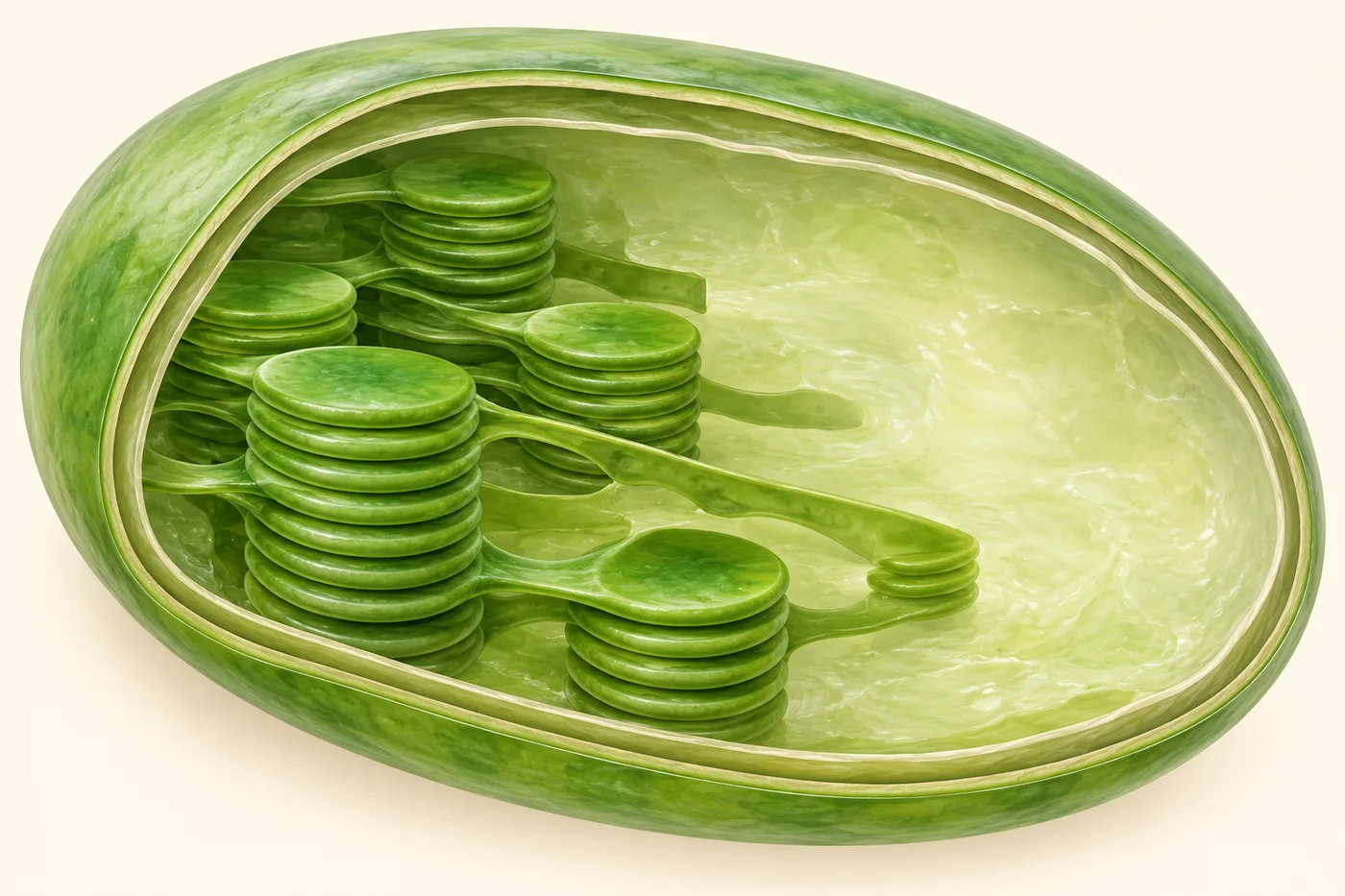
The Calvin cycle takes place mainly in the stroma, the fluid-filled space surrounding the thylakoids inside a chloroplast. The connected light reactions operate in the thylakoid membrane and supply ATP and NADPH. ATP supplies energy for the reactions; NADPH provides reducing power, helping convert carbon into more energy-rich organic molecules. Carbon dioxide supplies the new carbon entering the cycle.
The cycle can be divided into three stages: carbon fixation, reduction, and regeneration. To track the carbon, the account below groups three CO₂ molecules together. This is a simplified net balance, not a claim that molecules line up neatly or leave at fixed intervals.
Follow carbon around the cycle
Use the ring for the route and the molecule view for joining and splitting.
Outlines mark starting and product positions; solid C circles are the moving carbons.
Three five-carbon acceptors supply 15 carbons. Three CO₂ bring 3 more.
15 + 3 = 18 carbonsEach dot represents one carbon, without tracking atom identities. Rearrangement involves several enzyme reactions. Spread-out dots stand for rearranging intermediates, not free carbon atoms or structural formulas. P marks phosphate groups and Pi means inorganic phosphate; some water and H⁺ are omitted.
1. Carbon fixation: joining CO₂ to RuBP
Rubisco is the enzyme that catalyzes carbon fixation. It attaches one CO₂ molecule to a five-carbon molecule called RuBP (ribulose-1,5-bisphosphate). The short-lived six-carbon intermediate then splits into two three-carbon molecules of 3-PGA (3-phosphoglycerate).
For three CO₂ molecules, three RuBP molecules contain 15 carbon atoms. Adding the three carbons from CO₂ produces six 3-PGA molecules, with 18 carbon atoms in total. The carbon is accounted for throughout the change.
One reaction is shown: one RuBP plus one CO₂ produces two 3-PGA. The three-reaction balance used in this article yields six 3-PGA in total.
One reaction
3 RuBP (15 C) + 3 CO₂ (3 C) → 6 3-PGA (18 C)
C beads count carbons; P marks a phosphate group and Pi is free inorganic phosphate. This simplified model is not a structural formula or atom trace; some water and H⁺ are omitted.
2. Reduction: making G3P
Through several reactions, the six 3-PGA molecules use six ATP and six NADPH to form six molecules of G3P (glyceraldehyde-3-phosphate), each containing three carbon atoms. Here, reduction means a chemical change in which a molecule gains electrons; NADPH provides electrons and reducing power for this stage.
Reduction takes more than one step: ATP first phosphorylates 3-PGA to form 1,3-BPG (1,3-bisphosphoglycerate). NADPH then supplies reducing power as 1,3-BPG is converted into G3P and inorganic phosphate is released. The carbon skeleton still has three carbons.
Each 3-PGA gains one P; its carbon count stays the same.
Reduction forms G3P; each molecule releases one Pi, six Pi in total.
Every stage contains 18 carbons; phosphate groups and chemical state change.
C beads count carbons; P marks a phosphate group and Pi is free inorganic phosphate. This simplified model is not a structural formula or atom trace; some water and H⁺ are omitted.
In this account, one G3P is the net output. G3P can participate in several later pathways, including carbohydrate synthesis. It is not itself glucose, and net production does not mean that every G3P molecule necessarily leaves the chloroplast.
3. Regeneration: replenishing the carbon acceptor
The remaining five G3P molecules contain 15 carbon atoms. Through a series of rearrangements that uses three ATP, they regenerate three five-carbon RuBP molecules. These can accept more CO₂. In the simplified balance, fixing three CO₂ molecules and producing one net G3P requires nine ATP and six NADPH in total.
Several reactions first rearrange the carbon skeletons to form three molecules of Ru5P (ribulose-5-phosphate). ATP then adds phosphate to regenerate RuBP. The animation compresses those rearrangement reactions; it does not depict five intact G3P molecules simply colliding to make three RuBP.
Of six G3P, one is net output. All five remaining G3P are shown below.
Several intermediates and enzymes produce three five-carbon molecules.
Each Ru5P gains one P to regenerate RuBP.
The 15 retained carbons regenerate three RuBP so the cycle can continue.
C beads count carbons; P marks a phosphate group and Pi is free inorganic phosphate. This simplified model is not a structural formula or atom trace; some water and H⁺ are omitted.
If all six G3P molecules were counted as output, with none of the intermediate material left for regeneration, RuBP could not be replenished and the cycle could not continue. In real cells, intermediates also exchange with other metabolic pathways. This account shows the net relationship needed to maintain the cycle.
Carbon reactions, dark reactions, and the Calvin cycle
“Carbon reactions” emphasizes the processing of carbon during photosynthesis. The Calvin cycle is their core pathway for fixing and reducing carbon while regenerating RuBP. “Dark reactions” is a historical name often used for this part of photosynthesis: the individual reactions do not directly absorb photons.
The name does not mean they operate only at night. In plants, the cycle usually depends on ATP and NADPH from the light reactions and on light-related enzyme regulation. “Light-independent” should not be read as independent of all effects of light.
✕ A common mix-up “Dark reactions” means carbon fixation happens only at night.
✓ A better reading The cycle does not directly absorb photons, but its activity remains linked to energy supply and enzyme regulation.
✕ A common mix-up The cycle directly produces glucose.
✓ A better reading Its net product is three-carbon G3P; further reactions can use it to form glucose and other compounds.
Plants also differ in how they supply CO₂: C3, C4, and CAM plants use different strategies. Rubisco can also react with oxygen, leading into a separate pathway called photorespiration.
Frequently Asked Questions
Why track three CO₂ molecules at a time?
The net G3P has three carbon atoms. Grouping three CO₂ molecules makes it easier to compare those three new carbons with one net G3P and see how much carbon remains to regenerate RuBP.
Is G3P the same as glucose?
No. G3P has three carbon atoms, while glucose has six. G3P can participate in later synthesis, but the Calvin cycle does not directly produce a glucose molecule.
Why can’t a plant take all of the G3P away?
The cycle needs enough intermediate material to regenerate RuBP. If material only leaves and the carbon acceptor is not replenished, new CO₂ cannot keep entering the cycle.
Does the Calvin cycle need light?
Its reactions do not absorb light directly, but they usually depend on ATP and NADPH from the light reactions and on light-related enzyme regulation. “Not directly using light” does not mean “occurring only in darkness.”
Reading the abbreviations
Each dot represents one carbon atom. “18 C” means eighteen carbons, not eighteen molecules. The number before a molecule name gives the molecule count: “6 G3P” means six molecules containing eighteen carbons in total. Same-colored dots show counts, not the identities or final destinations of individual atoms.
| Symbol | Full name and role here |
|---|---|
| C, CO₂ | Carbon and carbon dioxide. Each CO₂ molecule contains one carbon atom. |
| RuBP | Ribulose-1,5-bisphosphate, the five-carbon CO₂ acceptor. |
| 3-PGA | 3-Phosphoglycerate, a three-carbon intermediate formed after fixation. |
| 1,3-BPG | 1,3-Bisphosphoglycerate, the three-carbon intermediate formed when 3-PGA receives phosphate from ATP. |
| G3P | Glyceraldehyde-3-phosphate, a three-carbon sugar phosphate used in regeneration or later synthesis. |
| Ru5P | Ribulose-5-phosphate, a five-carbon regeneration intermediate that is phosphorylated to form RuBP. |
| ATP, ADP | Adenosine triphosphate and adenosine diphosphate. ATP supplies energy and transfers phosphate in the reactions shown, producing ADP. |
| NADPH, NADP⁺ | Reduced and oxidized nicotinamide adenine dinucleotide phosphate. NADPH supplies reducing power and becomes NADP⁺. |
| P, Pi | Gold P badges stand for phosphate groups; Pi means inorganic phosphate. Neither symbol is used here to depict an isolated phosphorus atom. |
| e⁻, H⁺ | Electron and hydrogen ion (proton). The reduction diagram uses e⁻ to indicate reducing power; some H⁺ are omitted from the simplified reactions. |
| Rubisco | Ribulose-1,5-bisphosphate carboxylase/oxygenase, the enzyme catalyzing fixation here. It can also catalyze a reaction involving oxygen. |
| C3, C4, CAM | Different carbon-supply strategies. C3 and C4 refer to the three- or four-carbon first stable fixation products; CAM means Crassulacean acid metabolism. |
Evidence
References
These sources were used to check the plant-science concepts and gardening context in this article.