
A mycorrhiza is a close association between a plant root and a fungus. In many of these associations, fine fungal threads carry nutrients from the soil to the root, and the plant supplies the fungus with carbon-rich compounds. Where the two partners exchange resources, and which resources move between them, depend on the plant, the fungus and their surroundings.
Four common types are arbuscular mycorrhizae, ectomycorrhizae, ericoid mycorrhizae and orchid mycorrhizae. Fungi can help plants get phosphorus, nitrogen and some micronutrients. Phosphate transfer in arbuscular mycorrhizae is especially well studied, so it offers a close look at how an exchange works.
Four types of mycorrhizae and where the fungus grows
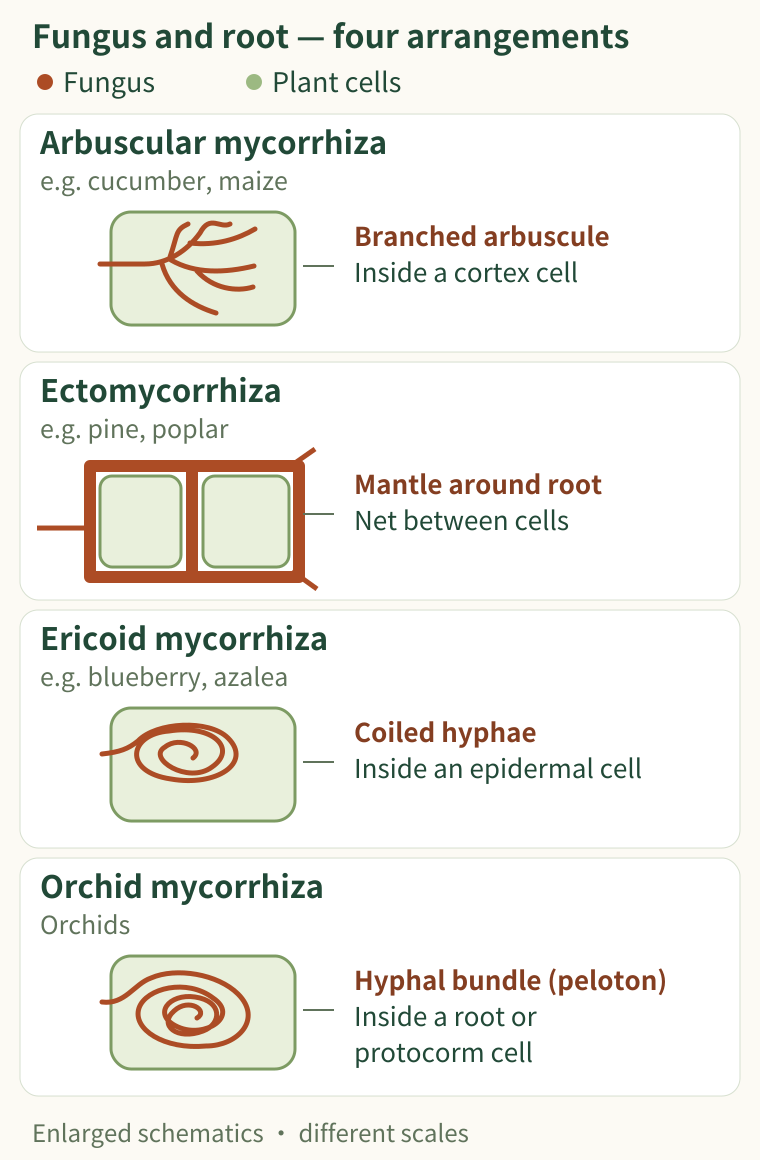
The fine threads that make up a fungus are called hyphae. Beyond the root, they can spread through the soil. Where they meet the plant, they form different structures. In the diagram, follow the orange threads to see whether they grow within plant cells or in the spaces between them.
Arbuscular mycorrhizae: branches inside root cells
Many plants, including cucumbers and maize, can form arbuscular mycorrhizae. Hyphae reach the root cortex, a region of tissue beneath the root surface. Inside some of its cells, the fungus branches repeatedly into little tree-shaped structures called arbuscules. The branches create a large surface where the plant can receive nutrients from the fungus.
The name arbuscular comes from these structures. An arbuscular mycorrhiza is the association itself. An arbuscular mycorrhizal fungus is the fungal partner.
Ectomycorrhizae: a sheath and a net between cells
Trees such as pines and poplars often form ectomycorrhizae. The fungus makes a sheath, or mantle, around the fine root. Some hyphae grow in the spaces between the root’s outer cells, forming the Hartig net. This is the exchange surface where the fungus can supply nutrients such as nitrogen and phosphorus.
Ericoid mycorrhizae: coils in the finest roots
Members of the heath family, including azaleas and blueberries, can form ericoid mycorrhizae. The fungus coils inside cells in the outermost layer of very fine roots. These plants often grow in acidic soils rich in organic matter. Some fungi in this group can get nitrogen from organic material and supply it to the plant.
These very fine roots are sometimes called hair roots. Each is a whole root, whereas a root hair is a tiny extension of a single surface cell.
Orchid mycorrhizae: bundles of coiled hyphae
An orchid’s fungal partner can form a bundle of coils called a peloton inside a root cell or a cell of the protocorm, the small structure that develops from a germinating orchid seed. As tiny orchid seeds germinate in the wild, their fungal partners supply carbon and other resources.
Once an orchid has green leaves, the direction of carbon flow varies with the species and its stage of growth. Some orchids keep receiving carbon from fungi, and some can send their fungal partners carbon captured by photosynthesis. Follow those early stages in how orchid seeds grow into seedlings.
What can fungi help a plant get?
Phosphorus is an element that plants need. Phosphate is an important form in which plants and fungi take it up from soil. Fungi can also tap into various nitrogen sources, including ammonium, nitrate and certain organic compounds. The forms they can use depend on the fungus.
- Phosphorus. Hyphae can reach soil farther from the root, take up phosphate and carry phosphorus back. This route is especially useful because phosphate moves slowly through soil.
- Nitrogen. Experiments show that arbuscular mycorrhizal fungi can carry nitrogen to plants. Some ectomycorrhizal and ericoid fungi can also use organic sources of nitrogen, such as amino acids or small fragments of proteins. This ability varies among fungi.
- Micronutrients. Researchers have tracked labeled zinc as it traveled through fungal threads to plants with arbuscular mycorrhizae. The amount of any element a plant receives depends on the soil and the partners involved.
- Water. In a particular experiment, water reached the plant along the hyphae of an arbuscular mycorrhizal fungus. How much water a plant gains this way, and whether it affects growth, depend on water availability and the condition of the roots and fungus.
Plants use nitrogen to make proteins and phosphorus to build cell membranes and transfer energy. See which mineral nutrients plants need for more examples.
A closer look at the exchange around an arbuscule
Roots take up phosphate dissolved in soil water. Because phosphate moves slowly through soil, the supply right next to a root can run low while more remains available farther away. Hyphae outside the root extend the area the plant can draw from, carrying phosphorus from that soil back into the root.
When the fungus branches into an arbuscule within a root cortex cell, a membrane made by the plant wraps around the little branches. This is the exchange surface. The fungus releases phosphate, and transport proteins in the plant membrane move it into the plant cell.
ARBUSCULAR MYCORRHIZA · FOLLOW THE EXCHANGE
The fungus brings phosphorus. The plant supplies carbon.
Use the blue and purple buttons to show or hide each direction. Blue dots illustrate phosphate transfer; the purple dashed arrow shows only the direction of carbon supply, as sugars and lipids follow different routes. Resources can move both ways at once. Phosphorus can change form inside hyphae. Speed, size and membrane spacing are illustrative.
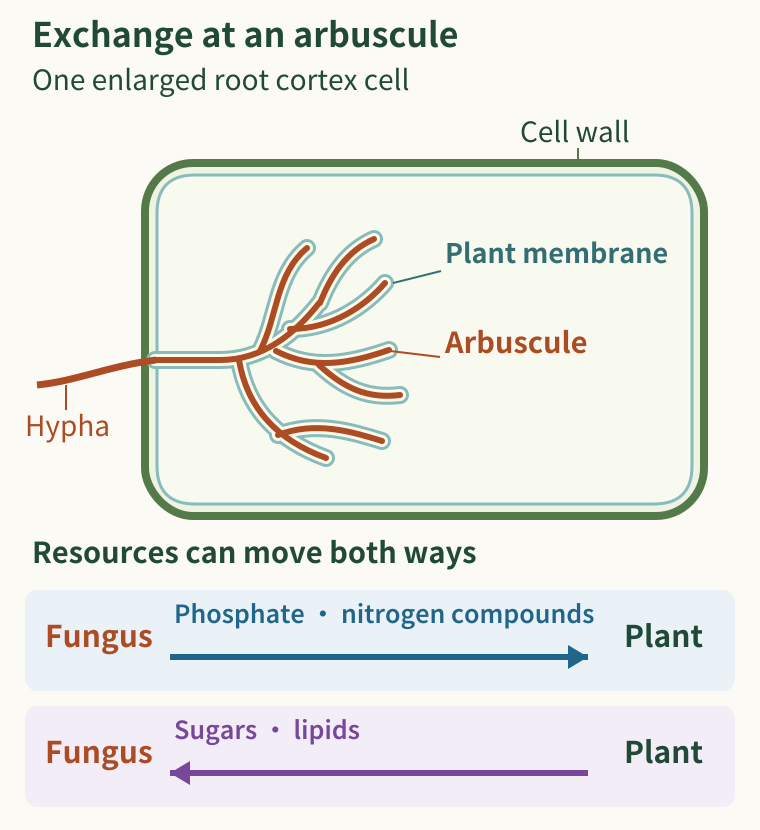
The fungus receives organic carbon, the carbon in compounds such as sugars and lipids. Leaves make sugars through photosynthesis, and the plant sends some of these products to its roots. The plant supplies the fungus with sugars and with lipids it makes.
In an experiment with container-grown cucumbers, researchers put labeled phosphate in a soil compartment only the hyphae could reach. They also gave the leaves labeled carbon dioxide. Tracking both labels showed phosphorus traveling to the plant through the hyphae and carbon captured by the leaves reaching the fungus.
What can you tell when you repot a plant?
White threads in potting mix are hard to identify by appearance alone. To see whether a fungus has formed a mycorrhiza, researchers usually need to examine the structures where fungus and plant meet, such as an arbuscule, a peloton or a Hartig net under a microscope.
Common confusions
- ✕A mycorrhiza is a type of fungus.
- ✓A mycorrhiza is an association between plant roots and fungi. The fungal partners are called mycorrhizal fungi.
- ✕An arbuscule inside a root cell directly touches the plant cell’s cytoplasm.
- ✓The plant membrane wraps around the arbuscule, separating the fungus from the plant cell’s cytoplasm.
- ✕White threads in soil or bumps on roots are enough to identify a mycorrhiza.
- ✓These are only clues. Identifying a mycorrhiza requires examining the structures where the fungus meets the root. Legume root nodules form with bacteria.
- ✕Carbon always moves from the plant to the fungus.
- ✓Orchids germinating in nature can receive carbon from compatible fungi. After orchids develop green leaves, the direction of carbon transfer varies with the species and stage of growth.
Frequently Asked Questions
Are all mycorrhizae arbuscular?
Mycorrhizae take several forms. Arbuscular mycorrhizae, ectomycorrhizae, ericoid mycorrhizae and orchid mycorrhizae are four common examples. They vary in which structures they form and which plants they commonly associate with.
Do mycorrhizal fungi only take up phosphate?
They can also take up nitrogen and some micronutrients. In some conditions, fungi can help a plant obtain water. Which resources they can supply, and how much, depends on the fungus, the plant and the environment.
Do all plants form mycorrhizae?
Many plants can form mycorrhizae. Some plants, including thale cress (Arabidopsis thaliana), generally do not form typical arbuscular mycorrhizae. For a partnership to develop, a compatible fungus and plant also need to meet under suitable conditions.
Does a plant with mycorrhizae always grow faster?
In experiments, some plants grew at much the same rate over the short term even when the fungus delivered a substantial share of their phosphorus. The outcome depends on the plant’s existing nutrient supply, which fungus it pairs with, the cost of supplying carbon and any other limits on growth.
Evidence and attribution
Sources and image rights
These sources were used to check the plant-science concepts and gardening context in this article.
View sources and further reading (17)
- pmc.ncbi.nlm.nih.gov — PMC151226
- pmc.ncbi.nlm.nih.gov — PMC5559270
- pmc.ncbi.nlm.nih.gov — PMC1540331
- pmc.ncbi.nlm.nih.gov — PMC2785963
- pmc.ncbi.nlm.nih.gov — PMC4102449
- doi.org — nph.12700
- genetik.uni-hannover.de — legume symbioses
- doi.org — j.1469 8137.1993.tb03839.x
- ask.ifas.ufl.edu — PP387.pdf
- nph.onlinelibrary.wiley.com — j.1469 8137.2005.01536.x
- link.springer.com — s12870 019 1741 y
- nph.onlinelibrary.wiley.com — nph.18281
- link.springer.com — s13007 020 00645 x
- nph.onlinelibrary.wiley.com — j.1469 8137.2008.02678.x
- nph.onlinelibrary.wiley.com — j.1469 8137.1989.tb00308.x
- nph.onlinelibrary.wiley.com — j.1469 8137.2006.01767.x
- nph.onlinelibrary.wiley.com — j.1469 8137.2001.00014.x
Image sources and rights
- Arbuscular exchange — Plant Note original · Created by Plant Note; no third-party image license applies — Created in SVG and served in its original format.
- Four mycorrhizal types — Plant Note original · Created by Plant Note; no third-party image license applies — Created in SVG and served in its original format.