
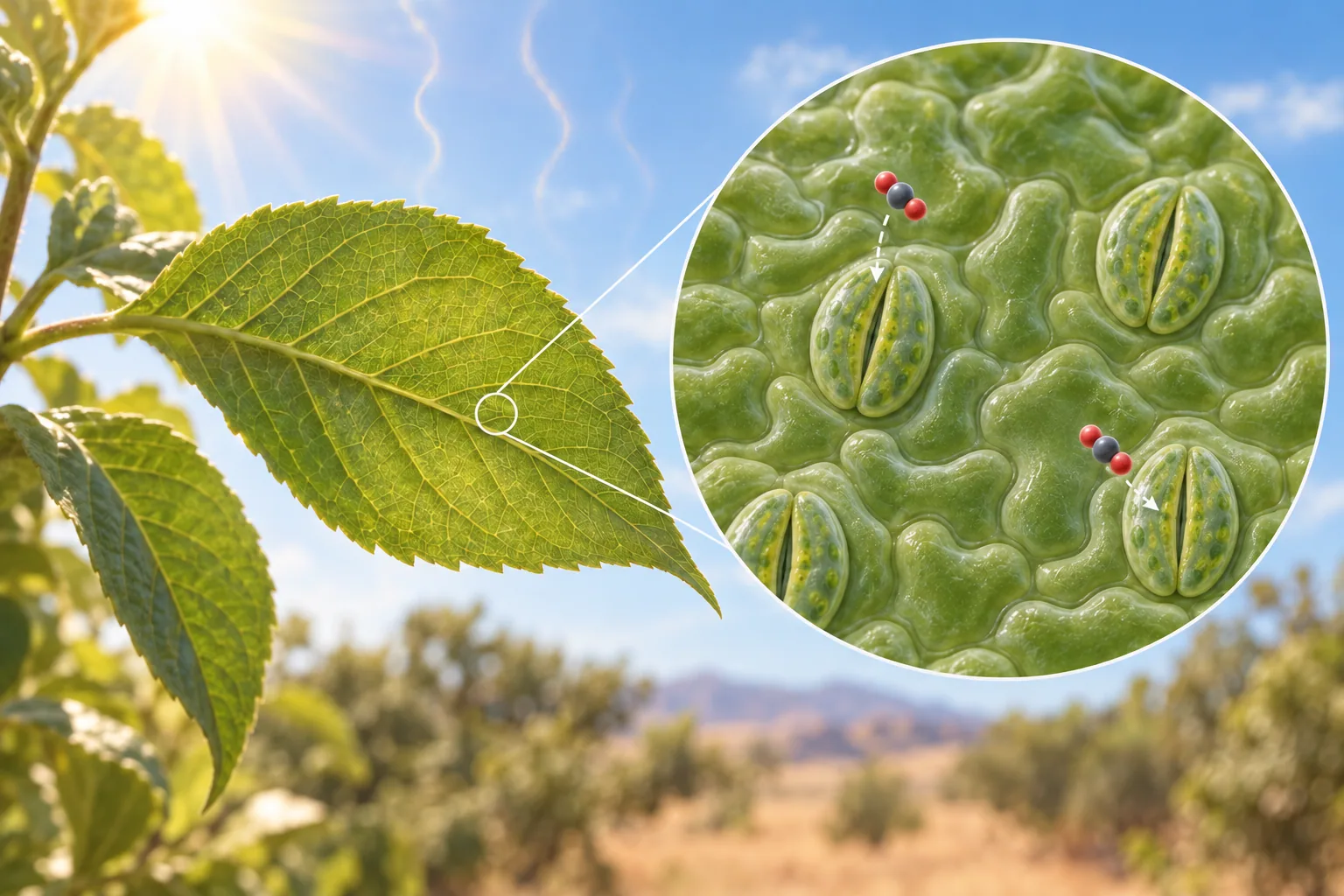
The short answer is that photorespiration happens because Rubisco cannot perfectly distinguish CO₂ from O₂. When it reacts with O₂, it produces 2-PG, which needs a separate processing route. From the perspective of net carbon assimilation and energy use in C3 plants, photorespiration is usually a cost and its overall effect is generally negative. It uses ATP and reducing power and releases some carbon as CO₂.
That does not make the salvage pathway useless. Once Rubisco has reacted with oxygen and produced 2-phosphoglycolate (2-PG), the plant must prevent this molecule from building up and disrupting photosynthesis. Photorespiration is a necessary cleanup and salvage route once oxygenation has produced 2-PG: it clears the molecule and recovers some of its carbon. It may also contribute to protection in some settings, but those benefits vary with species and conditions and do not make photorespiration universally advantageous.
Why does photorespiration happen?
Photorespiration is not a deliberate choice by the plant to waste energy. It follows from a limitation of Rubisco. Both CO₂ and O₂ are present inside a leaf, and Rubisco’s active site cannot distinguish them perfectly. When O₂ enters the reaction instead of CO₂, the products trigger the photorespiratory salvage pathway. The relative supply of the two gases around Rubisco, along with temperature and other conditions, shifts the chance of each reaction.
Rubisco is the enzyme that catalyzes carbon fixation in the Calvin–Benson cycle. It attaches either carbon dioxide or oxygen to RuBP, a carbon-accepting molecule that the cycle continually regenerates. In the carboxylation reaction, RuBP plus CO₂ produces two molecules of 3-phosphoglycerate (3-PGA). In the oxygenation reaction, RuBP plus O₂ produces one 3-PGA and one 2-PG.
Rubisco does not perfectly distinguish the two gases. The 3-PGA from either reaction can enter the carbon cycle, but 2-PG needs a separate route. If it builds up, it can interfere with photosynthetic metabolism, so the plant processes it rather than letting it accumulate.
How is 2-PG processed and returned to the cycle?
The salvage route passes between three cell compartments: the chloroplast, peroxisome, and mitochondrion. Think of it as a relay across the cell. The diagram shows the main carbon flow, while leaving out many reaction steps.
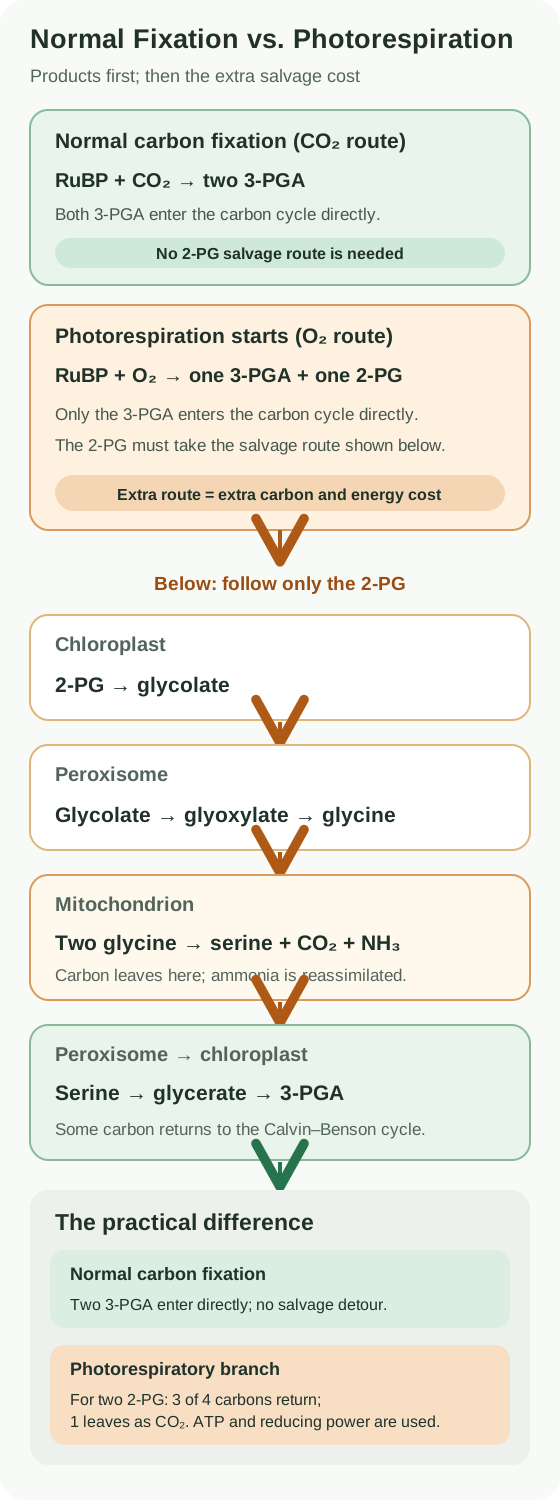
In the chloroplast, 2-PG is converted to glycolate. In the peroxisome, glycolate is processed into glyoxylate and then glycine. Reactions in the mitochondrion convert two glycine molecules into serine, releasing carbon dioxide and ammonia; the ammonia is later reassimilated. Serine returns to the peroxisome and is converted through hydroxypyruvate to glycerate. Back in the chloroplast, glycerate becomes 3-PGA and can rejoin the Calvin–Benson cycle.
The carbon does not all make it back. As a simplified count, two molecules of 2-PG contain four carbon atoms: three can return in 3-PGA, while one leaves this pathway as CO₂. This describes typical reaction bookkeeping, not a fixed net carbon loss for every leaf or environment. Some of the released CO₂ may be refixed by nearby photosynthetic reactions.
Processing 2-PG also takes resources, including ATP and reducing power. Photorespiration therefore has an energy and carbon cost, while also clearing a by-product that can disrupt photosynthetic metabolism. Calling it “completely wasteful” misses that salvage role. Researchers have also found links between photorespiration and other metabolic pathways; whether it provides a protective benefit depends on the context and remains an active area of study.
Why can photorespiration increase in heat or drought?
Temperature changes how selectively Rubisco reacts with CO₂ versus O₂. It also changes how readily each gas dissolves in the watery environment inside a leaf. Under common conditions, warming can increase the relative opportunity for Rubisco oxygenation in many C3 plants.
During water shortage, a plant may reduce stomatal opening to limit water loss. Smaller openings also restrict carbon dioxide entry. With less CO₂ around Rubisco, oxygenation becomes more likely relative to carboxylation. Temperature, stomatal behavior, species, and other growing conditions all matter, so hot or dry weather does not mean photorespiration always increases by the same amount. To learn how gases move into and out of leaves, see how diffusion and osmosis work in plants.
This is also why leaf appearance cannot reveal a photorespiration rate. Wilting, leaf-edge browning, or yellowing can arise under many water, temperature, or other environmental stresses. Those signs alone cannot show whether photorespiration has increased or measure its activity.
Can C4 and CAM plants reduce photorespiration?
C4 and CAM plants use different CO₂-concentrating strategies that raise carbon dioxide near Rubisco and reduce the chance of its oxygenation reaction. C4 plants separate initial carbon capture from the cells where Rubisco operates. CAM plants commonly take up CO₂ at night and release it for use during the day. These strategies reduce the opportunity for photorespiration to start; they do not guarantee that it is entirely absent. Many familiar trees, rice, and wheat are C3 plants; maize and sugarcane use C4 photosynthesis; cacti and agaves are familiar CAM examples.
For a fuller comparison of these strategies, read how C3, C4, and CAM plants differ. For the wider context of Rubisco and the carbon cycle, see what photosynthesis is.
Is photorespiration the same as cellular respiration?
No. Photorespiration starts when Rubisco oxygenates RuBP during photosynthesis. Its central task is to process 2-PG and recover some carbon. Cellular respiration is a separate pathway that breaks down organic molecules and transfers energy. Photorespiration uses reactions in the mitochondrion, but passing through that organelle does not make it cellular respiration.
A leaf can carry out photosynthesis, photorespiration, and cellular respiration at the same time. A change in CO₂ entering or leaving a leaf therefore cannot, by itself, distinguish their separate contributions. For more on the other pathway, read how plants carry out cellular respiration.
Frequently asked questions
Is photorespiration reabsorbing carbon that was already fixed?
Not as a whole packet of newly absorbed CO₂. The pathway begins after Rubisco adds O₂ to RuBP, and it recovers some of the carbon in the resulting 2-PG. Some carbon leaves the route as CO₂.
What is photorespiration useful for?
It converts 2-PG into molecules that can rejoin the photosynthetic carbon cycle and prevents this by-product from continually interfering with photosynthetic metabolism. That work costs energy and releases some carbon. Photorespiration is connected to other metabolism, too, but any protective benefit depends on the plant and conditions; it should not be treated as a universal outcome.
Do C4 or CAM plants have no photorespiration at all?
That is too absolute. Their CO₂-concentrating strategies generally make oxygenation less likely near Rubisco, but the actual balance varies with the species and conditions.
Why can heat or water shortage make photorespiration more likely?
Warming changes Rubisco’s relative reactions with CO₂ and O₂. When water shortage leads to reduced stomatal opening, less CO₂ may reach the leaf interior. Both can shift the conditions around Rubisco, with effects that vary across plants and environments.
Can I tell from a leaf whether photorespiration has increased?
No. Wilting, yellowing, or dry leaf edges have many possible causes. Photorespiration rates are studied with gas-exchange measurements or analysis of related metabolism, not diagnosed from appearance alone.
Key terms
- Rubisco: An enzyme that catalyzes both carbon-fixation and oxygenation reactions.
- RuBP: Ribulose-1,5-bisphosphate, the carbon-accepting molecule used in Rubisco’s reactions.
- 2-PG: 2-phosphoglycolate, the by-product of Rubisco oxygenation that needs further processing.
- 3-PGA: 3-phosphoglycerate, a molecule that can enter the Calvin–Benson cycle.
- Photorespiration: A pathway initiated by Rubisco oxygenation that processes 2-PG across several cell compartments.
- Stomata: Small openings on a leaf surface that affect carbon dioxide entry and water-vapor loss.
- Photosynthetic carbon oxidation cycle: Another name used for the photorespiratory pathway.
Related reading
Evidence and attribution
Sources and image rights
These sources were used to check the plant-science concepts and gardening context in this article.
View sources and further reading (7)
- pmc.ncbi.nlm.nih.gov — PMC3244903
- pmc.ncbi.nlm.nih.gov — PMC1182478
- pubmed.ncbi.nlm.nih.gov — 36566670
- pmc.ncbi.nlm.nih.gov — PMC349467
- extension.arizona.edu — drought and extreme heat plant responses and landscape maintenance practices
- pubmed.ncbi.nlm.nih.gov — 41784799
- doi.org — j.1365 3040.2007.01682.x
Image sources and rights
- Plant Note project-made image · Created by Plant Note; no third-party image license applies — Created in SVG and served in its original format.
- Plant Note project-made image · Created by Plant Note; no third-party image license applies — The project-made SVG was adapted as WebP for delivery.
- Plant Note project-made image · Created by Plant Note; no third-party image license applies — The project-made SVG was adapted as PNG for delivery.