
First ask whether the plant normally grows roots in the air
Aerial roots are roots that grow in the air or outside the usual soil or potting media. They are not automatically abnormal. In different plants, aerial roots may help with water uptake, attachment, climbing, or support.
When people see roots growing out of a pot, they often worry that the plant is in trouble. Sometimes it may be worth checking the growing conditions, but exposed roots are not always a problem. Some plants naturally produce roots in the air.
An aerial root is still a root. Its growing position is different from the soil roots most people expect. It may attach to bark, grow from a stem node, hang downward from a branch, or eventually touch the ground and become a support structure. The first question is not “Should I cut it?” It is “What plant is this, and what do its aerial roots usually do?”
Aerial roots do not all have the same function
Different plants use aerial roots in very different ways.
Phalaenopsis orchids are a familiar example. Many Phalaenopsis orchids are epiphytes in nature, so their roots should not be imagined as a dense root system in ordinary garden soil. Their roots are often thick and fleshy. The outer velamen layer can help absorb and temporarily hold water, and the roots can attach to bark or airy potting media. For a closer look at why orchid roots can appear green, silver, or white, see Why Are Orchid Roots Green or White?.
Climbing plants such as monstera and pothos often produce aerial roots near nodes. These roots often help the plant grip trunks, walls, poles, or other support surfaces. Ficus and related trees may produce downward aerial roots that thicken after touching the ground and become support roots.
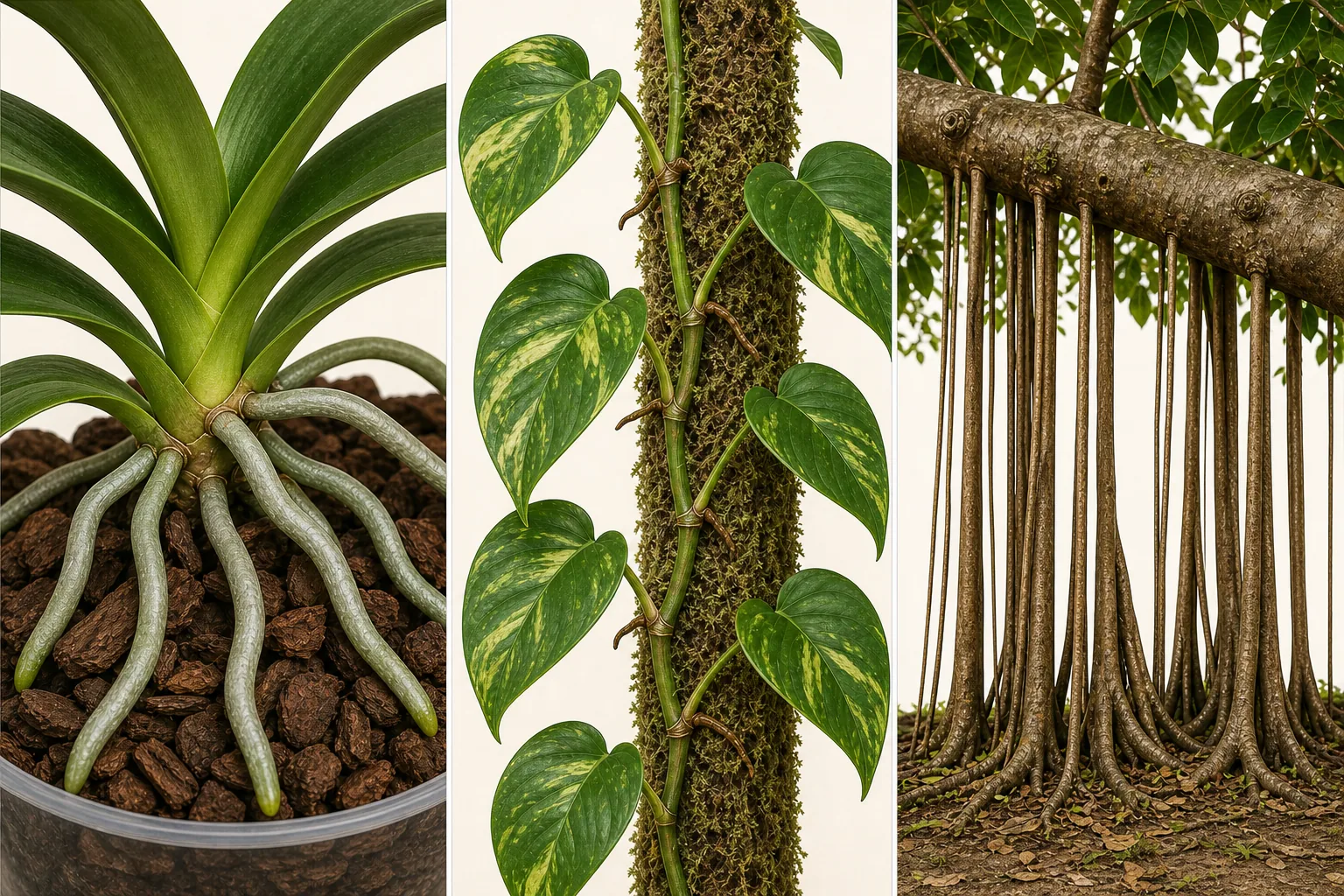
In potted plants, treat aerial roots as observation clues
Phalaenopsis roots growing outside the pot are often normal. They do not automatically mean the plant is thirsty, and they do not automatically need to be cut. A better observation is whether the roots are firm or shriveled, whether there is obvious rot or injury, and whether the potting media is too dense, too wet, or too dry. These are observation directions, not a single diagnosis.
Monstera or pothos roots growing from nodes are also common. If there is a pole, bark board, or other surface nearby, the roots may grow toward it and help the plant climb.
Aerial roots remind us that plants do not only interact with soil. Roots can interact with air, bark, surfaces, humidity, and support structures. The details depend on the plant.
Common confusions
- ✕ A plant makes aerial roots only when it lacks water.
- ✓ Aerial roots may be part of the plant’s normal life style, climbing behavior, or support system.
- ✕ All aerial roots can be cut off without concern.
- ✓ Different aerial roots have different functions. Their role should be understood before trimming.
- ✕ Aerial roots can absorb unlimited water from dry air.
- ✓ Some aerial roots can use rain, mist, humid surfaces, or surface water, but dry air is not an unlimited water source.
- ✕ Every exposed root is the same kind of root.
- ✓ Exposed roots on orchids, climbing plants, and support-root trees should be understood separately.
Frequently Asked Questions
Should I cut off Phalaenopsis roots growing outside the pot?
Do not cut them only because they are outside the pot. Phalaenopsis orchids commonly have exposed roots. Whether any root needs attention depends on whether it is shriveled, rotten, injured, and how the whole plant and potting media look.
Can aerial roots absorb water?
Some can, but it depends on the plant and environment. Roots of epiphytic orchids can use rain, mist, or moist surfaces. Aerial roots of many climbing plants are more strongly related to attachment and support.
Are aerial roots normal on monstera and pothos?
Yes, they are common. These are climbing foliage plants, and roots near the nodes can help the plant attach to a support.
If an aerial root dries out, is the plant dying?
Not necessarily. One dry aerial root does not mean the whole plant is dying. Look at leaves, new roots, potting media moisture, the overall root system, and recent environmental changes.
Can I push aerial roots into soil or potting media?
Some aerial roots may continue growing after contacting media, but that does not mean every aerial root should be forced into soil. Orchid roots, for example, need air around them; placing them in unsuitable dense media may be harmful.
Read Next
Evidence
References
These sources were used to check the plant-science concepts and gardening context in this article.