Think of root hairs as tiny absorbing contact surfaces
Root hairs are tiny structures that extend from the root surface. They increase the contact area between roots and the surrounding soil or potting media, helping the plant absorb water and dissolved mineral nutrients.
If a root is like a hand reaching into the soil, root hairs are like very fine fuzz on that hand. They are not separate little roots. They are small outward extensions from cells on the root surface.
The important point is not that root hairs “become new roots.” Their main role is to make the contact between the root and the surrounding environment much finer. Water and dissolved minerals often sit in small spaces between soil or media particles. Root hairs can reach into some of those small spaces and increase the plant’s chance of contacting water.
Root hairs form behind the root tip, not along every part of every root
The very front of a growing root has protective tissue. Behind that, cells divide and elongate so the root can keep growing forward. Farther back, cells mature, and some root surface cells grow outward to form root hairs. This region is often an active absorbing zone.
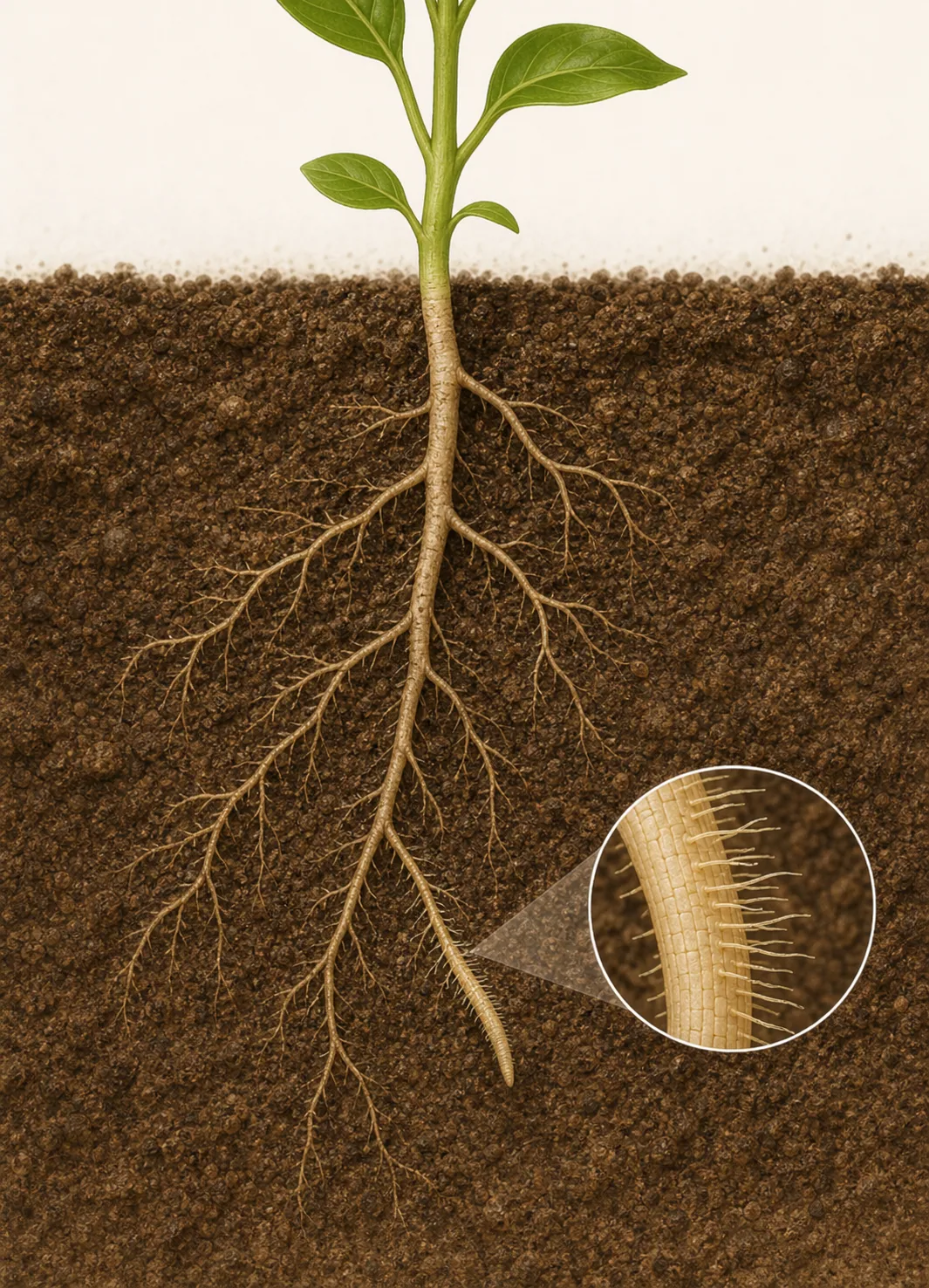
Root hairs are thin and numerous, so they greatly increase the surface area of a root segment. More surface area means more contact with water and dissolved mineral nutrients. At the same time, root hairs are delicate and can be disturbed by drying, rubbing, washing, or transplanting.
Do not confuse root hairs, fine roots, and lateral roots
The small roots you can see with the naked eye are usually still roots. They may continue to grow, branch, thicken, or produce their own root hairs.
Lateral roots are true root branches that grow from a main root or another root. They can lengthen, thicken, and branch again.
Root hairs are much smaller. Their main role is to increase contact between the root surface and the nearby environment.
Because of this, a white thread in potting media should not immediately be called a root hair. It may be a fine root, fungal hypha, media fiber, or another small structure. Root hairs are usually best confirmed at close range or with magnification.
Why gentle root handling matters during transplanting
When a plant is repotted, transplanted, or its roots are washed, fine roots, root tips, and root hair zones can be disturbed. This does not mean the plant will definitely die, and it does not mean fertilizer or treatment is automatically needed.
A safer way to understand the situation is this: after roots are disturbed, water and mineral uptake may be temporarily less stable. It is more useful to observe media moisture, light, airflow, and new root growth than to rush to a diagnosis.
The idea of root hairs helps us understand why large roots are not the whole story. Many small, active contact surfaces are important for everyday water uptake.
Common confusions
- ✕ Root hairs are very thin roots.
- ✓ Root hairs are extensions of root surface cells, not separate new roots.
- ✕ Every white thread in potting media is a root hair.
- ✓ Visible white threads may be fine roots, fungal hyphae, media fibers, or other structures.
- ✕ If root hairs are damaged, the plant will definitely die.
- ✓ Root hairs are renewed over time. The impact depends on plant type, root condition, and environment.
- ✕ Root hairs grow evenly on the entire root system.
- ✓ They are most commonly associated with certain active zones behind growing root tips.
Frequently Asked Questions
Are root hairs roots?
They are part of a root, but they are not independent new roots. A root hair is a tiny extension from a root epidermal cell.
Can you see root hairs with the naked eye?
Often not clearly. Root hairs are very small and usually require close observation or magnification. The fine roots you can see easily are not necessarily root hairs.
What is the difference between a root hair and a lateral root?
A lateral root is a real root branch that grows from another root and can keep growing. A root hair is a much smaller cell extension that mainly increases surface contact.
Why do root hairs help plants absorb water?
They increase the root’s surface area and help the root contact small spaces in soil or potting media where water and dissolved minerals are held.
If a plant looks weak after repotting, are damaged root hairs the cause?
Not necessarily. Repotting stress may involve disturbed roots, moisture changes, light changes, temperature, airflow, or plant condition. Root hair disturbance is one possible factor, not a complete diagnosis.
Read Next
Evidence
References
These sources were used to check the plant-science concepts and gardening context in this article.