
Start by thinking of roots as anchors and water-absorbing organs
Roots help a plant hold on to the ground, absorb water, absorb mineral nutrients, and in some plants store resources.
A root system is better pictured as both a branching contact network and an anchor, rather than as a single drinking straw.
As roots spread through soil or potting media, they hold the plant in place and create many points of contact with surrounding water and mineral nutrients. Water enters across active absorbing regions of young roots and then connects to transport tissues inside the plant.
Some roots also act like storage organs. They can store water, sugars, or other resources that the plant may use later. Not every plant uses roots this way, but it is an important root function in many species.
Roots do not only absorb water; they connect to the whole plant
The main functions of roots include anchoring the plant, absorbing water, absorbing mineral nutrients, and sometimes storing resources.
Young roots produce root hairs in the mature zone just behind the growing root tip. Root hairs are tiny, but they greatly increase the contact area between roots and the surrounding soil or potting media. That larger contact area helps the plant take up water and dissolved mineral nutrients.
After water and mineral nutrients enter the root, they can move through transport tissues into the stem and leaves. Leaves then use water, carbon dioxide, and light during photosynthesis to make sugars and other organic materials.
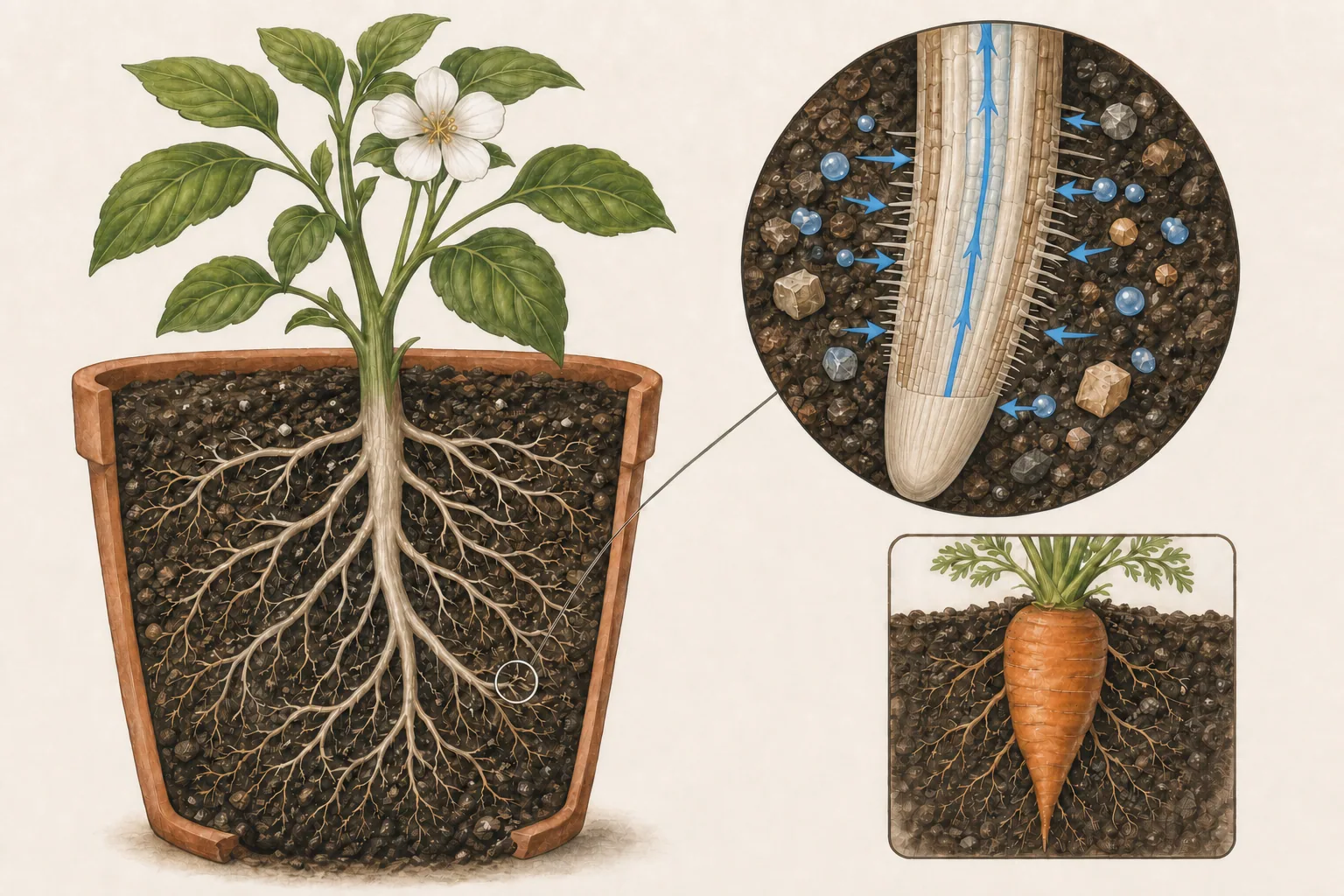
This means roots are not an isolated underground part. Root condition affects whole-plant water balance and growth.
In potted plants, look at roots and potting media together
For potted plants, root condition matters because the pot is a limited environment. The same amount of water can behave very differently depending on drainage holes, pot size, media particle size, light, season, and root density.
If potting media stays wet for too long, air spaces around the roots can become limited. Roots are living organs and their cells need oxygen. When the root zone stays wet and air-poor, roots may not work normally. A plant may look wilted even when the potting mix is wet, because damaged roots cannot take up water well.
If the pot is too small and roots fill the container, water and air conditions can also become unstable. The plant may dry quickly in some areas while older media remains compacted elsewhere.
That is why observing roots, potting media, watering behavior, and leaf changes together is more reliable than looking at leaves alone.
Common confusions
- ✕ Roots only absorb water.
- ✓ Roots also anchor the plant, absorb mineral nutrients, and in some plants store resources.
- ✕ A wilted plant is always short of water.
- ✓ Damaged roots or oxygen-poor root zones can also make a plant look wilted.
- ✕ All roots grow underground.
- ✓ Most roots grow in soil or media, but some plants produce aerial roots, such as certain climbing plants and epiphytes.
- ✕ Thick roots are always more important than fine roots.
- ✓ Fine active roots and root hairs often do much of the water and nutrient uptake work.
Frequently Asked Questions
Do roots breathe?
Yes. Root cells need oxygen for cellular respiration. This is why soil or potting media cannot remain completely airless for long periods.
Are root hairs roots?
Root hairs are part of the root surface, but they are not separate new roots. They are tiny extensions of root epidermal cells that increase the absorbing surface.
What are aerial roots?
Aerial roots are roots that grow in the air or outside the usual soil or potting media. Their function depends on the plant. Some help with attachment, some absorb water from humid surfaces, and some add support.
Can roots store nutrients?
Some roots can store water, sugars, or other resources. What is stored, and how much, varies widely among plants.
Why can a wet pot still have a wilting plant?
If roots are damaged or oxygen-starved, they may not absorb water well even when water is present. Wet media plus wilting leaves is a signal to inspect the root zone, not proof of a single cause.
Why are potting media and roots discussed together?
Roots live inside the media. The media controls how water, air, and physical support reach the root surface. Root health cannot be understood well if the media environment is ignored.
Read Next
Evidence
References
These sources were used to check the plant-science concepts and gardening context in this article.