
First decide whether the term describes shape, origin, or function
A taproot looks like a clear central root. A fibrous root system looks like many similarly sized roots forming a bundle or network. A prop root acts like a support leg growing from the stem, node, or branch toward the ground.
When you see the words taproot, fibrous root, and prop root, do not treat them as three perfectly equal categories. Ask what the term is describing: the shape of the whole root system, the place where the root comes from, or a special function.
Taproot and fibrous root usually describe root system form. A taproot system often has one stronger central root with smaller lateral roots. A fibrous root system does not have one obvious central axis; it often looks like many roots spreading out from the plant base.
Prop root is different. It emphasizes support. These roots may grow from stems, nodes, or branches, reach the ground, and become structures that help hold the plant upright.
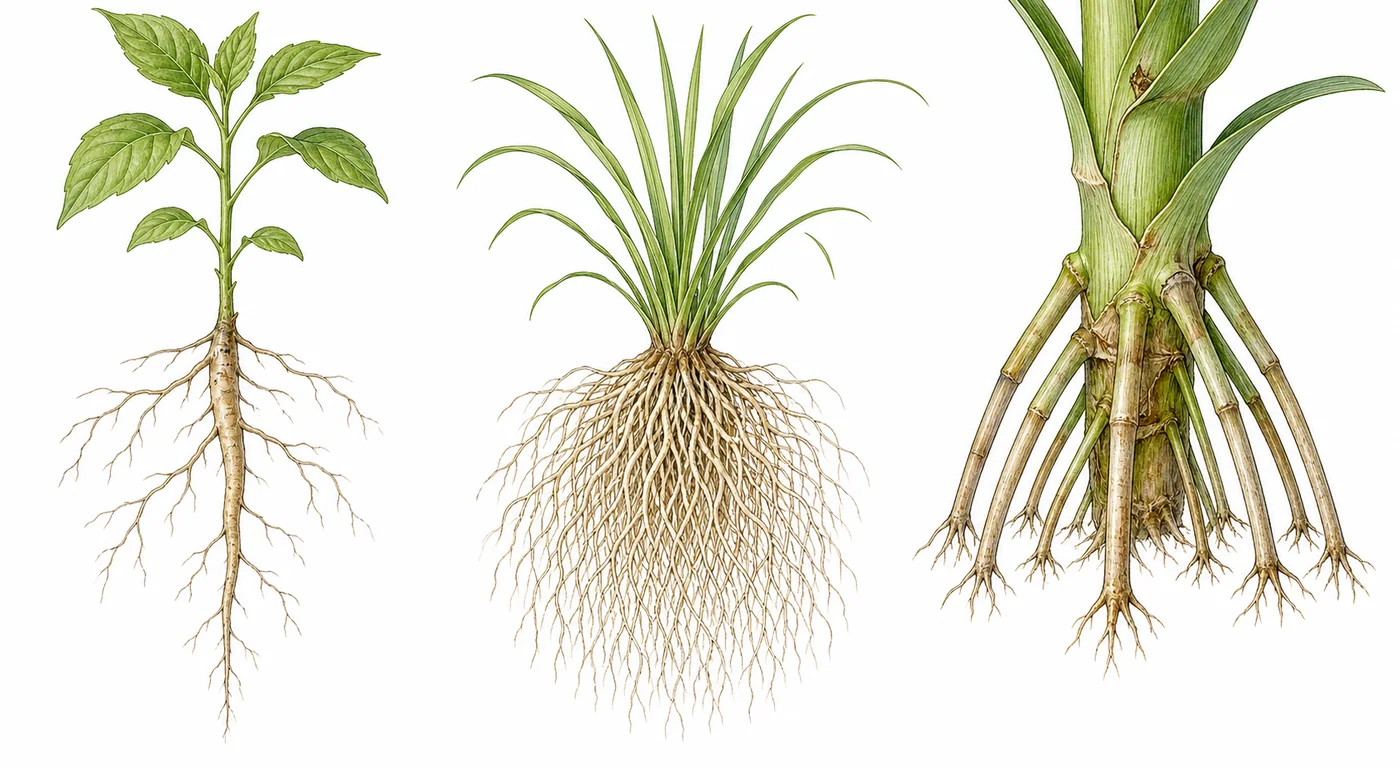
Taproots and fibrous roots describe root system form
When comparing taproots and fibrous roots, the main topic is root system pattern: what the whole root system roughly looks like.
A typical taproot system often develops from the young plant’s primary root. That root continues downward and forms a noticeable central axis. Lateral roots then branch from it. Many dicot seedlings are useful examples for this idea.
A typical fibrous root system works more like a group of roots. Many roots of similar size form near the plant base or from underground stems, and there may be no single obvious central root. Many grasses are commonly used as fibrous-root examples.
These are teaching patterns, not promises that every plant will look like a textbook diagram. Plant species, age, soil, pot size, transplanting, and root damage can all change how roots appear.
Prop roots describe support function
Prop roots need to be understood from another angle. They are often a kind of adventitious root. An adventitious root is a root that forms from a non-root location, such as a stem, node, branch, or sometimes even a leaf. This term describes where the root comes from.
When such roots grow downward, reach the ground, and help support the plant body, they may be called prop roots or support roots. In everyday terms, they are like extra support legs.
Prop roots and aerial roots can overlap, but they are not identical. Aerial root describes a root growing in the air or outside the usual soil zone. Prop root describes a root that helps support the plant. Some prop roots are aerial before they reach the ground. But not all aerial roots become prop roots, and not all aerial roots mainly function as support.
How to observe them in pots and outdoors
In pots, roots are limited by the container, so their shape may not match textbook examples. When repotting, a dense mass of thin roots may look fibrous, but the pot environment may have changed the root system. A potted root ball is a clue, not a final classification.
Seedlings can make the taproot idea easier to see. Soon after germination, many plants first produce a young root that grows downward, and later roots branch from it. But different plants grow differently, so one seedling does not represent every plant.
Prop roots are often easier to see outdoors or on larger plants. Banyan-like figs, screw pines, and corn roots near the lower stem can help explain how a root can also function as a support structure.
Phalaenopsis orchids are a useful reminder: not all roots fit neatly into a taproot-versus-fibrous-root contrast. Their exposed, fleshy roots are often better discussed through aerial roots, epiphytic life, and airy potting media.
Common confusions
- ✕ Taproot, fibrous root, and prop root are three equal categories in one classification.
- ✓ Taproot and fibrous root usually describe root system form; prop root emphasizes support function.
- ✕ A plant with a taproot is always more drought-tolerant.
- ✓ Water access and drought response depend on species, soil, pot conditions, root activity, and environment.
- ✕ Prop roots only support and never absorb water.
- ✓ Many roots can have more than one function. The name prop root simply highlights support.
- ✕ Every aerial root is a prop root.
- ✓ Some aerial roots may become support roots, but many aerial roots are mainly for attachment or water use in humid conditions.
Frequently Asked Questions
Which absorbs water better, taproots or fibrous roots?
You cannot decide from that label alone. Water uptake depends on active root tips, fine roots, root hairs, media moisture, aeration, and plant species. Taproot and fibrous root are root system patterns, not simple performance scores.
Is a prop root an aerial root?
Sometimes there is overlap. A prop root may hang in the air before it reaches the ground, so it may also be an aerial root for part of its development. But not every aerial root becomes a prop root.
Why do some plants not show an obvious taproot?
In some plants, the early primary root becomes less dominant, and many adventitious or fibrous roots become the main root system. Pot culture can also twist roots together and hide the original pattern.
Can you tell taproot versus fibrous root from a potted root ball?
Sometimes you can see a general direction, but often it is difficult. Pots limit root direction, and transplanting or root pruning can change root shape. Treat pot observations as clues, not absolute classification.
Are Phalaenopsis orchid roots taproots, fibrous roots, or aerial roots?
For everyday Phalaenopsis observation, it is usually more helpful to talk about aerial roots, epiphytic roots, and airy potting media than to force them into a textbook taproot or fibrous-root category.
Can one plant have different kinds of roots?
Yes. Root terms describe different things: appearance, origin, or function. One plant can show more than one root type depending on its age, position, and environment.
Related Terms
- Taproot: a noticeable central root, often with lateral roots branching from it.
- Fibrous root system: many similarly sized roots forming a dense bundle or network.
- Prop root: a root that helps support the plant body, often growing from a stem or branch toward the ground.
- Adventitious root: a root that grows from a non-root position such as a stem, node, branch, or leaf.
- Aerial root: a root that grows in the air or outside the usual soil or media zone; its function depends on the plant.
Read Next
Evidence
References
These sources were used to check the plant-science concepts and gardening context in this article.