Leaf veins are not decorative lines
If you hold a leaf up to light, you may see a thicker midrib, side veins, and smaller vein branches. These lines are not just patterns. They are the leaf’s transport and support network.
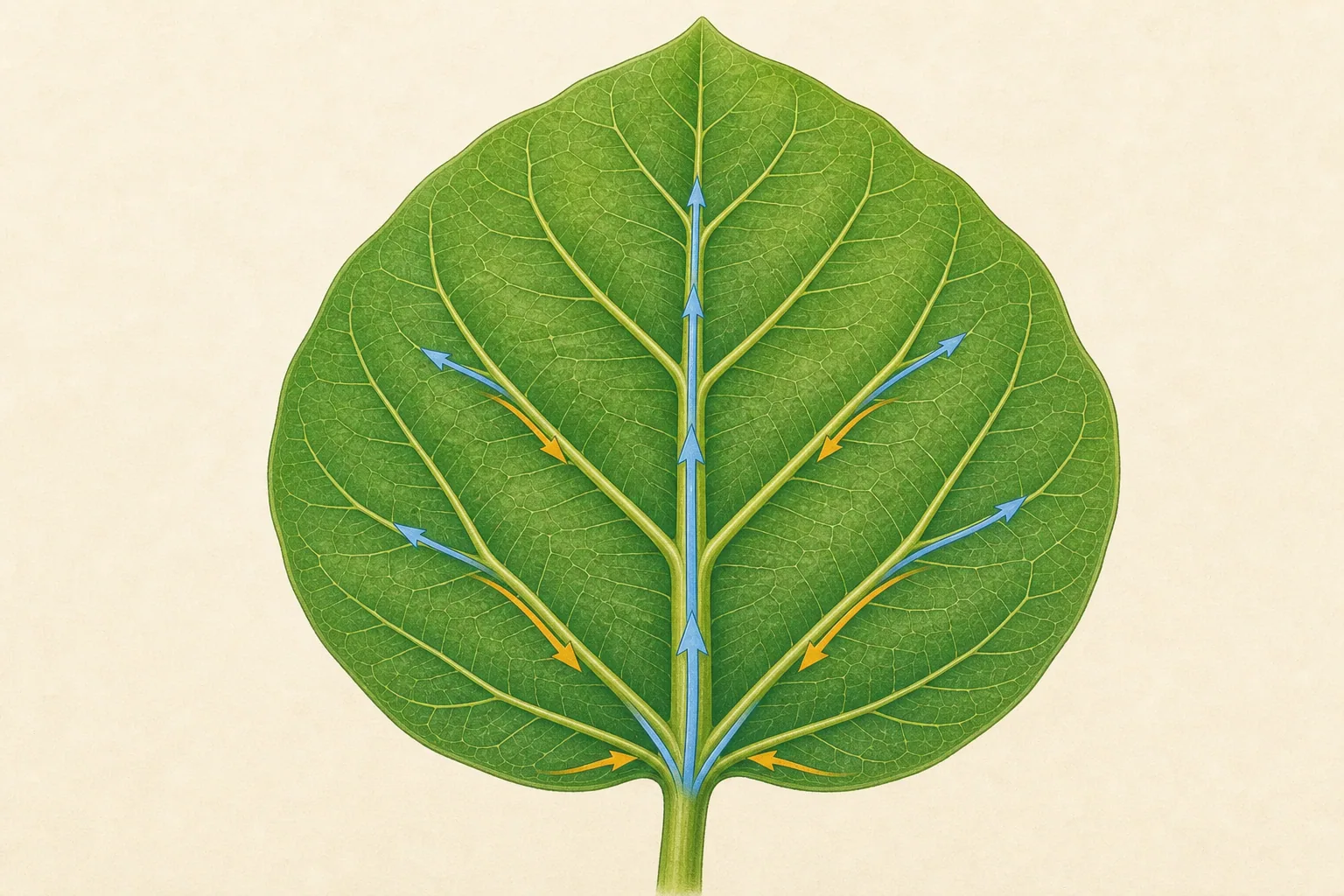
Think of leaf veins as roads inside the leaf. Water and mineral nutrients can enter the leaf through this network. Sugars and other organic materials made by photosynthesis can also move from the leaf back into the rest of the plant. Veins also act like a frame so the leaf is not just a thin unsupported film.
Leaf veins contain vascular bundles
More precisely, leaf veins are vascular bundles inside the leaf. Vascular tissues are plant transport tissues. They include xylem and phloem.
Xylem is mainly connected to water and mineral transport. Water enters through roots, moves through roots and stems, and reaches different parts of the leaf through xylem in leaf veins. Leaves need water to maintain cell condition and participate in photosynthesis.
Phloem transports sugars and other photosynthesis products made by leaves. Leaves do not keep all the materials they produce. New shoots, roots, flowers, fruits, and other growing parts may all need those materials.
Leaf veins are therefore not isolated leaf markings. They connect to vascular tissues in the stem and then to roots and other plant organs.
Veins are both transport lines and support frames
If a leaf had no support, it would be difficult to spread out to receive light. Veins help the leaf keep its shape and distribute water to areas far from the midrib.
You can think of the midrib as a large road, side veins as branching roads, and small veins as smaller paths reaching many leaf areas. Plants do not have a heart pumping blood around the body. Veins are a helpful transport analogy, but not the same as animal blood vessels.
Leaf support also depends on leaf cells, thickness, water status, and epidermal structure. Veins are one important part of the support system.
Parallel and netted venation
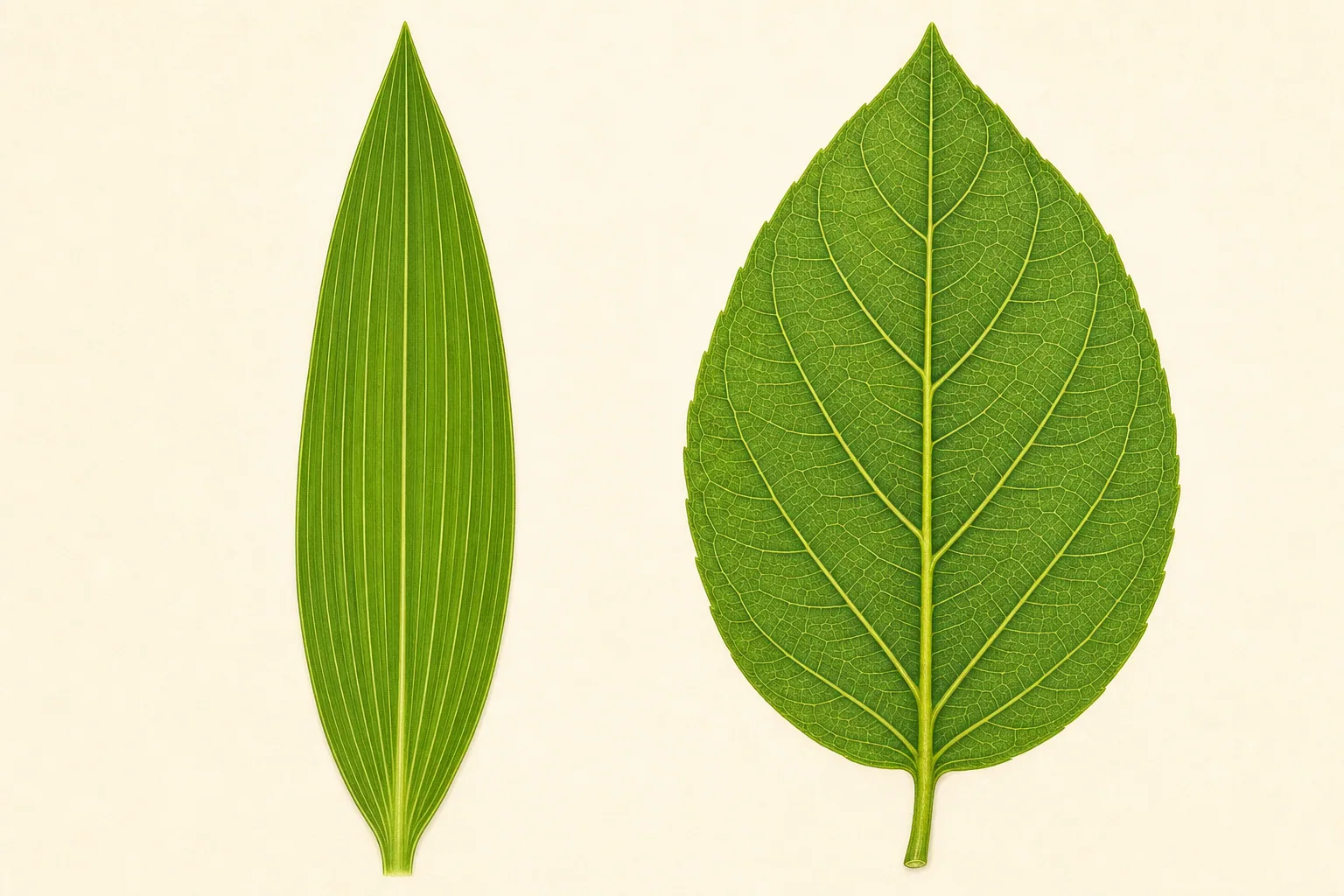
The arrangement of leaf veins is called venation. Two common patterns are parallel venation and netted venation.
Parallel venation is common in many monocots, especially grasses such as corn, rice, and bamboo. Major veins often run along the length of the leaf, looking like lines in the same direction.
Netted venation is common in many dicots. A midrib branches into side veins, which branch again into smaller veins, forming a network. Many broadleaf plants show this pattern.
Leaf venation can be a clue for plant groups, but it should not be the only clue. Monocot and dicot differences can also involve cotyledon number, flower parts, root systems, and vascular bundle arrangement in stems.
Two common vein arrangements
Common in many monocots, especially grasses such as corn, rice, and bamboo.
Common in many dicots, with a midrib, side veins, and smaller vein branches forming a network.
Veins connect to transpiration, stomata, and photosynthesis
Leaves need light, water, and carbon dioxide for photosynthesis. Carbon dioxide mostly enters through stomata. Water is delivered through roots, stems, and leaf veins. Sugars made by the leaf then move through phloem toward other plant parts.
Leaves also lose water through stomata during transpiration. As water leaves the leaf, new water must be supplied, linking leaf veins to the whole plant’s water transport pathway.
So leaf veins are not just about leaf appearance. They are an entry point for understanding photosynthesis, transpiration, water transport, and whole-plant division of labor.
Safe observation on potted plants
Choose a healthy, mature, undamaged leaf and observe it in bright but gentle light. Backlighting often makes veins clearer. Find the midrib first, then side veins, then smaller vein branches.
If leaves wilt, yellow, brown at the edge, or show strong vein color differences, do not diagnose from veins alone. Water, roots, media, light, temperature, humidity, airflow, and natural aging may all affect the leaf.
Common confusions
- ✕ Leaf veins are surface decoration.
- ✓ Leaf veins are vascular bundles involved in transport and support.
- ✕ Leaf veins are exactly like animal blood vessels.
- ✓ They help with transport, but plants do not have a heart or blood circulation.
- ✕ Thicker veins always mean a healthier leaf.
- ✓ Vein thickness depends on plant type, leaf age, and leaf form.
- ✕ Parallel and netted venation are only cosmetic differences.
- ✓ Venation is part of leaf support and transport and can be a plant-group clue.
- ✕ Vein color changes identify a specific nutrient problem.
- ✓ Vein color is only a clue and should not become a diagnosis by itself.
Frequently Asked Questions
What are the main functions of leaf veins?
Leaf veins support the leaf, bring water and mineral nutrients into the leaf, and carry sugars and other photosynthesis products away from the leaf.
Does water really move through leaf veins?
Yes. Xylem in leaf veins is part of the pathway that moves water from roots through stems into leaves. It does not work like a powered pipe system, but it is a real transport pathway.
Are leaf veins plant blood vessels?
Not exactly. The analogy can help, but plants do not have blood or a heart. A better term is vascular bundles.
Why do some leaves have netted veins and some have parallel veins?
That difference is venation. Many dicots have netted veins, while many monocots, especially grasses, have parallel veins. It is a clue, not a complete identification rule.
How are leaf veins related to photosynthesis?
Veins bring water into the leaf, and water is one photosynthesis material. Phloem in veins also carries leaf-made sugars and other products to the rest of the plant.
Why are veins easier to see with backlighting?
Veins contain vascular and support tissues, so they differ in thickness and texture from surrounding leaf tissue. Light passing through a leaf can make those differences more visible.
Related Terms
- Leaf vein: the vascular and support network inside a leaf.
- Midrib: the main large vein of many leaves.
- Side vein: a larger branch from the midrib.
- Small vein: smaller vein branches reaching leaf areas.
- Vascular bundle: a bundle of plant transport tissues.
- Xylem: tissue mainly involved in water and mineral transport.
- Phloem: tissue mainly involved in transporting photosynthesis products.
- Venation: the arrangement of veins in a leaf.
- Parallel venation: veins running in roughly the same direction.
- Netted venation: branching veins forming a network.
Read Next
Evidence
References
These sources were used to check the plant-science concepts and gardening context in this article.