
Model of stomatal opening and closing
SolutesWater
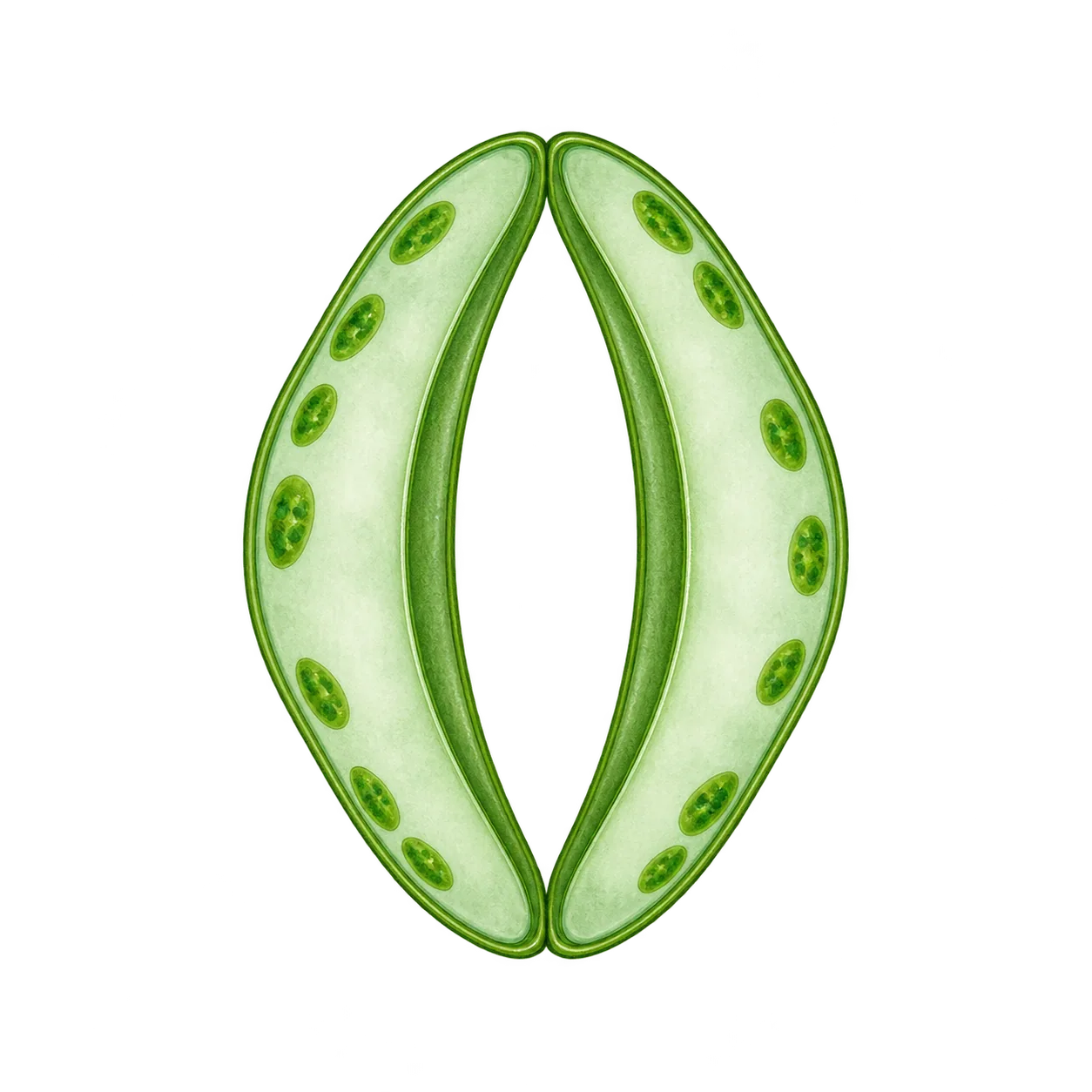
Mechanism: osmosis and guard-cell mechanics. Schematic kidney-shaped cells; dots indicate solute and water movement.
Stomata are adjustable tiny doors on leaf surfaces
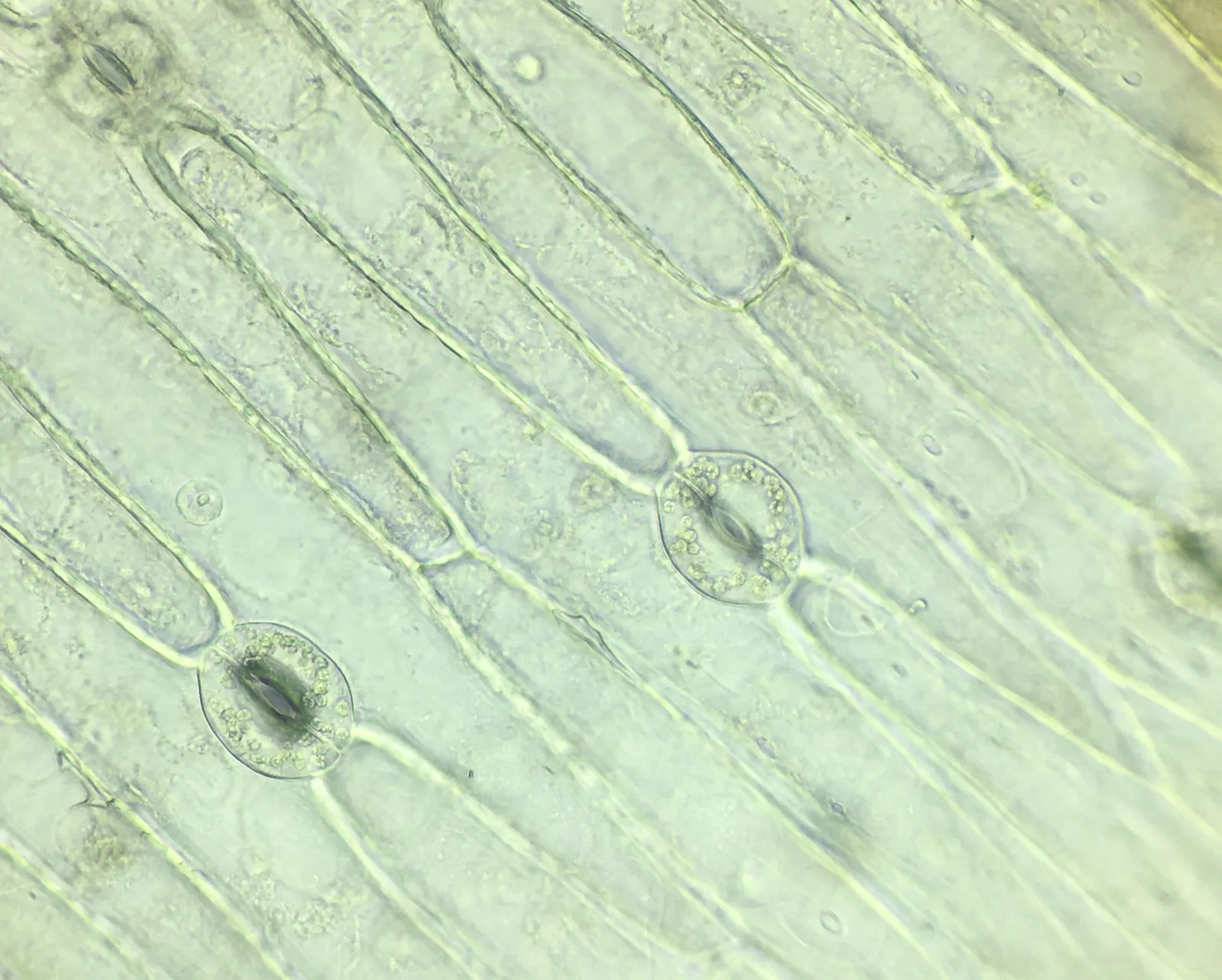
Stomata are tiny openings in the plant epidermis, most often discussed on leaves. They work like adjustable doors on the leaf surface. When the opening is wider, gases move in and out more easily. When it closes down, the plant can reduce water loss.
A typical stoma is bordered by a pair of guard cells. Water moving into and out of these cells changes their turgor—the pressure of the cell contents against the wall. As guard cells accumulate solutes, water is drawn in, changing their volume and turgor.
Cell-wall structure and fiber orientation constrain how the cells deform. In kidney-shaped guard cells, the ends resist stretching while the middle bows outward, so swelling widens the pore between them. As water leaves, the pore narrows.
Stomata let carbon dioxide enter and water vapor leave
One of the most important stomatal roles is allowing carbon dioxide into the leaf. Once inside, carbon dioxide can be used in photosynthesis as a carbon source for sugars and other organic materials.
But the same opening also allows oxygen and water vapor to leave. Oxygen produced during photosynthesis may diffuse out through stomata. Water vapor leaving leaves is a major part of transpiration.
So stomata are not simply “better when more open.” Wider openings help carbon dioxide enter, supporting photosynthesis. But they also increase water loss. Smaller openings reduce water loss but limit carbon dioxide entry. Plants constantly balance carbon gain and water conservation.
Saying plants “breathe through stomata” needs care
In everyday speech, saying that plants breathe through stomata can help beginners. More precisely, stomata are important openings for gas exchange; they are not noses or lungs.
Living plant cells carry out respiration. Respiration releases usable energy from sugars and other organic materials so cells can work. This happens in leaves, roots, stems, seeds, and growing tissues.
Stomata help leaves exchange gases with the outside. Leaf cells need oxygen for respiration and release carbon dioxide. At the same time, in daylight, leaves often carry out photosynthesis, using carbon dioxide and releasing oxygen. These processes overlap around the leaf, so it is too simple to say “plants only take in carbon dioxide during the day and oxygen at night.”
Stomata are not always in one fixed place
Many land plants have more stomata on the underside of leaves. This can reduce some water loss caused by direct exposure to strong light, heat, and dry air. But it is not an absolute rule.
Some plants have stomata on both leaf surfaces. Plants with unusual habitats or special photosynthetic pathways may have different arrangements. A safer statement is: stomata occur in leaf epidermis, often more on the underside in many land plants, but distribution varies.
In potted plants, stomata are a clue, not a diagnosis
In gardening, stomata are often connected with leaf water loss. Hot, dry, windy conditions can make water vapor leave leaves more quickly. If root water uptake cannot keep up, leaves may temporarily soften or droop.
But this is not a diagnosis formula. Drooping may relate to light, temperature, humidity, wind, roots, media, water supply, or short-term environmental change. Stomata help explain why leaves lose water, but they cannot alone diagnose what is wrong with a plant.
Common confusions
- ✕ Stomata are plant noses.
- ✓ Stomata help leaves exchange gases, but plants do not have noses or lungs.
- ✕ Stomata are only about respiration.
- ✓ Stomata connect photosynthesis, respiration, transpiration, and water balance.
- ✕ Stomata are always on the underside of leaves.
- ✓ Many land plants have more on the underside, but different plants have exceptions.
- ✕ Wider stomatal opening is always healthier.
- ✓ Wider openings help gas exchange but increase water loss.
- ✕ Drooping leaves are always caused by stomata.
- ✓ Stomata are one clue; roots, water, media, light, and environment must also be observed.
Frequently Asked Questions
Why does swelling open the pore instead of blocking it?
Guard cells do not swell equally in every direction. Their wall structure constrains deformation; in kidney-shaped cells, the ends stretch less and the middle bows outward. This pulls the pore-facing walls farther apart, widening the opening.
Are stomata plant noses?
No. Stomata can be thought of as tiny doors for gas exchange, but plants do not have noses, lungs, or animal-style breathing movements.
Are stomata only on the underside of leaves?
Not always. Many land plants have more stomata on the underside, but distribution differs by plant type and leaf environment.
If stomata close, can the plant still live?
Short-term closing can reduce water loss, but it also limits carbon dioxide entry. Plants adjust stomata as part of balancing water and gas exchange. Long-term effects depend on plant type and environment.
Do plants respire at night?
Yes. Living plant cells need energy day and night, so respiration continues. Without enough light, photosynthesis stops or decreases, but respiration continues.
Why are some succulents said to open stomata at night?
Some succulents and dry-environment plants use CAM photosynthesis. They often open stomata at night to take in carbon dioxide and close more during the day to reduce water loss. This is a special adaptation, not a rule for all plants.
Can I use stomata to tell whether a plant lacks water?
Not directly. Most readers cannot see stomata opening and closing. Treat leaf condition as a clue and observe light, media moisture, roots, temperature, humidity, and airflow together.
Related Terms
- Stoma: a tiny opening in the plant epidermis, often discussed on leaves.
- Guard cells: the pair of cells that regulate stomatal opening and closing.
- Epidermis: the outer protective tissue of plant organs.
- Photosynthesis: the process in which plants use light to make organic materials.
- Respiration: the cellular process that releases usable energy from organic materials.
- Transpiration: water vapor loss from plant surfaces into the air.
Read Next
Evidence and attribution
Sources and image rights
These sources were used to check the plant-science concepts and gardening context in this article.
View sources and further reading (10)
- pubmed.ncbi.nlm.nih.gov — 28943087
- pmc.ncbi.nlm.nih.gov — PMC10095868
- pubmed.ncbi.nlm.nih.gov — 28408539
- openstax.org — 30 4 leaves
- openstax.org — 30 5 transport of water and solutes in plants
- openstax.org — 8 1 overview of photosynthesis
- openstax.org — 8 3 using light energy to make organic molecules
- extension.oregonstate.edu — plant growth development
- extension.oregonstate.edu — environmental factors affecting plant growth
- propg.ifas.ufl.edu — 10 celltypes stomate.html
Image sources and rights
- Emilio Ermini / Wikimedia Commons · CC BY 4.0 — The source JPEG was prepared as WebP for delivery.
