Leaves do more than look green
Leaves are often the first part people notice on a plant. But a leaf is not just a green decoration. For many plants, leaves are important working surfaces for receiving light, making organic materials, exchanging gases, and losing water vapor.
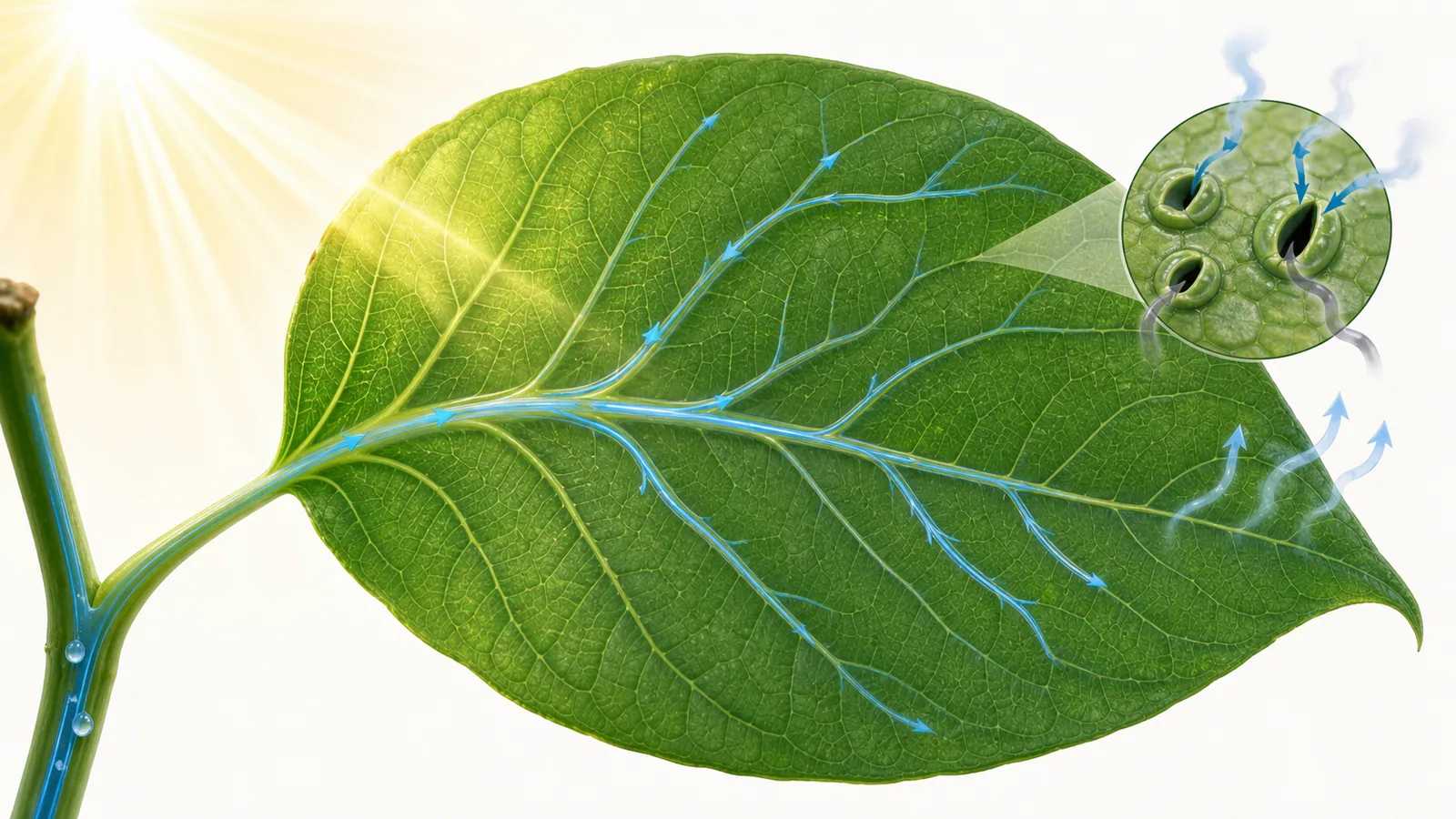
A useful first model is “a light-receiving work surface with ventilation and pipelines.” The leaf receives light and uses water plus carbon dioxide from the air during photosynthesis. Tiny openings on the surface allow gases to move in and out. Veins bring water into the leaf and connect leaf-made products back to the whole plant.
Leaves receive light and make photosynthesis possible
Photosynthesis is often summarized as this: plants use light energy to turn water and carbon dioxide into sugars and other organic materials, releasing oxygen. This does not mean leaves “eat sunlight.” It means leaves use light as energy to make usable materials.
Many leaves contain cells rich in chloroplasts. Chloroplasts are cell structures closely connected to photosynthesis. Chlorophyll is a pigment that absorbs light energy and often makes leaves look green.
The first major function of leaves, then, is to provide a place where light can be received and photosynthesis can occur. Many leaves are broad and flat because that shape helps expose surface area to light. But this is a common pattern, not a rule for every plant.
Stomata exchange gases and also let water vapor leave
Leaf surfaces have tiny openings called stomata. Guard cells around each stoma help regulate opening and closing. As a beginner model, stomata let carbon dioxide enter the leaf, while oxygen and water vapor can leave.
This creates a tradeoff. When stomata open, carbon dioxide enters more easily, which supports photosynthesis. But water vapor also leaves more easily. The loss of water vapor from plant surfaces is part of transpiration.
Many land plants have more stomata on the underside of leaves, which can reduce some direct exposure to heat and dry air. But there are exceptions, so “stomata are always on the underside” should not be treated as a rule. To compare the structures and roles of the two leaf surfaces, continue with What Is the Difference Between the Upper and Lower Surfaces of a Leaf?.
Veins are not decoration; they support and transport
Leaf veins may look like patterns, but they are not only surface decoration. Veins help support the leaf and contain vascular tissues.
Xylem in leaf veins brings water and mineral nutrients into the leaf. Phloem carries sugars and other photosynthesis products from the leaf toward stems, roots, new leaves, flowers, or other growing parts.
This is why leaves should not be understood alone. Leaf light capture, stomatal exchange, and vein transport all connect to root water uptake, stem transport, and whole-plant growth.
Different leaf shapes reflect different tradeoffs
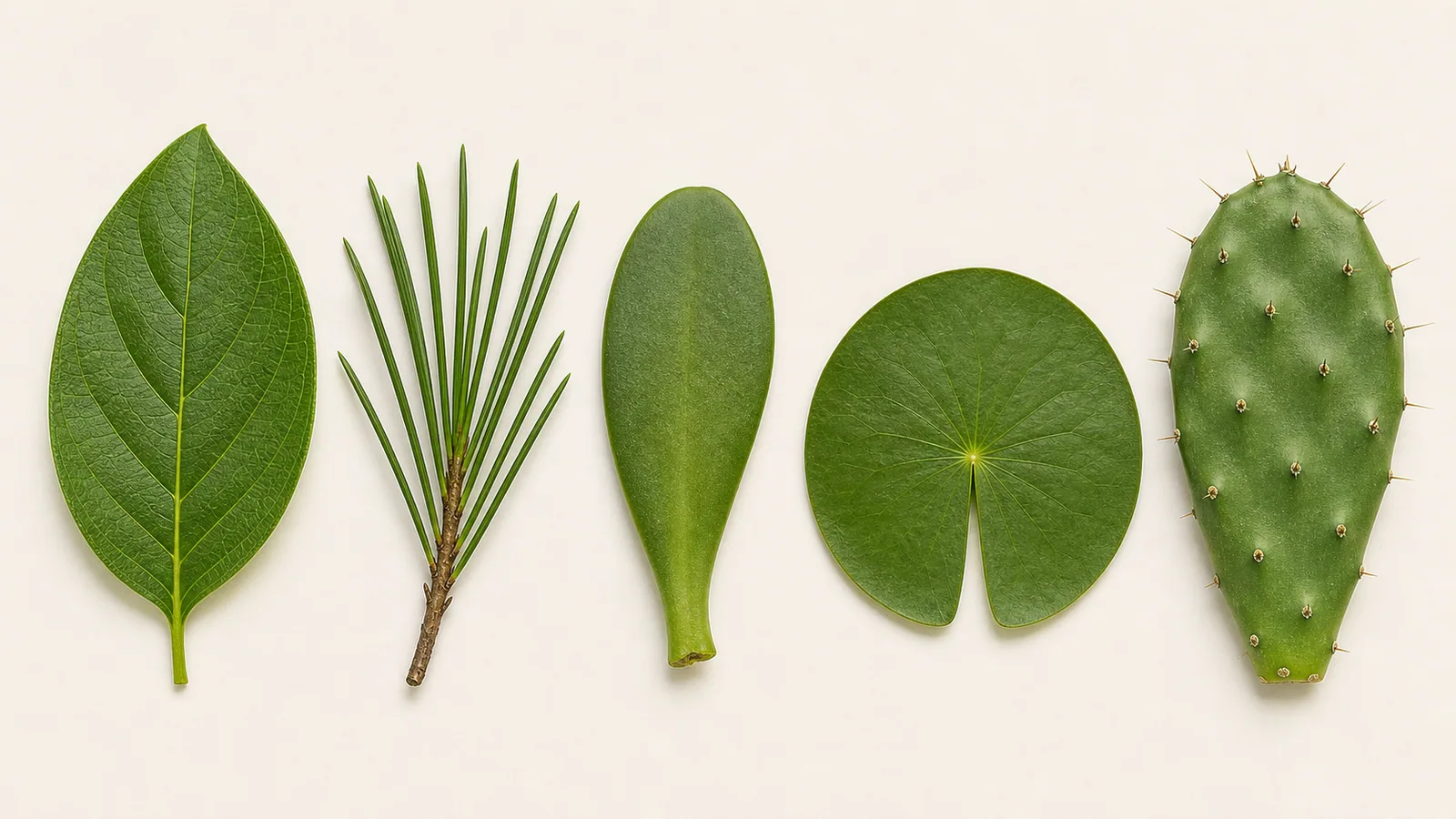
Not all leaves look like broad flat blades. A large leaf can capture more light, but it may also lose more water. Needle-like leaves, small leaves, thick leaves, waxy leaves, and floating leaves can all reflect different environmental tradeoffs.
Some leaves become very modified. Cactus spines are modified leaves, while green stems often do more photosynthesis. Floating leaves of water lilies suit a water-surface life. Thick leathery Phalaenopsis orchid leaves can also help readers see how ornamental plants connect back to basic leaf function.
These examples are not for memorizing categories. They show that leaf size, shape, and thickness often relate to light capture, water loss, support, protection, or environmental adaptation.
To compare cactus spines with thorns and prickles from other plants, continue with Are plant thorns leaves, stems, or something else?.
To look more closely at why leaves become broad, narrow, lobed, or compound, continue with why do leaves have different shapes?.
Treat leaf problems as clues, not instant diagnoses
On potted or indoor plants, leaves are the easiest organs to see. A plant near a window and a plant far from a window may receive very different light. Leaf veins remind us that support and transport happen inside the leaf.
But yellowing, curling, brown edges, or wilting should not be diagnosed from a single leaf alone. Leaf condition can relate to light, water, roots, potting media, temperature, humidity, airflow, or natural aging. This article builds the leaf-function map; plant problems need a separate observation path.
Common confusions
- ✕ Leaves are just decoration.
- ✓ Leaves are involved in photosynthesis, gas exchange, transpiration, and transport.
- ✕ Leaf-made materials stay only in the leaf.
- ✓ Sugars and other organic materials can move through phloem to other plant parts.
- ✕ Stomata are only for breathing.
- ✓ Stomata are involved in carbon dioxide entry, oxygen release, and water vapor loss.
- ✕ Veins are only patterns.
- ✓ Veins are support and transport systems.
- ✕ All leaves should look similar.
- ✓ Leaf size, thickness, and shape vary with plant type, environment, and function.
Frequently Asked Questions
What are the main functions of leaves?
Leaves receive light, carry out photosynthesis, allow gas exchange, lose water vapor through transpiration, and connect to the rest of the plant through veins.
Do leaves make food or nutrients?
In everyday language, people say leaves make food. More precisely, leaves make sugars and other organic materials through photosynthesis. Mineral nutrients from fertilizer are also important, but they are not the same as leaf-made organic materials.
Why do plants need carbon dioxide?
Carbon dioxide supplies carbon for photosynthesis. With water and light energy, plants use carbon dioxide to make sugars and other organic materials.
What are stomata?
Stomata are tiny openings in the leaf epidermis. Guard cells regulate their opening. They allow carbon dioxide in and oxygen plus water vapor out.
What do leaf veins do?
Leaf veins support the leaf and contain transport tissues. Xylem brings water and minerals into the leaf, while phloem carries photosynthesis products to other plant parts.
Can plants without typical leaves photosynthesize?
Some plants use green stems or other chloroplast-containing tissues for photosynthesis. Cactus spines are modified leaves, while green stems often do much of the light capture work.
Related Terms
- Leaf blade: the light-receiving surface of a leaf.
- Chloroplast: a cell structure closely involved in photosynthesis.
- Chlorophyll: a pigment that absorbs light energy and often makes leaves green.
- Stoma: a small opening on the leaf surface for gas exchange.
- Guard cells: cells that regulate stomatal opening and closing.
- Leaf vein: a support and transport network inside a leaf.
- Xylem: tissue mainly associated with water and mineral transport.
- Phloem: tissue that transports sugars and other photosynthesis products.
- Transpiration: water vapor loss from plant surfaces.
Read Next
Evidence
References
These sources were used to check the plant-science concepts and gardening context in this article.