Not every point on a stem is the same
On a plant stem, the positions where leaves, buds, branches, flowers, or sometimes adventitious roots commonly attach are called nodes. The stem section between two nodes is called an internode.
Think of a stem as a road with stations. The stations are nodes. The road sections between stations are internodes. Once you see these two positions, it becomes easier to understand where new shoots come from, why leggy plants are described as having long spaces between leaves, and why cutting propagation often mentions “a node.”
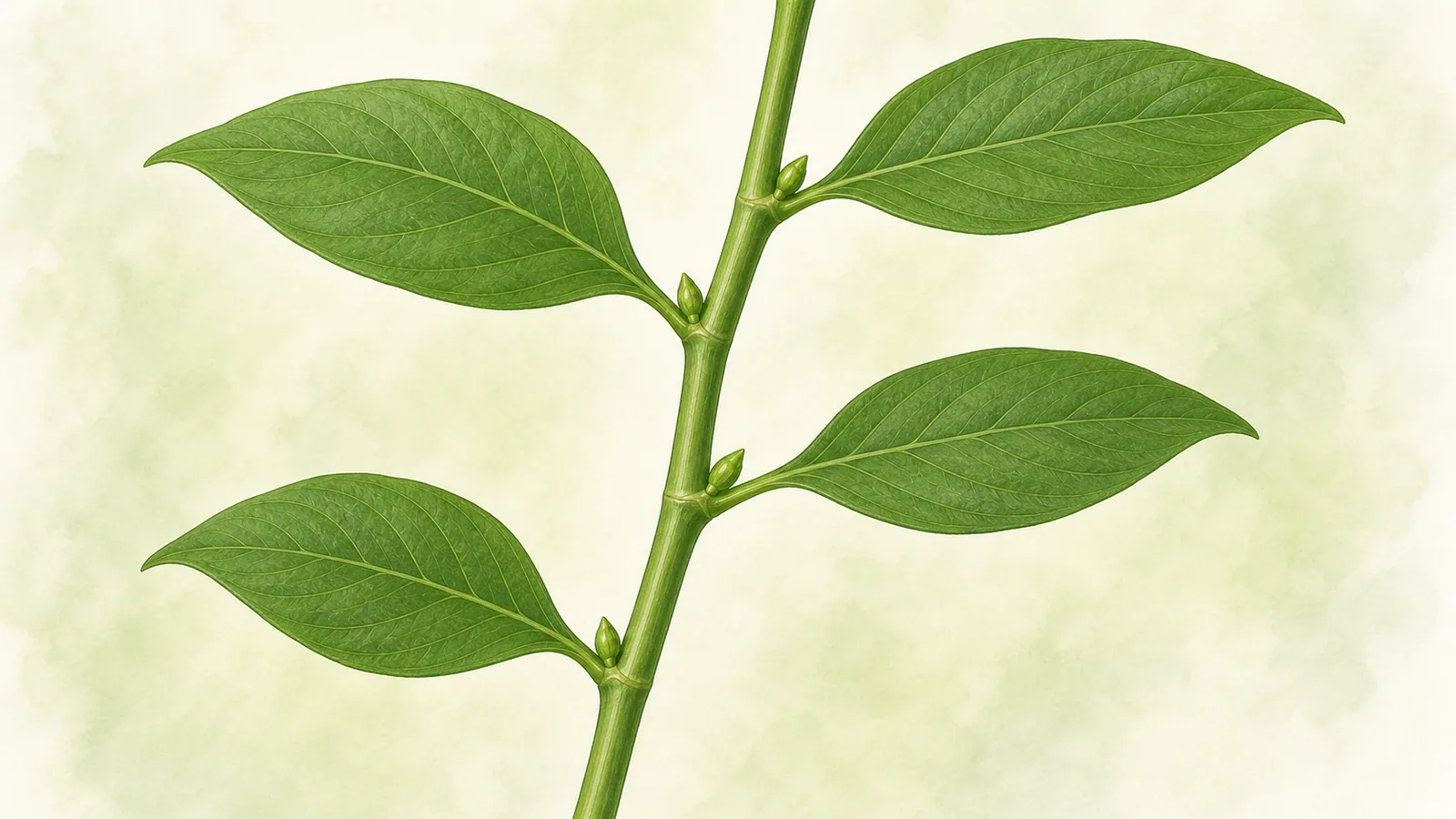
Locate a node, an internode, and an axillary bud
Select Node, Internode, or Axillary bud on the illustration to compare their positions and explanations.
 Node Internode Axillary
bud
Node Internode Axillary
bud A node is a leaf attachment position on the stem
Trace a petiole back to the main stem to find a node. A node is a position, distinct from the projecting petiole; a visible bump alone does not define it.
Look inside the gold ring where the left petiole joins the main stem.
An internode is a stem section between two nodes
Find two neighboring leaf attachment points, then follow the main stem between them. The gold line marks that section, excluding petioles and leaf blades.
Follow the gold line from the upper node toward the next node below.
An axillary bud near the leaf axil can be a new growing point
The angle between a leaf and stem is the leaf axil. A bud near it is an axillary bud, which may form a side shoot or another structure. Its activity depends on the plant, season, and growth conditions.
Look just above the same node for the small green bud near the petiole base.
A node is like a station, and buds often sit nearby
A node is not just a raised spot or a small stalk. It is the place where structures connect to the stem. Some plants attach leaves by petioles; others have leaves sitting close against the stem. Either way, the key is the attachment point.
The angle between a leaf and the stem is called the leaf axil. A small bud often sits near the axil. This axillary bud may later become a shoot, leaf, or flower, but it does not always grow. Plant type, season, light, and whole-plant growth condition all affect whether a bud becomes active.
This is why observing a branch means looking beyond the leaf blade. The place where the leaf attaches to the stem often contains clues about the plant’s next growth.
Internode length can tell you something, but not everything
An internode is the stem section between two nodes. Different plants naturally have different internode lengths. Mint, basil, pothos, and many vine-like plants often make nodes easy to see. Other plants have very short internodes, so leaves appear crowded together.
One plant can also change internode length as conditions change. Low light, crowding, season, or rapid new growth can make new internodes longer. Articles about leggy growth often mention long internodes because this is an easy feature to observe.
But a long internode is not a diagnosis by itself. Compare old and new growth on the same plant. Is the newer growth thinner, longer, or more widely spaced? Then check light, space, and whole-plant condition together.
Why cuttings and pruning often mention nodes
Many gardening instructions say to cut near a node or use a cutting with a node. The reason is that nodes are often related to buds, new shoots, or adventitious root formation. In some plants, a cutting with only a leaf but no node may lack the growing point needed to make a new shoot.
But this should not be reversed into a guarantee. A node does not automatically mean successful rooting or regrowth. Plant type, cutting maturity, season, water, air, and environment still matter. Nodes are important positions, not promises.
Nodes can appear on stems that are not upright branches
We often use upright stems to learn nodes and internodes because they are easy to see. But nodes and internodes also appear on other stem types.
Strawberry runners spread along the surface, and new small plants often form at nodes. Some rhizomes, creeping stems, or underground stems also have nodes and internodes. Even though their position looks different from an upright branch, the presence of nodes, buds, or leaf scars helps identify stem-like structures.
Grasses, corn, and bamboo also show nodes and internodes clearly. This article builds the general concept rather than turning it into a crop-specific topic.
Common confusions
- ✕ A node is any bump on a stem.
- ✓ A node is defined by the attachment of leaves, buds, branches, flowers, or other structures.
- ✕ Longer internodes always mean a healthier plant.
- ✓ Longer internodes may be normal growth, or may relate to light, crowding, or other conditions.
- ✕ A cutting with a node is guaranteed to root.
- ✓ Nodes are important for potential new growth, but success depends on plant type and environment.
- ✕ Only upright stems have nodes and internodes.
- ✓ Runners, creeping stems, rhizomes, and some underground stems can also have nodes and internodes.
Frequently Asked Questions
Are nodes always visible?
No. Some plants have obvious nodes, such as bamboo, mint, basil, and many vining foliage plants. Others have very short internodes, so nodes are harder to identify at a glance.
If a leaf falls off, is the node still there?
Usually yes. A leaf scar, bud, or branch position may still mark the node. Woody stems often keep these clues after leaves drop.
How are nodes, petioles, and buds different?
A node is a position on the stem. A petiole is the stalk connecting a leaf blade to the stem. A bud is a growing point often found near the leaf axil.
Why do cuttings often need a node?
In many plants, buds and adventitious roots are associated with nodes or nearby tissues. A cutting with a node is more likely to include a place where new growth can begin, though success still depends on plant and environment.
Are long internodes the same as leggy growth?
Not always. Leggy growth often includes long internodes, thin stems, and widely spaced leaves, but internode length also depends on plant type, season, light, density, and growth speed.
Are strawberry runner plantlets related to nodes?
Yes. A strawberry runner is a stem that spreads near the surface, and new plantlets commonly form at nodes.
Related Terms
- Node: a point on a stem where leaves, buds, branches, flowers, or other structures commonly attach.
- Internode: the stem section between two nodes.
- Petiole: the stalk connecting a leaf blade to the stem.
- Leaf axil: the angle between a leaf and the stem.
- Axillary bud: a bud near the leaf axil that may grow into a shoot, leaf, or flower.
- Leggy growth: stretched growth with long internodes and a loose plant shape.
- Runner: a stem that grows along or near the surface and may form new plantlets at nodes.
Read Next
Evidence
References
These sources were used to check the plant-science concepts and gardening context in this article.