
A stem does more than hold a plant upright
When people look at a plant, leaves, flowers, or roots often get attention first. The stem can seem like background structure. But the stem is one of the main connecting organs: it links roots, leaves, flowers, buds, and branches into one working plant.
A useful first image is “support frame plus road system.” The support frame holds leaves where they can receive light and places flowers, buds, and fruits where they can develop. The road system moves water and mineral nutrients upward from roots, and it also helps distribute sugars and other organic materials made by leaves to roots, buds, flowers, and other growing parts.
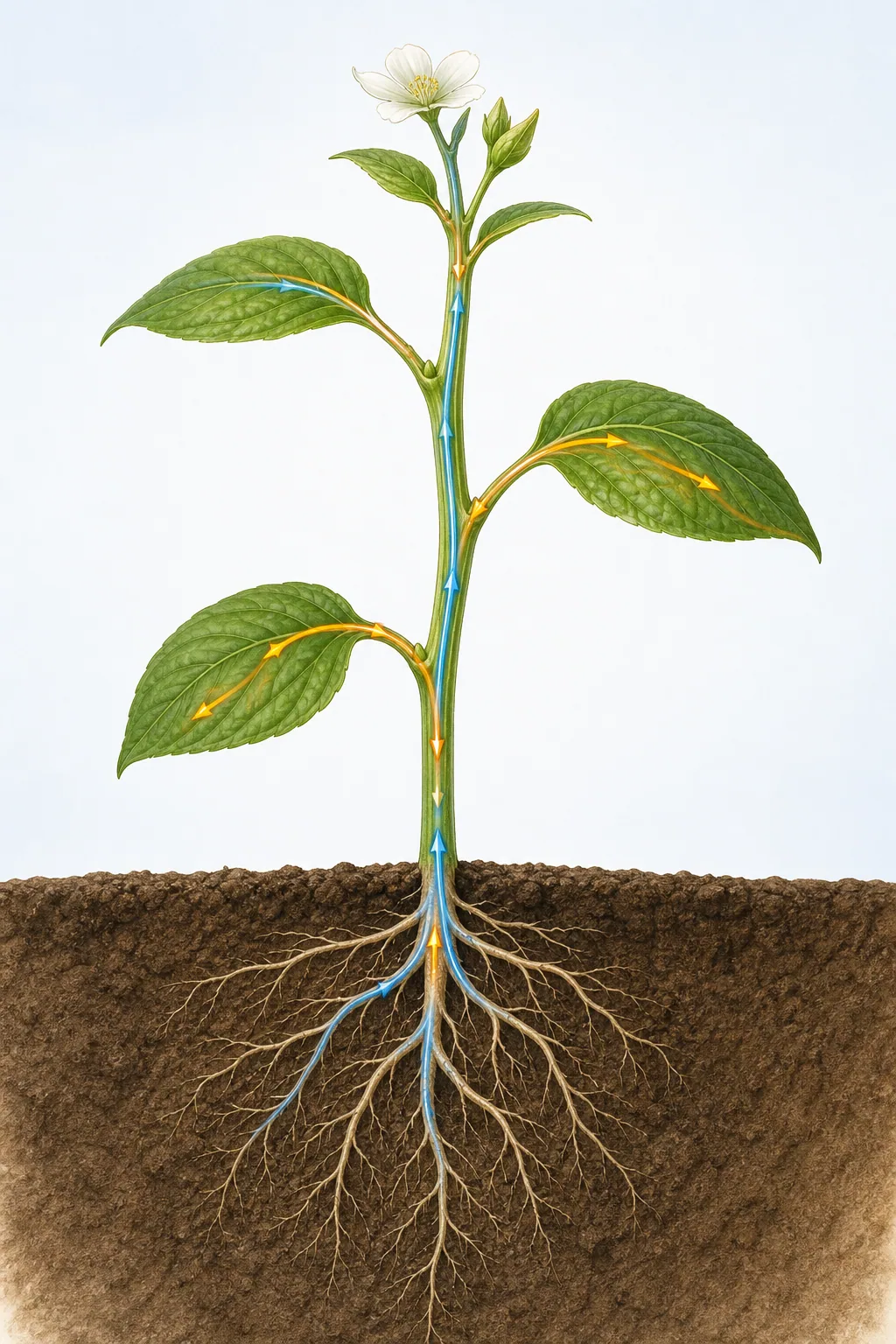
Support, connection, and transport are the three big stem roles
The first role is support. Soft herbaceous stems can lift leaves into the light. Tree trunks and branches are also stems, just harder and longer-lasting.
The second role is connection. Leaves, branches, flowers, and buds often attach at specific points on the stem called nodes. The stem section between two nodes is an internode. Once you understand nodes and internodes, it becomes much easier to see where new leaves, shoots, and flower buds may appear.
The third role is transport. Stems contain vascular bundles, including xylem and phloem. As a beginner model, xylem mostly carries water and mineral nutrients upward, while phloem carries sugars and other photosynthesis products made by leaves. Real transport is more complex, but this model explains why stems are not just supports.
New shoots and flower buds often begin near nodes
Many plants have buds near nodes. A bud may later grow into a shoot, leaf, or flower. When observing a stem, do not only ask whether it is straight or thick. Look at where leaves attach, how long the internodes are, and whether small buds are visible near leaf bases.
Long internodes can make a shoot look stretched, with leaves farther apart. Gardeners often call this leggy growth. Legginess is commonly related to low or uneven light, but it is still an observation clue, not a single-cause diagnosis.
Older stems may become harder and browner through lignification. Lignification helps stems support the plant. Trunks, branches, vines, and soft herbaceous stems can all be understood through the same basic functions: support, connection, and transport.
Some stems do not look like a main trunk
Introductory diagrams often show upright stems because they are easy to see. In real plants, stem forms vary widely.
Some stems climb. Some creep close to the ground. Some grow underground. Rhizomes, runners, stolons, and tubers can confuse beginners because they may look like roots or storage organs. A useful question is: does this structure have nodes, internodes, or buds? If it does, it may have stem characteristics.
This article builds the basic stem concept. Underground stems, runners, tendrils, and thickening woody stems can be handled in later articles.
Common confusions
- ✕ Stems only hold the plant up.
- ✓ Stems support, connect, transport, and hold nodes where leaves, buds, branches, or flowers may form.
- ✕ Only upright aboveground parts are stems.
- ✓ Some stems creep, climb, trail, or grow underground.
- ✕ Stems and roots are always easy to tell apart.
- ✓ Usually they are, but underground stems and tubers can be confusing. Nodes, internodes, and buds are important clues.
- ✕ Long internodes prove one exact problem.
- ✓ Long internodes are an observation clue and should be read with light, whole-plant condition, and environment.
Frequently Asked Questions
What is the biggest difference between a stem and a root?
Roots mainly anchor the plant and absorb water and mineral nutrients. Stems mainly support, connect, transport, and produce leaves, buds, branches, or flowers. Stems often have nodes and internodes; roots usually do not show that same arrangement.
Do stems always grow above the ground?
No. Many stems grow above the ground, but some are underground or creeping. These special stems can be confused with roots, so nodes and buds become useful clues.
What are nodes and internodes?
A node is a position on the stem where leaves, buds, branches, or flowers often attach. An internode is the stem section between two nodes.
Is a tree trunk a stem?
Yes. Trunks and branches are stems of woody plants. They are harder than many herbaceous stems and are often connected to lignification and secondary growth.
Does the stem really contain transport pathways?
Yes. Vascular bundles inside stems contain xylem and phloem. Xylem is closely related to water and mineral transport; phloem carries sugars and other products made by photosynthesis.
Will cutting near a stem node always produce new growth?
No. Nodes and buds are related to new growth, but whether a plant produces new shoots depends on plant type, season, plant health, and environment. This article explains the structure, not a pruning guarantee.
Related Terms
- Stem: the plant organ that connects roots, leaves, flowers, and buds, often supporting and transporting materials.
- Node: a position on a stem where leaves, buds, branches, or flowers commonly attach.
- Internode: the stem section between two nodes.
- Bud: a growing point that may develop into a shoot, leaf, or flower.
- Vascular bundle: a group of plant transport tissues.
- Xylem: tissue mostly associated with water and mineral transport.
- Phloem: tissue that transports sugars and other photosynthesis products.
- Lignification: the process that makes some plant tissues harder and better able to support.
Read Next
Evidence
References
These sources were used to check the plant-science concepts and gardening context in this article.