
Plants use light to make usable organic materials
Plants do not eat food the way animals do. Most green plants receive light with their leaves, then use water and carbon dioxide from the air to make sugars and other organic materials inside their bodies.
As a first model, photosynthesis is a plant manufacturing process. Light provides energy. Water and carbon dioxide provide materials. Cells in the leaf convert them into sugars and related compounds the plant can use. Those sugars can support respiration, new leaves, new roots, flowers, fruits, and other plant body materials.
Photosynthesis also releases oxygen. That is why photosynthesis is so often discussed when people talk about plants, the atmosphere, and life on Earth.
Image interaction
Look at the leaf: what enters and what leaves
Think of the leaf as a small factory. Light powers the process, water and carbon dioxide are materials, sugars stay inside the plant for use, and oxygen is released.
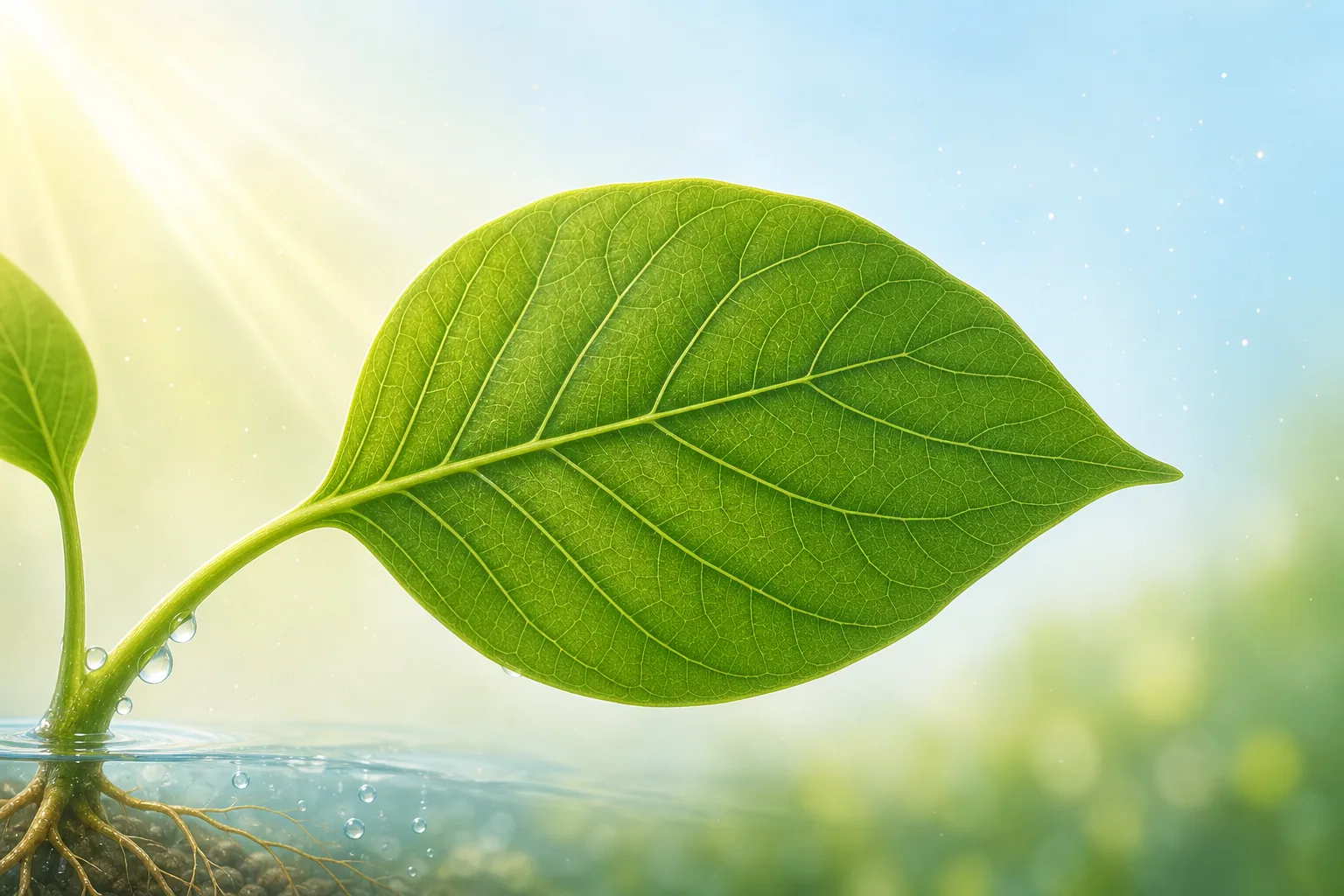
Light reaches chlorophyll and powers the reaction system
Light is not a raw material that turns directly into sugar. It works more like the energy supply that lets the leaf's reaction system operate.
Water is usually absorbed by roots and moved to leaves
Water is an important material in photosynthesis. It usually enters through roots and moves through the plant's transport system to the leaves.
Carbon dioxide enters the leaf from the air
Small pores on the leaf surface, called stomata, allow gases to move in and out. Carbon dioxide supplies carbon that becomes part of sugars and other organic materials.
Sugars are not released; they are used by the plant
The plant can move sugars to roots, stems, new leaves, flowers, and fruits, where they support respiration, growth, and new body materials.
Oxygen is released from the leaf
Photosynthesis releases oxygen. Oxygen is not the main goal of sugar production, but it is extremely important for Earth's atmosphere and living organisms.
Water, air, and light meet in the leaf
Photosynthesis is often simplified in this direction:
carbon dioxide + water + light energy -> sugars and other organic materials + oxygenThis equation is not here for memorizing chemistry. It helps separate the roles. Carbon dioxide and water are materials. Light is energy. Sugars and other organic materials are products the plant can use. Oxygen is released.
Carbon dioxide mainly enters through stomata on the leaf surface. Water is often absorbed by roots and transported to leaves. Light provides the energy that drives the process.
Process diagram
Light does not become sugar directly; it powers the leaf first
A more accurate first idea is this: chlorophyll absorbs light, the leaf makes short-lived usable energy, and that energy is then used to build sugar precursors from carbon dioxide.
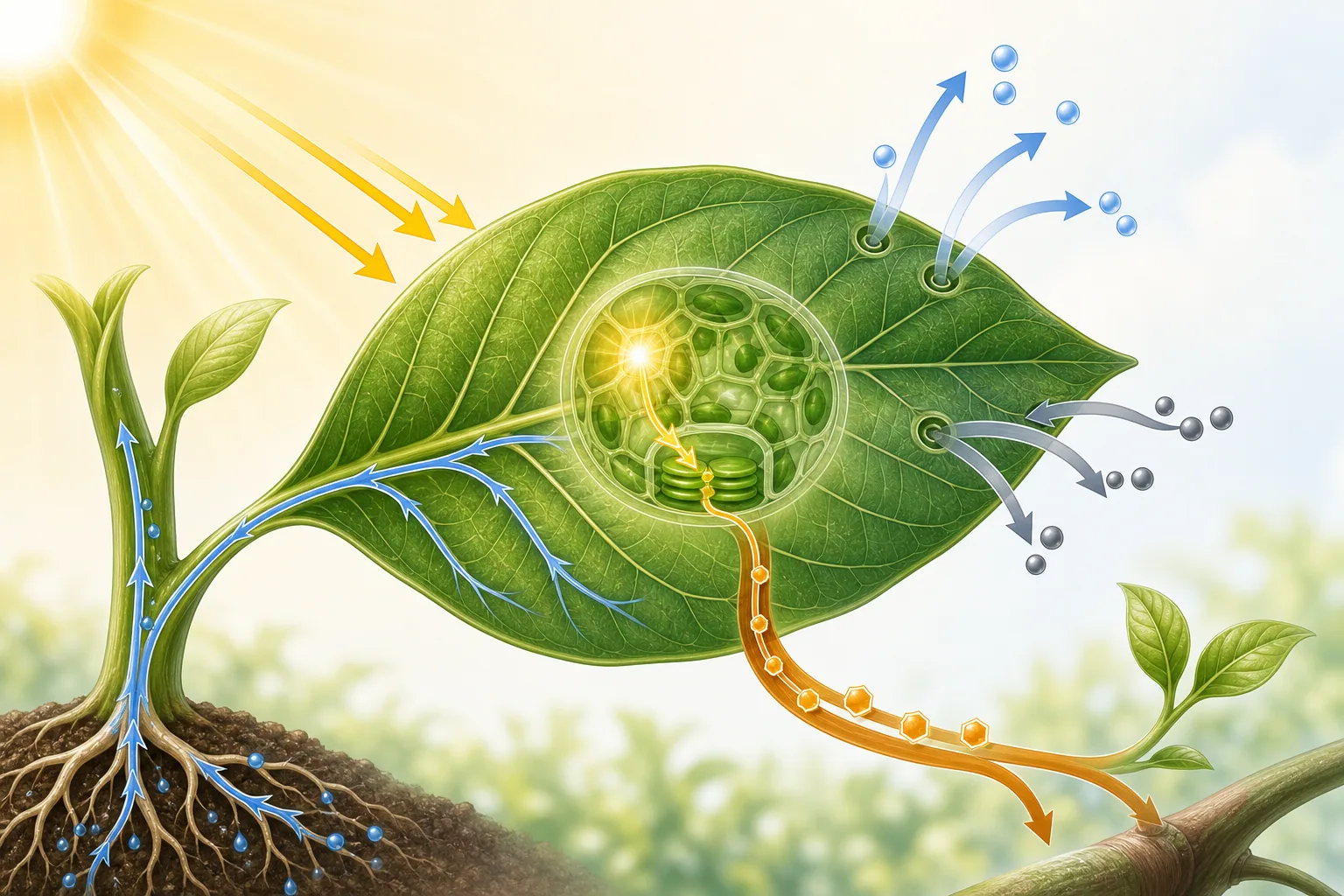
Light reaches the leaf and provides energy.
Water moves from roots toward leaves.
Carbon dioxide enters the leaf from the air.
Oxygen is released from the leaf.
Sugars move toward stems and growing parts.
Chlorophyll absorbs light so the reaction system can start.
The leaf does not turn light directly into sugar. It first makes short-lived usable energy.
Carbon dioxide supplies carbon that becomes part of sugars and other organic materials.
This is a simplified explanation. The real reactions are more complex, but the core idea is that light supplies energy and the carbon in sugars mainly comes from carbon dioxide.
More precisely, photosynthesis mainly occurs in cells that contain chloroplasts. Chloroplasts are cell structures closely involved in photosynthesis. Chlorophyll is an important pigment inside them that absorbs light. Leaves often contain many cells suited for light capture and gas exchange, so we usually treat leaves as the main photosynthetic organs.
To follow how light drives electron transfer and how ATP and NADPH form, continue with the illustrated guide to light reactions and the electron transport chain.
Fertilizer matters, but it is not plant food in the strict sense
People often say plants “eat fertilizer.” That phrase is understandable in casual conversation, but it is not precise in plant science.
Fertilizers mainly supply mineral nutrients such as nitrogen, phosphorus, and potassium. These nutrients are important for growth, chlorophyll formation, and many plant processes. But many of the sugars and organic materials plants use for respiration, growth, and body building are not taken directly from fertilizer. They are produced through photosynthesis from carbon dioxide and water.
A clearer statement is: fertilizer supplies mineral nutrients; photosynthesis is a major process by which plants make sugars and other organic materials. Both matter, but their roles are different.
Indoor plants often run into the light problem first
At home, the key question is not simply whether the room has lights. The question is how much useful light actually reaches the leaves. A room can look bright to human eyes while still providing too little light for plant growth.
This article is not a lighting prescription. The principle is that ordinary room lighting is not the same as effective plant light. Many household lights are designed for human vision, not plant photosynthesis. They may be too weak, their spectrum may not fit the plant’s needs, and useful light drops quickly with distance. For many indoor plants, window light or a properly designed plant light is more likely to support steady growth than ordinary room lighting alone.
So the accurate idea is: photosynthesis does not require outdoor direct sun in every case, but it does require enough usable light. Shade-tolerant plants still need light; they are just better adapted to lower light than many other plants.
The same word "light" can mean very different things to a plant
It is often much stronger than ordinary indoor lighting, though direction, shade, and distance still matter.
The plant may receive too little useful light for long-term growth.
This is a separate environment topic. Here we only clarify the principle, not equipment settings.
Common confusions
- ✕ Plants eat sunlight.
- ✓ Plants use light energy to make sugars and other organic materials. Light is energy, not a material that is eaten.
- ✕ Fertilizer is plant food in the same way food is animal food.
- ✓ Fertilizer supplies mineral nutrients. It does not replace photosynthesis as the source of plant-made organic materials.
- ✕ Any indoor light lets plants photosynthesize normally.
- ✓ A room may look bright to people while still providing too little usable light for a plant.
- ✕ Plants photosynthesize all night.
- ✓ Photosynthesis requires light. At night, plants still respire, but they do not photosynthesize in the same way they do with light.
Frequently Asked Questions
Does photosynthesis require sunlight? Can indoor light work?
Photosynthesis requires light energy, but not every plant needs outdoor direct sun. However, “there is an indoor light” does not mean the plant receives enough usable light. Many household lights are weak for plant growth and are not designed for plant photosynthesis.
Do plants photosynthesize at night?
In general, photosynthesis requires light. At night, plants still respire and use stored organic materials for energy, but they do not carry out photosynthesis as they do in light.
Where do the sugars made by photosynthesis go?
Sugars can be used in respiration, moved to growing areas such as roots and new leaves, or turned into other organic materials. They may also support flowers, fruits, and storage tissues.
Is fertilizer plant food?
Not in the strict plant-science sense. Fertilizer supplies mineral nutrients. Sugars and many other organic materials are mainly made by the plant through photosynthesis.
Can a plant without typical leaves photosynthesize?
It depends on the plant. Some plants use green stems or other chloroplast-containing tissues instead of broad leaves. This article uses common green leaves as the entry point.
Why can a room look bright to people but still be dim for plants?
Human eyes adjust to brightness. Plants depend on usable light reaching their leaves over time. A room may feel bright while the actual light intensity at leaf level is still low.
Related Terms
- Photosynthesis: the process in which plants, algae, and some microorganisms use light energy to make organic materials.
- Chloroplast: a cell structure closely involved in photosynthesis.
- Chlorophyll: a light-absorbing pigment that often makes leaves green.
- Carbon dioxide: one of the main materials used in photosynthesis.
- Stomata: tiny openings on leaf surfaces that regulate gas exchange.
- Organic materials: carbon-containing materials used as plant body material or energy sources; sugars are important examples.
Read Next
Evidence and attribution
Sources and image rights
These sources were used to check the plant-science concepts and gardening context in this article.
View sources and further reading (5)
Image sources and rights
- Plant Note project-made image · Created by Plant Note; no third-party image license applies — The project-made PNG was adapted as WebP for delivery.