
Diffusion and osmosis
Purple: solute, a substance dissolved in water
Mechanism: random molecular motion, selective permeability and water-potential equilibrium.
Model conditions
The demonstration membrane is set to pass water but block the purple solute. Plant cell membranes have different permeabilities depending on the substance and membrane proteins. The compartments have equal areas, constant temperature and equal atmospheric pressure at their surfaces. During osmosis each side retains its solute amount and total water stays fixed. More solute lowers water potential; with equal initial levels, water moves on average from the more dilute to the more concentrated side. Growing pressure from the level difference offsets the osmotic driving force, so equilibrium need not mean equal concentrations. Dots, arrows and playback speed illustrate trends in an ideal dilute solution without experimental scales.
Start by separating two related ideas: diffusion and osmosis
Diffusion and osmosis both describe molecular movement, but they focus on different things. Diffusion is the net movement of a substance from a region of higher concentration toward a region of lower concentration, produced by the molecules’ ongoing random motion. Osmosis specifically describes water moving across a selectively permeable membrane, also called a semipermeable membrane.
Carbon dioxide, oxygen, and water vapor in a leaf can often be understood through diffusion. Water entering or leaving root cells and other plant cells can involve osmosis. But the long-distance movement of water from roots to leaves through xylem cannot be simplified to “osmosis all the way.” That pathway requires a separate discussion of water potential, transpiration, and whole-system water flow through xylem.
The model below compares diffusion and osmosis from the same starting point. Choose a mode and use “Next step” to follow the process. The third step keeps playing so you can watch movement continue at equilibrium.
In plants, gas diffusion around stomata also depends on random molecular motion; water entering or leaving cells also depends on membrane permeability and water potential. The compartments magnify this physical distinction.
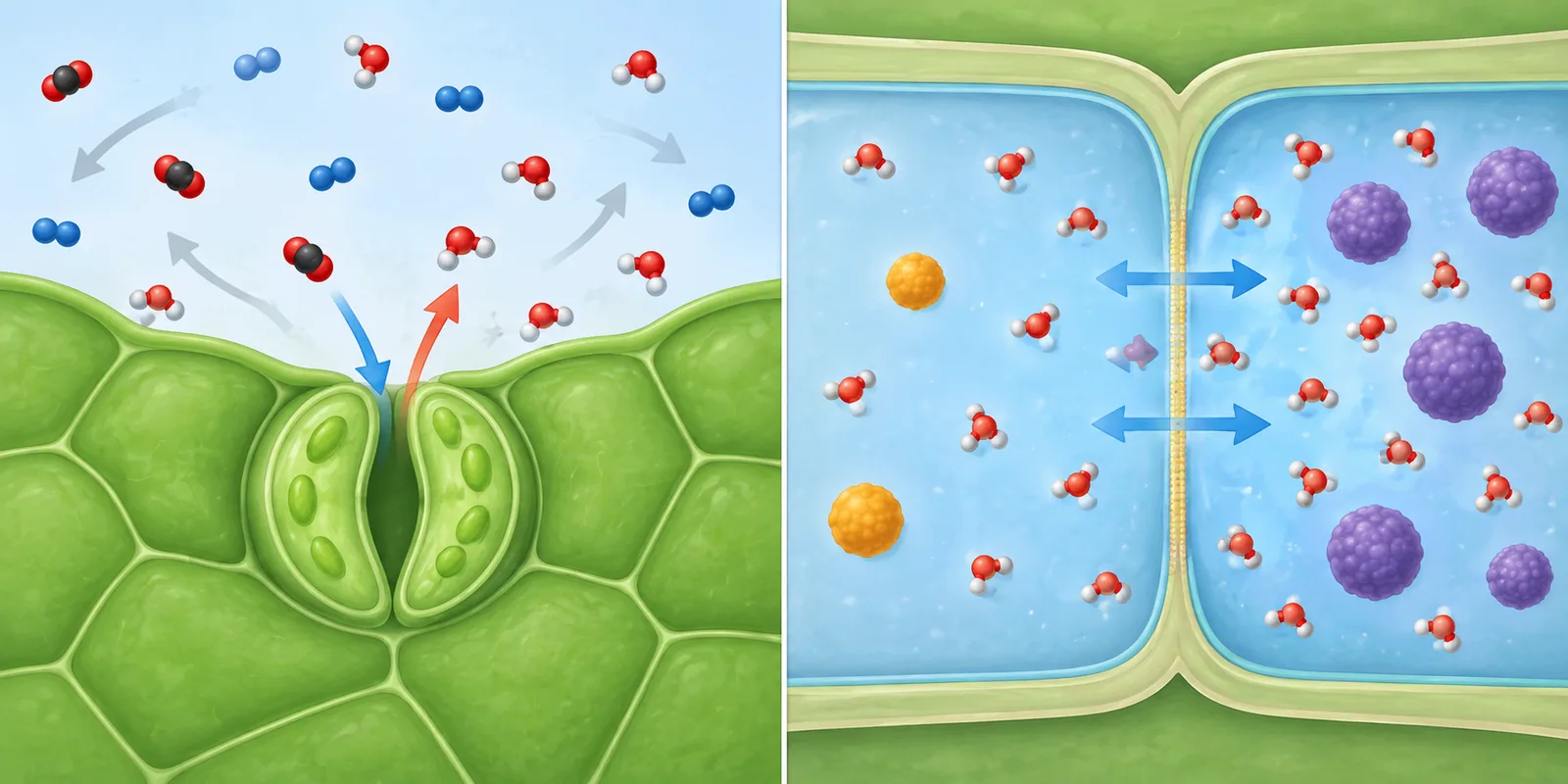
Diffusion: molecules move randomly, but the net pattern follows a concentration difference
You can begin by thinking of concentration as the relative amount of a substance in a particular space. When there is more of the same substance in one region and less in another, its molecules still move randomly in every direction. Looking at the total number of molecules, however, more move from the high-concentration region toward the low-concentration region. That overall pattern is the net direction of diffusion.
This does not mean that every molecule lines up and travels the same way. Molecules can move back and forth on both sides. Once the average distribution is similar on both sides, the molecules are still moving, but the numbers moving in each direction roughly balance, so there is no obvious net movement.
Passive diffusion down a concentration difference does not require the cell to directly spend ATP—adenosine triphosphate, a commonly used cellular energy molecule. Plants can still use energy to move certain substances and maintain concentration differences. That active maintenance can leave a gradient in place so that later passive movement still has a direction.
Gas exchange in leaves: carbon dioxide, oxygen, and water vapor can all diffuse
Stomata are common gas-exchange openings on leaf surfaces. When a stoma is open, carbon dioxide, oxygen, and water vapor can move between the leaf and the outside air according to their own concentration differences. How open or closed the stoma is changes the resistance along that pathway.
When a leaf is in the light and carrying out photosynthesis, its mesophyll cells use incoming carbon dioxide. The carbon-dioxide concentration inside the leaf may therefore be lower than outside, creating a tendency for carbon dioxide to diffuse inward. Oxygen produced during photosynthesis may diffuse outward. The air spaces inside a leaf are usually humid, so water vapor leaving the leaf and entering drier outside air is part of transpiration.
Cellular respiration is still taking place. The actual direction and rate of exchange depend on light, humidity, temperature, stomatal state, plant species, and the plant’s physiological condition at that moment. The direction of one gas should not be treated as permanently fixed.
After a gas leaves or approaches a stoma, it must also pass through the layer of air close to the leaf surface. How that air moves can change how easily water vapor and carbon dioxide are exchanged. You can continue with What Is the Leaf Boundary Layer? for this part of the pathway.
Roots also exchange gases. Root cells need oxygen for cellular respiration, and oxygen usually diffuses from air in the pore spaces of soil or potting media toward the root. When those pore spaces remain filled with water for a long time, gas diffusion through the water is generally slower than diffusion through air, so oxygen replenishment around the roots may be limited. Why Do Roots Need Air? follows this root-zone pathway in more detail.
Root cells also produce carbon dioxide. It can diffuse in the opposite direction, away from the root zone and toward air-filled pore spaces or the outside air. Root hairs are extensions of root epidermal cells that increase the surface area in contact with surrounding water. They are not hollow straws. You can continue with What Are Root Hairs, and Why Do Plants Need Them? for that structure.
This is a physical and physiological relationship. Looking only at the surface of a pot is not enough to determine the condition of the entire root zone.
Osmosis: water crosses a selectively permeable membrane
Osmosis can be introduced as a special case of diffusion involving water. If a membrane allows water to pass more easily while restricting some solutes, water can show a net movement because the water conditions on the two sides differ.
As an introductory rule, when pressure, gravity, and other conditions are similar, water tends to move from the side with more freely available water and a more dilute solution toward the side with less freely available water and relatively more solute.
Plant physiology more often describes this tendency using water potential. Adding solute usually lowers water potential, but water potential is not determined by solute alone. Pressure, gravity, and the way soil or potting media holds water can also matter. Therefore, “water always moves toward the saltier side” is only a conditional beginner’s explanation, not a rule that fits every root, leaf, or container situation.
The cell membrane of a plant cell is selectively permeable: some substances cross more easily than others, while other substances are restricted. Water can cross the membrane directly and can also move through water-channel proteins that speed its movement. The cell wall outside the membrane mainly provides support. Its porous nature and its selectivity should not be treated as the same thing as the cell membrane’s selective permeability.
This distinction matters. Osmosis is not defined merely by the presence of “a wall.” The key is that a membrane has different levels of permeability to different substances.
Roots have more than one water pathway
After water enters a root, it can move along cell walls and the spaces outside cells. This route is the apoplastic pathway (apoplast). Water can also remain in the cytoplasm and move from cell to cell through plasmodesmata, forming the symplastic pathway (symplast). Water may also cross cell membranes repeatedly, forming a transcellular pathway. The relative importance of these routes can change with plant species, root tissues, developmental stage, and environment. They are not three pipes with fixed shares.
The root endodermis is a key boundary before water and solutes enter the stele and xylem. The Casparian strip in endodermal cell walls prevents water and solutes from simply bypassing the endodermis through cell-wall spaces. They must cross the endodermal cell membrane or take another regulated route before entering the root’s internal transport system. This is why saying that water touches a root hair and then flows unchecked straight into xylem is not precise.
Water in plants: local movement can involve osmosis, but long-distance transport is not just osmosis
Water near root hairs may enter root cells by crossing cell membranes. At this local scale, a difference in water potential and osmosis can help explain the movement of water. The apoplastic, symplastic, and transcellular routes described above can also contribute, so the actual flow is not one single route in which every water molecule passes through each cell by osmosis.
Once water enters the xylem, it moves along a continuous pathway through roots, stems, and leaf veins. Transpiration from the leaves lowers water potential toward the leaf end. Together with the cohesion between water molecules and the structure of xylem, this creates conditions that support long-distance water flow.
This whole-system movement is a different scale from water crossing one cell membrane by osmosis. How Does Water Move from Roots to Leaves? explains the larger pathway from roots through xylem to leaves.
Water in a leaf may eventually leave as water vapor. Water moving inside the leaf toward a stoma, passing out through the stoma, and then moving through the air layer outside the leaf involve transfer processes at different scales. That is why the whole plant cannot be described with one word such as “absorbing” or “evaporating.”
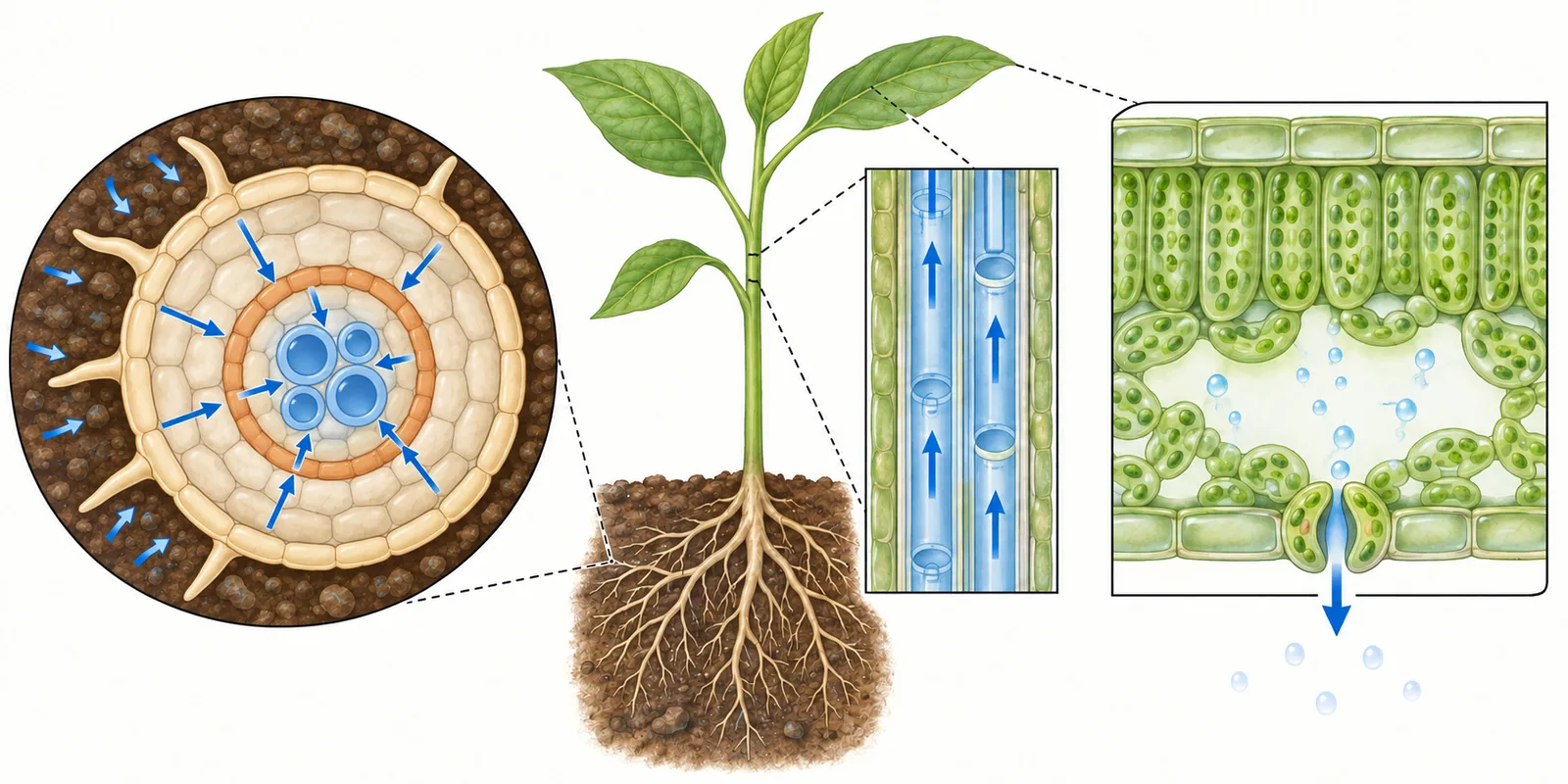
Four questions that quickly distinguish diffusion from osmosis
Four questions that quickly distinguish them
Gases, solutes, and other particles can diffuse. Osmosis specifically focuses on water.
Ordinary diffusion can occur in air or tissue spaces; a membrane is not required by the definition of diffusion.
When carbon dioxide, oxygen, and water vapor enter or leave a leaf, concentration differences help explain the net direction.
Water may move across root-cell membranes by a process that involves osmosis, while root-to-leaf transport is a separate water-potential and whole-system flow problem.
What can you observe next to a potted plant?
You usually cannot see the molecules themselves. In everyday plant observation, it is more useful to look for clues that may change the conditions for diffusion or osmosis than to use appearance alone to make a firm conclusion about the plant.
- When looking at leaves, picture the stoma, the air inside and outside the leaf, the surrounding humidity, and air movement together. No obvious breeze near a leaf does not mean gas exchange has stopped; the boundary layer may simply be more stable, and transfer resistance may be different.
- When looking at the root zone, visible water in a pot does not mean root cells can certainly obtain water. Water potential, solutes, root condition, pore spaces, and oxygen supply all affect the plant’s water relations.
- When leaves wilt, curl, or grow more slowly, diffusion and osmosis can help explain some of the physical background. They cannot by themselves identify the cause or produce a fixed care prescription.
Common confusions
-
✕ Diffusion means that all molecules move together in one direction.
-
✓ Molecules still move randomly in every direction. When a concentration difference exists, the overall numbers produce a net movement from higher concentration toward lower concentration.
-
✕ A stoma is a plant mouth or lung that actively inhales gases.
-
✓ A stoma is an opening regulated by guard cells. Gases usually diffuse according to their own concentration differences; a stoma is not an animal respiratory organ.
-
✕ Plants stop respiring at night and exchange gases only during the day.
-
✓ Cellular respiration usually continues. Light changes photosynthesis and therefore the common net exchange direction of carbon dioxide and oxygen; special cases such as CAM should not be treated as a rule for every plant.
-
✕ Osmosis is solute crossing a semipermeable membrane.
-
✓ Osmosis specifically refers to water crossing a selectively permeable membrane. Whether a solute can cross depends on the membrane’s permeability to that solute.
-
✕ Water always moves toward the side with more salt.
-
✓ When pressure, gravity, and other conditions are similar, a higher solute concentration often corresponds to lower water potential, so water tends to move that way. Real plant systems must be understood through the complete water-potential situation.
-
✕ The entire process of plant water uptake and transport is called osmosis.
-
✓ Water crossing a root-cell membrane can be understood partly through osmosis. Once water enters xylem, long-distance upward transport is a separate whole-system water-flow problem.
-
✕ Root hairs are hollow straws that send water straight to xylem.
-
✓ Root hairs are extensions of root epidermal cells. Water may use apoplastic, symplastic, or transcellular pathways, and the endodermis and Casparian strip influence its route before it reaches the stele.
-
✕ The cell wall is the semipermeable membrane.
-
✓ The cell membrane provides selective permeability. The cell wall mainly provides support and cannot be treated as the same structure as the cell membrane.
-
✕ Carbon dioxide and oxygen are carried like liquids through xylem to every leaf.
-
✓ Gas exchange between leaves and the outside air mainly uses stomata and diffusion through tissue spaces. Xylem is mainly the long-distance pathway for water and dissolved minerals.
Frequently Asked Questions
What is the simplest difference between diffusion and osmosis?
Diffusion is the net movement of a substance caused by a concentration difference, and it can describe gases, solutes, or other particles. Osmosis is the special case in which water moves across a selectively permeable membrane. Osmosis belongs within the broader idea of diffusion, but not every kind of diffusion is osmosis.
Does osmosis require a plant cell?
No. As long as there is water, a selectively permeable membrane, and different water conditions on the two sides, osmosis can help explain the net movement of water. A plant cell membrane is a useful biological example, but osmosis is not unique to plants.
Does water always move from a dilute solution toward a concentrated solution?
That is a useful beginner’s simplification, but it needs conditions. If a membrane mainly allows water to cross and pressure, gravity, and other factors are similar, water usually moves from the side with more freely available water toward the side with less freely available water. Plant physiology uses water potential to include solutes, pressure, and other factors together.
Is all water transport from roots to leaves osmosis?
No. Water entering some root cells may involve osmosis across membranes. But after water enters xylem, the long-distance movement from roots to leaves is better understood through water-potential differences, transpiration, and the continuous xylem pathway. Calling every part of the water stream osmosis confuses different scales and routes.
Is transpiration diffusion or osmosis?
When liquid water moves inside a leaf or crosses a cell membrane, water potential and osmosis may be involved. When water vapor leaves through a stoma and enters the outside air, its movement is mainly understood as diffusion of water vapor. Transpiration is the larger process in which water leaves the plant as vapor; not every step within it is the same kind of transport.
Why can roots be affected even when there is water in the pot?
Root water uptake depends on more than visible water in the container. Water potential, solutes, root condition, pore spaces, and oxygen exchange all matter. When pore spaces stay filled with water for a long time, oxygen diffusion may slow. Surface wetness alone does not describe the entire root zone.
Do water molecules stop moving at osmotic equilibrium?
No. Water molecules can still cross the membrane in both directions, but the amounts entering and leaving balance on average, so there is no continuing net movement. The level difference in the model creates a pressure difference. Pressure also affects water potential, so equal water potential does not necessarily mean equal solute concentration.
Does diffusion require a plant to spend energy?
Passive diffusion down a concentration difference does not require the cell to directly supply ATP. Plants often use energy to move ions or other substances and establish or maintain the concentration differences that make later passive movement possible. Therefore, “diffusion does not directly consume energy” does not mean that the plant can maintain its whole physiological system without energy.
Can leaves still exchange gases when there is no obvious wind?
Yes. The random movement of molecules can still produce diffusion, and natural convection may also occur. The air boundary layer near the leaf may be more stable when there is little air movement, so transfer resistance and exchange speed can change. A single observation is not enough to determine the plant’s water status.
Do plants still respire at night?
Usually, yes. Cellular respiration releases energy for cells and generally continues in darkness. Darkness stops photosynthesis, which changes the common net exchange direction of carbon dioxide and oxygen. Actual gas exchange still depends on species, tissues, stomatal state, and the environment; special physiology such as CAM is not a universal rule.
Related Terms
- Diffusion: the net movement of molecules from higher concentration toward lower concentration when a concentration difference exists.
- Osmosis: the movement of water across a selectively permeable membrane; it can be understood as a special case of diffusion involving water.
- Concentration gradient: a difference in the concentration of the same substance between locations, which influences the net direction of diffusion.
- Selectively permeable membrane: a membrane that allows some substances to cross more easily while restricting others.
- Water potential: a way to describe the tendency of water to move in a particular system, influenced by solutes, pressure, gravity, and other factors.
- Apoplast: the route through cell walls and spaces outside the cell membranes.
- Symplast: the route through connected cytoplasm, with water and solutes moving between cells through plasmodesmata.
- Transcellular pathway: a route in which water crosses cell membranes repeatedly as it moves through root tissues.
- Endodermis: a root tissue layer at a key boundary before water and solutes enter the stele and xylem.
- Casparian strip: a specialized barrier in endodermal cell walls that restricts water and solutes from bypassing the endodermis through cell-wall spaces.
- Water-channel proteins: membrane protein channels that can increase water permeability; they are not motors that actively pump water upward.
- Stoma: a small opening on a leaf surface that can regulate gas exchange and water-vapor loss; the plural is stomata.
- Transpiration: the process in which a plant’s water leaves as water vapor and enters the air.
- Xylem: plant tissue that mainly transports water and dissolved minerals over long distances.
Read Next
Evidence
References
These sources were used to check the plant-science concepts and gardening context in this article.
View sources and further reading (13)
- openstax.org — 11 4 colligative properties
- openstax.org — 5 2 passive transport
- openstax.org — 30 3 roots
- openstax.org — 30 4 leaves
- openstax.org — 30 5 transport of water and solutes in plants
- openstax.org — 30 5 transport of water and solutes in plants
- labs.plb.ucdavis.edu — Chapter11nf.pdf
- passel2.unl.edu — 5
- openstax.org — 8 1 overview of photosynthesis
- pmc.ncbi.nlm.nih.gov — PMC3982727
- extension.colostate.edu — understanding tree roots
- aggie-horticulture.tamu.edu — air water and media putting them all together
- rhs.org.uk — how plants breathe