Root rot often starts with roots staying too wet and too airless
When people hear “root rot,” they often think “too much watering.” That direction is often related, but a more accurate explanation is that the balance of water and air around roots has broken down.
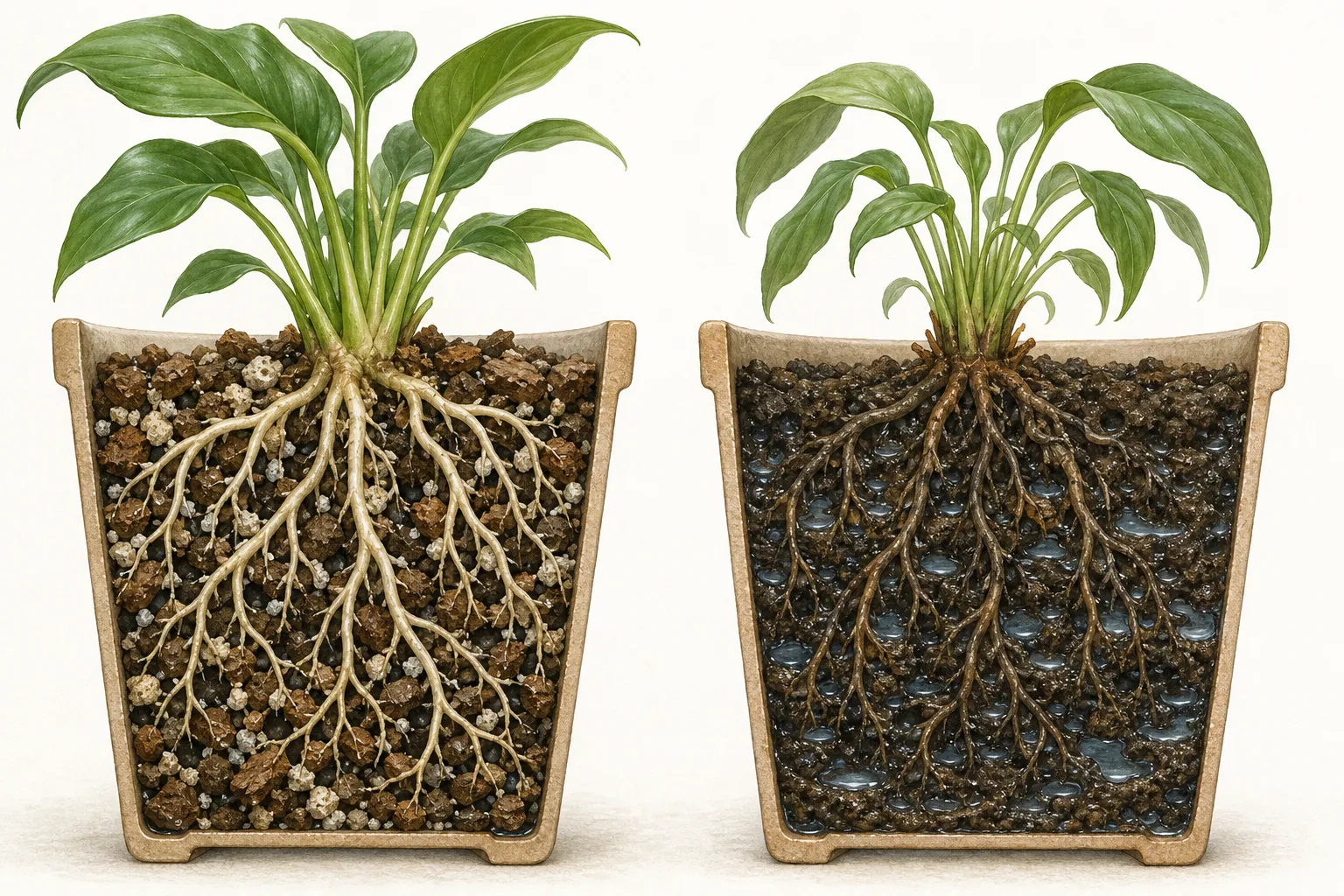
Roots do more than absorb water. They are living organs, and their cells need oxygen. Potting media contains many pores, or spaces, that can be filled by water or air. When water fills those spaces for too long, air cannot return easily, and fine roots are more likely to be damaged. Once fine roots are damaged, the plant’s ability to absorb water declines. That is why leaves may look wilted even when the potting mix is wet.
Damaged roots can make a wet plant look thirsty
This point causes many mistakes: the potting mix is wet, but the leaves droop. One possible reason is that the roots are no longer working well.
Healthy fine roots are working surfaces for water uptake and gas exchange. If roots stay in a wet, low-oxygen environment for a long time, fine roots can be damaged. Even when water is present, the plant may not absorb it normally. Leaves may wilt, yellow, or drop. On the surface, it can resemble drought, but the cause may be the opposite.
This is why leaves alone cannot diagnose the issue. Yellowing, wilting, and leaf drop may relate to roots, but also to light, temperature, old leaf turnover, media change, or other stress. These signs tell you to check the root environment; they do not prove one cause.
Drainage holes, media pores, and saucers all affect root-zone air
A pot is a limited container. Water does not move through it the same way it moves through a deep outdoor soil profile. Whether extra water can leave depends on drainage holes, media particle size, pot shape, root volume, season, and environment.
Focus on three observations:
- Drainage holes: Does extra water have an exit? Does an outer pot or saucer hold standing water for long periods?
- Media pores: Are there still spaces for air between particles, or has the media become fine, dense, and slow to dry?
- Wet-dry cycle: After watering, does the pot stay heavy for a long time? Is the surface dry while the bottom remains wet?
These clues are not instructions to take one immediate action. They help return the problem to the root environment. Root rot is not just “too much water.” It is a risk created by water, air, media, and time together.
Some root rots also involve pathogens
In everyday gardening, “root rot” is a broad term. It may describe roots that become dark, soft, nonfunctional, or decayed. The exact cause can vary. Sometimes long-term low oxygen and root damage are central. Sometimes wet, dense conditions also make certain soilborne pathogens more active.
This article stays at the low-risk observation level. It explains water, air, roots, and media. It does not provide pesticide, fungicide, or disease-treatment instructions.
Different plants respond differently to wet, dense media
Different plant roots are adapted to very different conditions. Phalaenopsis orchids are a useful example because they are epiphytic orchids and are often grown in airy bark-based media. Their thick fleshy roots make it easier to understand that roots need water and air.
But Phalaenopsis is not the standard for every plant. Succulents, ferns, foliage plants, bedding flowers, and woody plants all differ in water, aeration, and media needs. The reliable path is to understand the principle first, then return to the plant type and actual environment. A fixed watering schedule cannot fit every pot.
Common confusions
- ✕ Root rot is simply “watering too much.”
- ✓ Drainage holes, media aeration, pot size, season, light, and plant type all affect how long water stays around roots.
- ✕ Yellow leaves automatically mean root rot.
- ✓ Yellow leaves can remind you to check roots, but they can also come from many other environmental factors.
- ✕ Stones at the bottom of a pot guarantee root rot prevention.
- ✓ The key is whether the whole pot and media system allows extra water to leave and air to return.
- ✕ Wet media means the plant has enough water available.
- ✓ If roots are damaged, water may be present but not usable by the plant.
Frequently Asked Questions
Is root rot always caused by overwatering?
Not always. Excess watering is one direction, but drainage holes, media particles, pot size, season, light, plant type, and media aging all affect how long water stays. The better question is whether roots are staying wet and air-poor for too long.
Why does a plant wilt when the potting mix is wet?
If fine roots are damaged, the plant may not absorb water normally even when water is present. Wet stress and dry stress can look similar on leaves, even though the root-zone conditions differ.
Will every pot without drainage holes get root rot?
Not necessarily, but risk is higher. Drainage holes let extra water leave and make it easier for the pot to return to a water-air balance. Without them, water position inside the pot is harder to manage.
Do rocks at the bottom of a pot prevent root rot?
They should not be treated as a reliable guarantee. The real issue is the pore structure and drainage of the whole media and pot system, not simply a rock layer at the bottom.
Do yellow leaves mean root rot?
No. Yellow leaves are common and may relate to old leaf turnover, light, water, temperature, root stress, or other changes. Yellowing can prompt a root check, but it is not proof of root rot.
Related Terms
- Root rot: an everyday gardening term often describing roots that become dark, soft, decayed, or nonfunctional; exact causes can vary.
- Root respiration: root cell use of oxygen to maintain life processes.
- Oxygen shortage: low oxygen around roots, which can affect growth and water uptake.
- Drainage: the ability of excess water to leave the potting media and container.
- Aeration: the ability of media pores to hold and exchange air around roots.
- Pore: a space between media particles that can contain water or air.
Read Next
Evidence
References
These sources were used to check the plant-science concepts and gardening context in this article.