Water retention and drainage
Particles close together
Connected to an outlet below
Gravity-driven drainage and capillary retention.
Model conditions
An enlarged qualitative view of wettable particles with connected pores and an open outlet below. Film thickness and timing are not to scale. Retention also depends on pore shape, connectivity and surface properties. Not all retained water is available to roots.
Aeration does not mean making potting media dry
Aeration in potting media is about whether pores inside the media allow air to move and remain around roots. It does not mean “the drier, the better,” and it does not mean “the looser, the better.” A more accurate idea is that roots need both water and air near them.
Think of potting media as many particles piled together. The spaces between particles are pores. Sometimes those pores contain water; sometimes they contain air. Right after watering, water enters many pores. After extra water drains away, some pores should refill with air, so roots do not remain in a wet, air-poor environment.
Roots need oxygen too
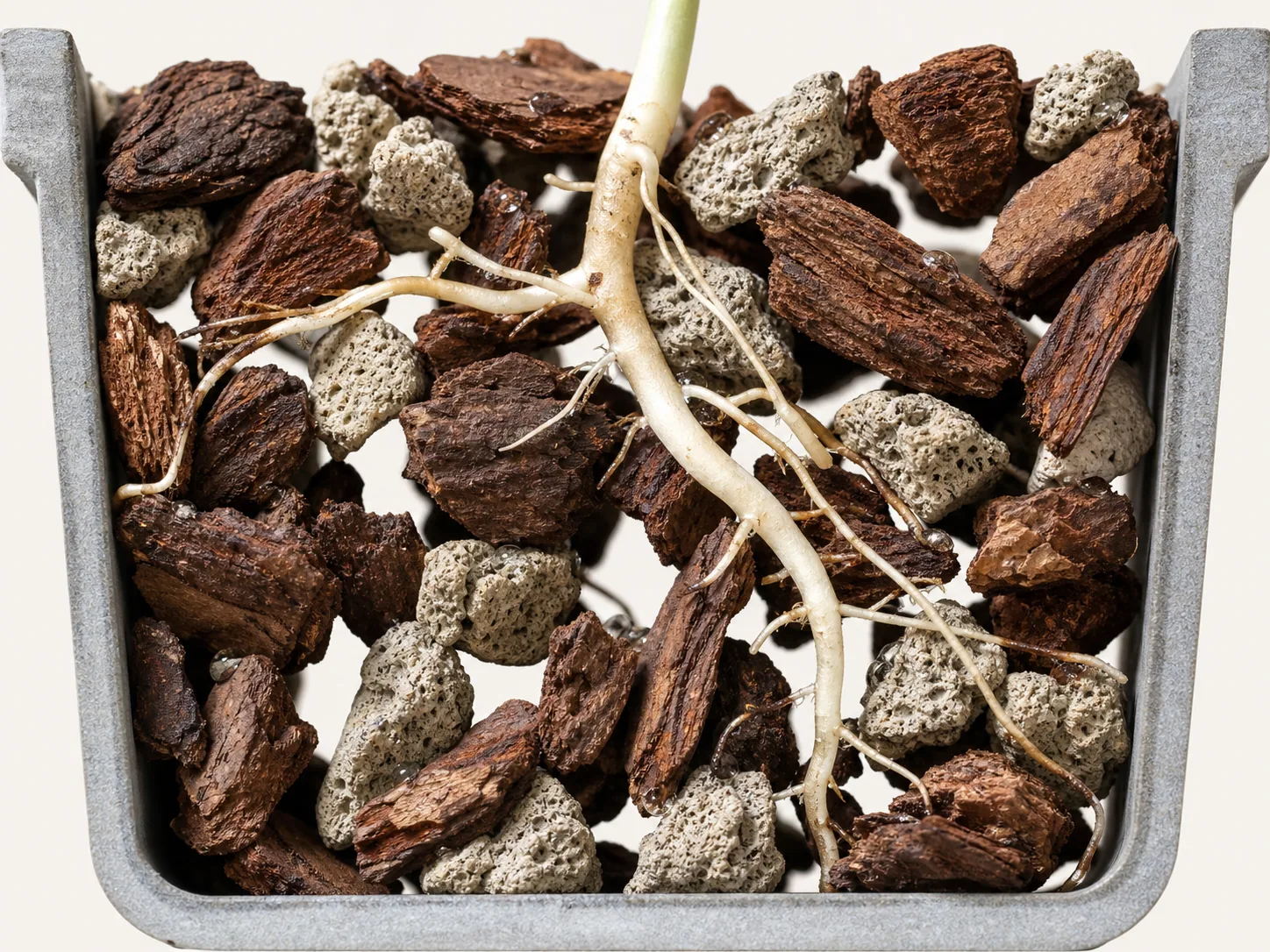
Roots do not only absorb water. Root cells also need oxygen for respiration, the cellular process that supports life activities. This is not breathing through a nose; it is the use of oxygen by cells.
If potting media stays so wet that pores remain filled with water, oxygen around roots decreases. The roots may not fail immediately, but long-term low oxygen can affect root growth and water uptake.
This is why drainage and aeration are connected. Drainage gives excess water a path out. Aeration means that after water leaves, pores can exchange air with the outside. Looking only at whether you watered is not enough. You also need to notice how long water stays and whether air can return.
The model below enlarges the pores between particles. Select “Start watering” and watch the larger channel regain air as water drains away, while some water remains in the narrow gap and on particle surfaces.
Particle size changes where water and air sit
Fine, compact media usually has smaller pores where water can remain longer. Coarser particles and larger pores usually allow water and air to move more easily. This is one reason potting mixes may include bark, perlite, or other particle materials to adjust drainage and aeration.
But this does not mean coarser is always better. Media that is too coarse and loose may not hold enough water, and roots may not have stable contact. A useful potting medium balances aeration, water retention, drainage, and physical support.
Media also changes over time. Materials can break down, become powdery, or compact. Large pores decrease, and both water movement and air exchange can slow. Even if your watering habit does not change, the root environment may no longer be the same as when the plant was first potted.
The “stuffy” part of a pot is often hidden
Do not judge only from the surface. A dry surface does not prove the bottom is dry. A loose-looking surface does not prove the inside has enough air.
More useful clues combine time and weight. After watering, does the pot stay heavy for a long time? Has the media become finer or denser? Does water take a long time to appear from the drainage holes? Does the same pot dry much more slowly in winter than in summer? These clues do not diagnose everything, but they can tell you to include root-zone wetness and aeration in your observations.
Common confusions
- ✕ Good aeration means the potting mix should be as dry as possible.
- ✓ Roots still need water. The issue is that water should not fill all pores for too long.
- ✕ Very loose media is always the best.
- ✓ Media that is too loose may hold too little water and support roots poorly.
- ✕ Drainage and aeration are the same thing.
- ✓ Drainage is about extra water leaving; aeration is about air spaces and air exchange.
- ✕ A pot with a bottom hole can never become air-poor.
- ✓ Dense media, fine particles, or standing water in a saucer can still reduce air around roots.
Frequently Asked Questions
Is aeration the same as drainage?
No, but they affect each other. Drainage asks whether excess water can leave. Aeration asks whether pores can hold and exchange air after water drains away.
Why does constantly wet media make roots uncomfortable?
When pores stay filled with water, oxygen around roots decreases. Root cells need oxygen for respiration, so long-term wet and air-poor conditions can weaken roots.
Do bark, perlite, sphagnum moss, and peat have the same aeration?
No, and the material name alone is not enough. Bark and perlite often create larger spaces. Sphagnum moss and peat often hold more water. But particle size, compaction, age, and mix ratio all change the real behavior.
How can I observe whether potting media is too dense or air-poor?
Watch whether the pot stays heavy for a long time after watering, whether media becomes powdery or compacted, whether the bottom stays wet, and whether roots show little new growth. These are observation directions, not formal diagnoses or automatic instructions to repot.
Does better aeration always mean watering more often?
Not always. Better aeration can change how quickly water leaves and how roots use the media, but watering frequency also depends on plant type, root amount, pot size, season, light, and airflow.
Related Terms
- Potting medium: the material in a pot that supports roots and provides access to water and air.
- Aeration: the ability of media pores to hold and exchange air around roots.
- Pore: a space between media particles that can contain water or air.
- Drainage: the ability of extra water to leave the media and pot.
- Water retention: the ability of media to hold some water for roots to use over time.
- Root respiration: the process by which root cells use oxygen to support life activities.
Read Next
Evidence
References
These sources were used to check the plant-science concepts and gardening context in this article.