
A bract is not a petal
Some of the most eye-catching parts of a plant look like petals but are actually bracts. A bract is a modified, leaf-like structure associated with a flower or an inflorescence. A petal, by contrast, is part of an individual flower. Bracts and petals can have similar colors and shapes, so brightness or size alone cannot tell them apart.
Look at how each part connects to the flower. Petals and sepals belong to an individual flower: petals make up the corolla, while sepals make up the calyx. Together, these floral parts form the perianth. A bract is associated with a flower, a flower-bearing axis, or a group of flowers. The forms and arrangements vary among plants, so it helps to look closely for the individual flowers rather than judge by appearance alone.
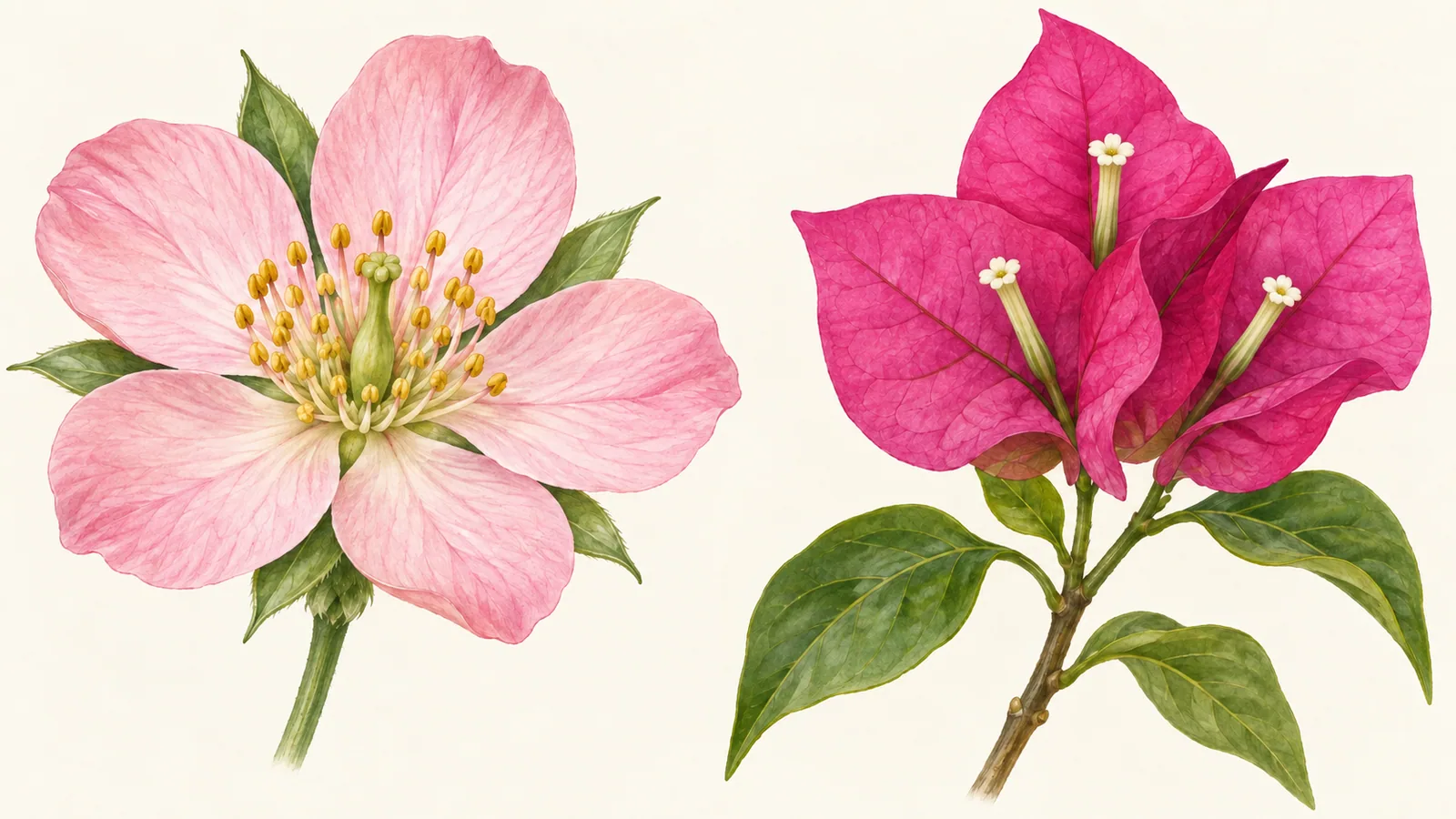
Find the individual flowers within the display
The colorful parts of bougainvillea are often mistaken for petals, but they are bracts. North Carolina State Extension describes clusters of three small, white tubular flowers accompanied by three to six showy bracts. Those counts describe the example; they should not be treated as a fixed pattern for every cultivar or branch. From a distance, the bracts may draw more attention than the flowers, but the two are different structures.
Poinsettia is another familiar example. Its showy red, pink, or white parts are bracts. The center contains several cyathia; one is a cyathium, the specialized inflorescence of Euphorbia. Each cyathium has a cup-shaped involucre that encloses highly reduced female and male flowers. A conspicuous yellow nectar gland sits on its rim. So the familiar “large red flower” is not a single bloom surrounded by red petals.
Bracts do not have to be colorful. Some are small, inconspicuous, and green; others are more noticeable than the flowers. Petals do not have to be large or brightly colored, either. Sepals can also be colorful or petal-like. When petals and sepals look alike or are not clearly differentiated, botanists may use the more neutral term tepals. In some plants, showy bracts may make a flower cluster more conspicuous, but bracts have varied functions across plants; it is not accurate to say that they all attract insects.
Not every petal-like structure is a bract. A sunflower looks like one flower from a distance, but its flower head is an inflorescence made up of many small flowers, or florets. The yellow, strap-shaped parts around the outside are the corollas of ray florets, not bracts. The green, leaf-like structures at the base of the flower head are involucral bracts. This example shows why a flower-like appearance does not reveal which structural level a part belongs to.
If you are unsure, observe the plant in this order:
- Look for visible stamens, a pistil, or individual florets to work out where the flowers are.
- Check whether the showy part belongs to an individual flower’s corolla or is a leaf-like structure associated with a flower or flower cluster.
- Do not identify a part by color, size, or a petal-like appearance alone. Some plants have highly specialized floral structures that cannot be identified from a distant view.
For the parts of an individual flower, see What Are the Main Parts of a Flower?. If you are looking at a group of flowers, continue with What Is an Inflorescence?. You can also learn more about what petals do.
Common points of confusion
- ✕ A brightly colored structure that looks like a petal must be a petal.
- ✓ Bracts can be colorful or petal-like. Check whether the structure belongs to an individual flower, and look for nearby flowers or an inflorescence.
- ✕ A cluster of colorful parts must be one flower.
- ✓ A flower cluster can contain many small flowers together with bracts, as in bougainvillea.
- ✕ Bracts are always green or always smaller than petals.
- ✓ Bracts vary in color and size; neither feature identifies them on its own.
Frequently Asked Questions
What is the main difference between a bract and a petal?
A petal is part of the corolla of an individual flower. A bract is a modified, leaf-like structure associated with a flower or an inflorescence. Sepals are also parts of an individual flower: they form the calyx, while petals form the corolla. Color alone cannot distinguish these structures, so look at how each one connects to the flower or flower cluster.
Are bracts always green?
No. Bracts can be green, red, white, or other colors, and some look much like petals. The colorful parts of bougainvillea and poinsettia are bracts.
Are the colorful parts of bougainvillea petals?
No. The showy parts are bracts, while the small tubular flowers in the cluster are the flowers themselves. Their number can vary.
Are all the yellow-green structures at the center of a poinsettia flowers?
No. The center is a cluster of cyathia, the plural of cyathium. Each cyathium has a cup-shaped involucre that encloses highly reduced female and male flowers; the conspicuous yellow structure on its rim is a nectar gland. The showy red or other-colored parts around the cluster are bracts, not petals.
Are the yellow parts around the edge of a sunflower head bracts?
No. They are the corollas of the outer ray florets. The green, leaf-like structures at the base of the flower head are the involucral bracts. A sunflower head is an inflorescence made up of many small flowers.
Does every flower have an obvious bract?
No. Bracts may be small, green, or difficult to see, and they are not always conspicuous around an inflorescence. Color and outline alone are often not enough to identify a plant structure.
Key terms
- Bract: A modified, leaf-like structure associated with a flower or an inflorescence. It may be inconspicuous or showy and petal-like.
- Petal: A part of an individual flower; petals together make up the corolla.
- Sepal: A part of an individual flower; sepals together make up the calyx.
- Perianth: The floral parts that surround the reproductive structures, including petals and sepals when they are differentiated.
- Tepal: A perianth part used when petals and sepals are similar or not clearly differentiated.
- Inflorescence: A flower-bearing arrangement or system, often understood as a group of flowers arranged along a shared axis or its branches.
- Cyathium: The specialized, flower-like inflorescence of Euphorbia. Its cup-shaped involucre encloses highly reduced female and male flowers. The plural is cyathia.
- Ray floret: An outer individual flower in a head-shaped inflorescence of the daisy family; its corolla forms the flat, strap-like part.
- Bougainvillea: The garden plant used here as an example of small tubular flowers accompanied by colorful bracts.
Keep reading
Evidence
References
These sources were used to check the plant-science concepts and gardening context in this article.