
Where does a tree add new wood?
The orange frame on the cross-section links to the enlarged view. Start by finding where new growth happens.
Both sides grow: the cambium adds wood inward and dark-pink new phloem outward.
Watch where the new wood appears, and how earlywood and latewood join to form one year’s growth.
How to read this model
A qualitative model of conifer wood with distinct earlywood, latewood and annual growth bands. Shape, cell sizes, layer counts, colors, ring widths and speed are simplified; the cambium is enlarged for visibility. Demo years count added wood, not the tree’s total age.
The enlarged view follows the current year’s cambium, shifting outward between years. New wood cells expand, thicken their walls and mature; that timing is compressed here. In real wood, neighboring cells can be at different stages of development.
The cambium also adds phloem outward. Dark pink marks the new tissue; older phloem moves outward and is shown slightly compressed. In real stems, some older conducting cells collapse and lose their transport function; not all older phloem dies together. Phloem is not preserved intact as wood rings are. Timing and proportions on both sides are simplified, not necessarily simultaneous or in a fixed ratio.
Transitions, colors and proportions vary with species and conditions. The article below explains false rings, locally missing rings and bands that are not annual.
The bands visible in a cross-section of wood are commonly called tree rings. They form as the vascular cambium adds new xylem outside older wood. When growing conditions change with the seasons, wood cells may also differ, leaving visible bands. In trees with clear seasonal growth whose annual pattern has been confirmed, one growth increment usually corresponds to one year. But a visible band does not automatically represent a calendar year.
Tree rings build up in the wood over time
The trunk contains a very thin layer of growing tissue called the vascular cambium. It lies between the xylem and phloem. When active, the cambium adds new xylem toward the inside of the stem and new phloem toward the outside. Wood is made mostly of xylem accumulated over many years. To see how the cambium helps some stems grow thicker, read Why Do Some Stems Grow Thicker?.
Each new layer of xylem forms between the older wood and the cambium. In a cross-section, wood closer to the center usually formed earlier, while wood nearer the bark is usually newer. The cambium itself is extremely thin. Growth bands are features within the xylem; they are not thick layers of cambium.
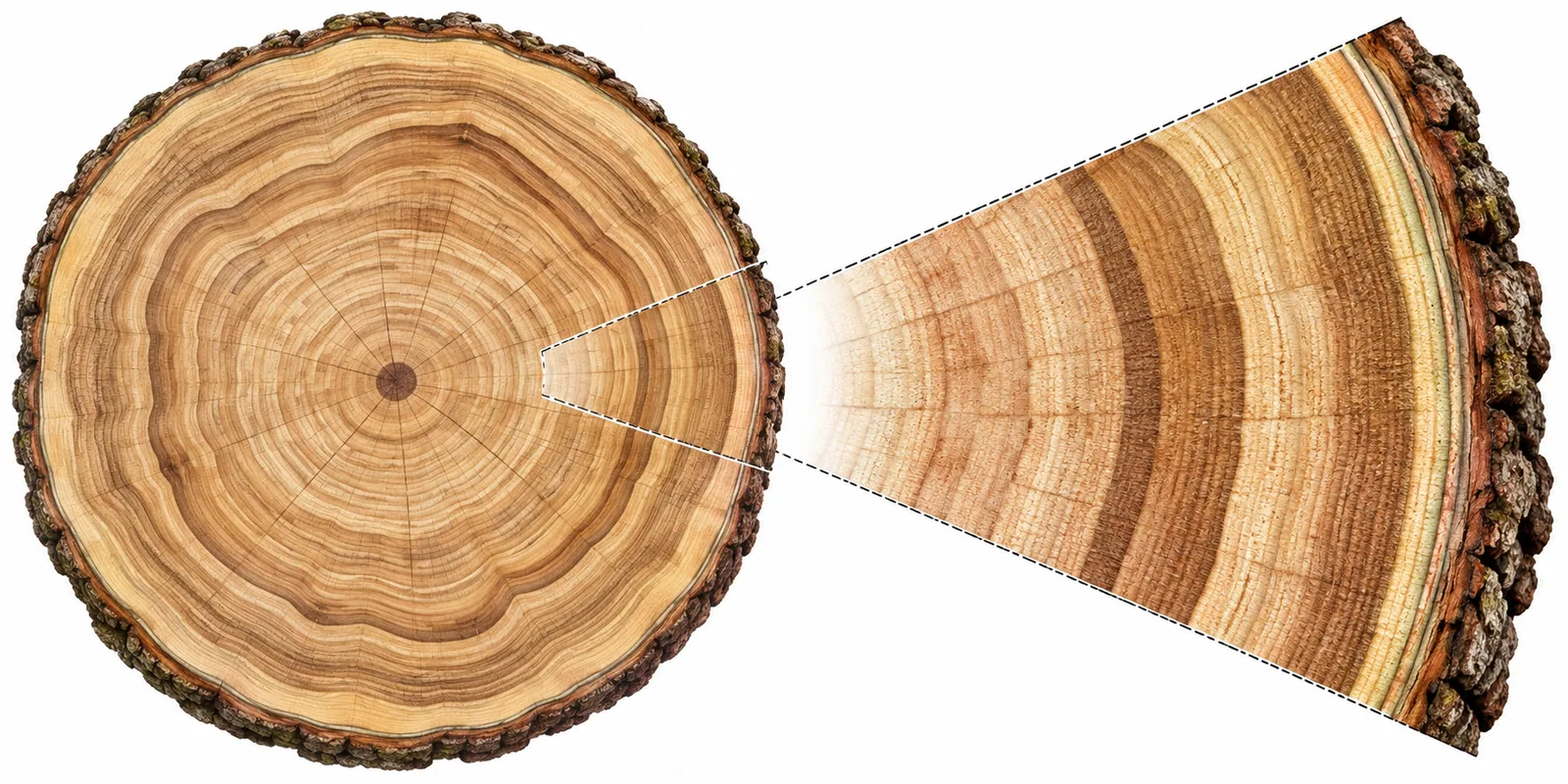
Earlywood vs. latewood: seasonal growth leaves different bands
In places with marked seasons, cambium activity changes over the course of a year. In many trees, earlywood forms earlier in the growing season. Its cells are often larger and have thinner walls, so the wood may look lighter. Latewood, which forms later in the season, often has smaller cells with thicker walls and may look denser or darker. These differences can create visible bands in the wood.
In some trees, earlywood and latewood are different parts of the same annual growth increment, not two separate years. Wood structure varies among species: the transition between earlywood and latewood may be sharp, gradual, or difficult to identify by color alone. In some woods, changes in vessel size or arrangement make the growth bands easier to see. A light-and-dark pattern is a common clue, not a universal template.
The demonstration below uses conifer wood with distinct earlywood and latewood. Start it to follow new cells forming just inside the cambium, then add another year to see where the next wood appears. A cell’s lumen is the space enclosed by its wall, visible in the enlarged view.
What can growth bands tell us about a tree?
For a tree whose annual growth pattern has been confirmed, the width of each annual ring can give a clue to how much wood the trunk added outward during that period. For trees whose growth is limited by water, a wetter growing season may sometimes coincide with a wider ring. Elsewhere, temperature, the length of the growing season, or other conditions may matter more. A tree’s age and size, light exposure, competition from nearby plants, and other disturbances can also affect its wood increment.
That is why a wide band by itself cannot show that rainfall was high, that a tree was healthy, or that one environmental factor caused the growth. Researchers first check that a growth pattern is annual, then compare patterns across multiple trees with local environmental records. Tree-ring studies can measure width and wood density, among other features; a dark band seen by eye cannot be used on its own to infer a specific temperature or amount of rainfall.
False rings and missing rings can complicate a count
Where growing and dormant seasons are distinct, the cambium often adds one increment of wood each year, making annual rings easier to identify. Still, species, location, and growing conditions all affect how clearly a boundary appears.
If conditions worsen and then improve within a single growing season, the wood may develop a false ring that looks like a boundary between years. Conversely, a growth band may fail to form or may be hard to recognize in part of a trunk, creating a locally missing ring. Counting lines in just one cross-section can therefore lead to a count that is too high or too low.
Tropical trees do not all lack annual rings. Some species form recognizable annual growth bands in response to seasonal changes in rainfall. In other species, growth is harder to match to calendar years. Whether a tree’s bands are annual cannot be decided from a tropical or temperate label alone, or from a single wood cross-section.
Common mix-ups
- ✕ Every visible band represents one year.
- ✓ A growth band can be assigned to a year reliably only when the annual pattern has been confirmed for that species and site. False rings and locally missing rings can occur.
- ✕ One light band and one dark band each represent a year.
- ✓ In some seasonal woods, lighter earlywood and darker latewood are different parts of the same growth increment.
- ✕ A wider ring means more rain or a healthier tree that year.
- ✓ Ring width depends on local growth limits and on differences among trees. It cannot, by itself, diagnose health or determine the weather.
- ✕ Tropical trees never form annual rings.
- ✓ Some tropical trees form annual growth bands in response to seasonal conditions; in other species, boundaries may be unclear or not yet interpretable by year.
Frequently asked questions
In an earlywood-and-latewood pair, how many years are there?
In some woods with seasonal growth, lighter earlywood and darker latewood are often different parts of the same growth increment, so they should not be counted as separate years. Cell structure and color patterns vary among species, so color alone cannot determine the year.
Do tree rings always mean one year?
No. Seasonality, species, and growing conditions affect how clearly a boundary forms. A false ring can form within a year, and a ring may be missing from part of a trunk. Researchers need to confirm an annual pattern before interpreting growth bands by year.
Does a wider ring mean there was more rain?
For some trees limited by water, wetter growing conditions may coincide with wider rings. Other trees may be more affected by temperature, light, age, competition, or other conditions. The width of one ring on one tree cannot identify a single cause for that year’s growth.
Can tree rings tell us a tree’s exact age?
They can provide clues about when a tree grew, but the number of bands visible in one cross-section does not guarantee an exact age. Annuality must be confirmed, and false or locally missing rings can make a simple count inaccurate. Professional studies cross-check more than one line of evidence.
Do tropical trees have annual rings?
Some do. Seasonal changes in rainfall can lead some tropical trees to grow in recognizable cycles. Other species do not leave clear boundaries that can be matched to calendar years. Whether bands are annual depends on evidence for the species and site.
Related terms
- Vascular cambium: A growth tissue that can keep producing new cells; in woody stems, the cambium adds xylem toward the inside.
- Xylem: One of a plant’s vascular tissues, commonly involved in water transport and support. Wood is made mostly of accumulated xylem.
- Earlywood: Wood formed earlier in a seasonal growth increment; its cell structure often differs from latewood.
- Latewood: Wood formed later in the same seasonal growth increment; it may be denser or darker, though its appearance varies by species.
- Growth ring: A recognizable increment of growth in wood. It should be called an annual ring and interpreted by year only when the pattern is known to form once a year.
- Dendrochronology: The study of tree rings and the timing and environmental signals they record.
Read next
Evidence
References
These sources were used to check the plant-science concepts and gardening context in this article.
View sources and further reading (12)
- link.springer.com — s00468 014 1026 x
- sheppard.ltrr.arizona.edu — RingStructure.htm
- frontiersin.org — full
- extension.usu.edu — what is a tree
- fpl.fs.usda.gov — fpl gtr282.pdf
- research.fs.usda.gov — 38087
- besjournals.onlinelibrary.wiley.com — j.1365 2745.1999.00361.x
- ltrr.arizona.edu — ringanomalies.htm
- frontiersin.org — full
- ncei.noaa.gov — how can tree rings teach us about climate
- ncei.noaa.gov — tree ring
- nist.gov — how do you measure age tree