
A useful way to understand it: cells make tissues, and tissues make organs
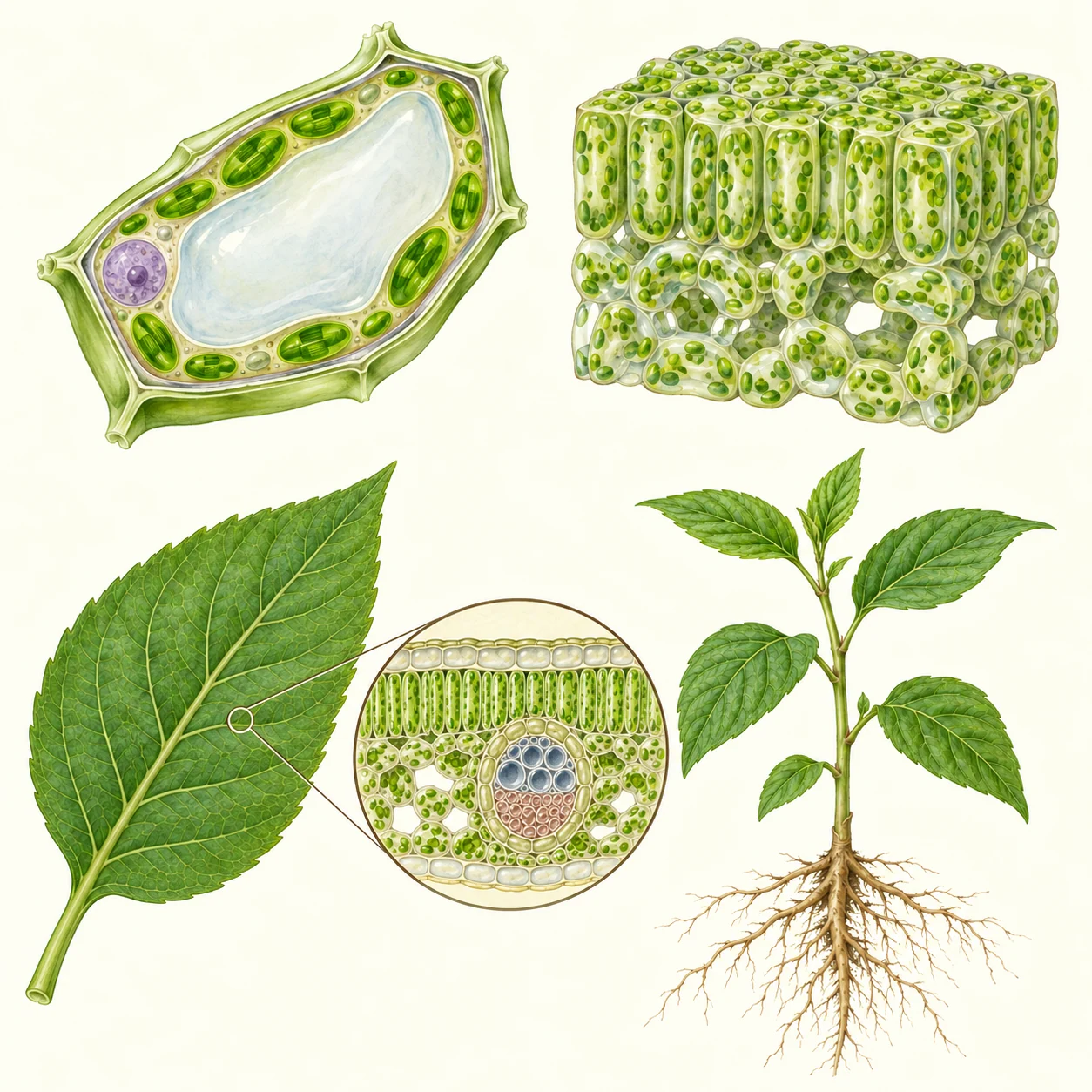
A plant cell is a basic structural and functional unit of a plant. Many cells arranged in an organized way and working together form a tissue. Several kinds of tissue, in turn, combine to form an organ with a characteristic structure and set of jobs.
Consider one leaf. A single mesophyll cell can carry out photosynthesis. Many mesophyll cells arranged together form mesophyll tissue. Mesophyll, the upper and lower epidermis, and the vascular tissues in the veins all contribute to the leaf as an organ. A cell, a tissue, and an organ are not simply three sizes of the same thing. They are nested levels of biological organization.
Plant cells are not identical building blocks
Plants are multicellular organisms. Their cells have a cell membrane, cytoplasm, and genetic material. Many mature plant cells also have a cell wall, a relatively large central vacuole, and plastids. But cells throughout a plant do not all develop the same shape, and they do not all perform the same work.
Mesophyll cells commonly contain many chloroplasts and are well placed to receive light and carry out photosynthesis. A root hair is an outward extension of an epidermal cell that increases the root’s contact area with its surroundings. Xylem contains cells suited to water transport, storage, and support, while phloem combines cells involved in moving organic substances. Such differences arise through differentiation, the developmental process by which cells acquire particular structures and functions.
So “plants are made of cells” does not mean that a plant is a pile of completely identical units. Cell type, position, arrangement, and connections all help determine what a tissue—and ultimately an organ—can do.
A tissue is a coordinated group, not necessarily one cell type
An introductory definition often describes a tissue as a group of cells with related forms and functions. That is a useful starting point, but it should not be reduced to “one kind of cell equals one tissue.” Some plant tissues consist mainly of similar cells; others contain several cell types whose work depends on one another.
Xylem and phloem, for example, are not individual cells. Xylem includes different cells involved in conduction, storage, and support. Phloem includes sieve-tube elements, companion cells, and other cells. Both are vascular tissues, and together they form part of the plant’s long-distance transport network through roots, stems, and leaves. To see how they are arranged within organs, continue with What Is a Vascular Bundle?.
In familiar vascular plants, three tissue systems provide one useful way to understand a mature organ:
- The dermal tissue system forms the outer covering. It is important in protection and can also participate in gas exchange and absorption. Here, the epidermis of leaves and young organs is the main example. See What Does the Plant Epidermis Do?.
- The ground tissue system occupies much of the space between dermal and vascular tissues. Depending on the organ and cell types involved, it can contribute to photosynthesis, storage, and support.
- The vascular tissue system includes xylem and phloem. It connects organs for long-distance transport and also contributes to support.
All three systems occur in roots, stems, and leaves, but their arrangements differ. Those arrangements help a leaf spread out to receive light, a root extend through its growing environment, and a stem support and connect the two.
An organ is not simply a tissue made bigger
An organ is a structure made of several tissues organized to carry out a set of major functions. Roots, stems, leaves, flowers, fruits, and seeds are familiar organs of flowering plants. The Basic Organs of a Plant provides a useful whole-plant map.
A leaf is not merely “many mesophyll cells.” Its outside includes epidermal tissue; its interior includes mesophyll; and its veins contain xylem and phloem. It also has stomata, guard cells, and supporting structures. Together, these tissues let the leaf receive light, exchange gases, obtain water, and move organic products to other parts of the plant. The leaf’s work depends on coordination among several tissues, not on one cell type acting alone. What Do Leaves Do? places those activities back in the context of the whole leaf.
Roots and stems follow the same general principle. They also contain outer protective tissues, ground tissues, and vascular tissues, arranged differently for their jobs. Young roots and stems usually have an epidermis; in many roots and stems that continue to thicken, another protective tissue called periderm later replaces it. To decide whether something is a cell, tissue, or organ, do not rely on size alone. Ask which level of organization it belongs to, what it is made of, and what the structure accomplishes as a whole.
At the next level up, the organs of a vascular plant can be grouped into a root system and a shoot system. The root system consists of roots and related structures. The shoot system includes stems and leaves, as well as reproductive structures such as flowers and fruits. An entire plant is an organism, not one extremely large organ. This root–shoot model is mainly for vascular plants and should not be applied without qualification to nonvascular plants such as mosses.
Where do meristems fit into this map?
Growing regions such as root tips and shoot tips contain meristems. Their cells are not yet fully differentiated and can continue dividing. The new cells they produce later enlarge, differentiate, and contribute to mature tissues and organs.
By contrast, the terms mature tissue or permanent tissue in introductory botany usually describe tissue whose cells have completed their main differentiation and are not characterized by ongoing division. “Permanent” does not mean that every living cell in such tissue is absolutely incapable of re-entering the cell cycle under any conditions.
This points to two different ways of classifying plant tissues:
- Meristematic versus mature (or permanent) tissue emphasizes developmental state—whether a region is actively producing new cells and how far its cells have differentiated.
- Dermal, ground, and vascular tissue systems emphasize position, continuity through the plant, and major functions in mature organs.
These are two different classification angles. A meristem should not be forced into a list as if it were a fourth mature tissue system alongside dermal, ground, and vascular tissue.
In a garden, a shoot tip, root tip, or new branch emerging from a bud after pruning can help you connect visible growth with meristems and cell division. What you see with the naked eye is the result of growth, however; appearance alone cannot tell you which developmental step every cell is undergoing at that moment.
Common mix-ups
- ✕ The organelles inside a cell are the same as plant organs such as roots, stems, and leaves.
- ✓ An organelle is a structure inside a cell, such as a chloroplast. An organ, such as a leaf, is built from several tissues.
- ✕ A tissue is just a pile of completely identical cells.
- ✓ Cells in a tissue are organized and work together. A complex tissue may contain several cell types.
- ✕ A leaf contains only mesophyll tissue.
- ✓ A leaf is an organ containing epidermal, mesophyll, vascular, and other structures.
- ✕ Meristematic tissue is a fourth mature tissue system alongside dermal, ground, and vascular tissue.
- ✓ Meristematic tissue describes actively dividing, not-yet-fully-differentiated growth regions. The three tissue systems describe the major tissue organization of mature organs.
- ✕ Any single plant cell can always grow into an entire plant.
- ✓ Some plant cells can regain developmental flexibility under suitable conditions and signals, but regeneration depends on species, cell state, and culture conditions. It is not guaranteed.
Frequently asked questions
What is the simplest difference between a plant cell, tissue, and organ?
A cell is a basic structural and functional unit. A tissue consists of cells arranged in an organized way and working together. An organ combines several tissues to carry out a set of major functions. “Mesophyll cell → mesophyll tissue → leaf” is a useful first example.
Is a chloroplast a cell, tissue, or organ?
None of those. A chloroplast is an organelle, a structure inside certain plant cells. Mesophyll is a tissue, while a leaf is an organ. They belong to different levels of organization.
Are xylem and phloem cells or tissues?
They are tissues, and each includes more than one cell type. Xylem is mainly associated with the transport of water and minerals as well as support. Phloem mainly transports sugars and other organic substances. Within an organ, they often occur together in vascular bundles or other vascular arrangements.
Are roots, stems, and leaves all organs?
Yes. In familiar vascular plants, roots, stems, and leaves are vegetative organs. Each is made of several tissues, but their forms, arrangements, and major functions differ.
Why does onion epidermis look like many small boxes under a microscope?
You are seeing many cells in a layer of epidermal tissue, and their cell walls make the boundaries easy to distinguish. Each “box” is a cell, not the whole tissue. The cells arranged together in that position form the epidermal tissue.
Do all plant cells have chloroplasts?
No. Many light-exposed mesophyll cells contain chloroplasts, but root cells and many epidermal cells generally do not. Whether obvious chloroplasts are present depends on the organ, tissue, developmental state, and function of the cell.
Why are meristems important?
Meristems are important growth regions in which plants continue to produce new cells. Those new cells can later enlarge and differentiate into mature tissues, contributing to the growth of roots, stems, leaves, and other organs.
What is the difference between tissue damage and organ damage?
The terms describe different scopes. Tissue damage affects a particular tissue or local group of cells. Organ damage affects a whole structure such as a leaf, root, or stem and may involve several tissues at once. External appearance alone usually cannot identify the exact level or extent of damage.
Related terms
- Cell: A basic structural and functional unit of a living organism.
- Organelle: A structure inside a cell that performs a particular job, such as a chloroplast.
- Tissue: A group of cells and associated structures arranged to work together.
- Tissue system: A broad, continuous category of tissues found across organs. In vascular plants, the three major systems are dermal, ground, and vascular.
- Organ: A structure made of several tissues and characterized by a particular form and set of major functions.
- Organ system: A group of functionally related organs. A vascular plant can first be divided into root and shoot systems.
- Organism: The organizational level represented by an entire plant, not by a single organ.
- Differentiation: The developmental process by which cells acquire particular structures and functions.
- Meristem: A plant growth region containing cells that are not fully differentiated and can continue dividing.
Keep exploring
Evidence
References
These sources were used to check the plant-science concepts and gardening context in this article.
View sources and further reading (8)
- openstax.org — 1 2 themes and concepts of biology
- openstax.org — 30 1 the plant body
- openstax.org — 30 4 leaves
- extension.oregonstate.edu — em 9898 internal plant parts
- extension.oregonstate.edu — em 9904 vegetative plant parts
- open.lib.umn.edu — 6 1 plant cells and tissues
- open.lib.umn.edu — 7 1 meristem morphology
- ncbi.nlm.nih.gov — NBK26922