
Growing-media pH describes how acidic or alkaline the water around plant roots is. It does not tell you how much nutrient a potting mix contains. Instead, pH can change the chemical forms and solubility of some nutrients in the water held within the media. That can change how much is present in forms roots can take up.
In ordinary aqueous solutions, pH 7 is the neutral reference: values below 7 are acidic, and values above 7 are alkaline. Chemically, pH is the negative base-10 logarithm of hydrogen-ion activity. A change of one pH unit corresponds to roughly a tenfold difference in that activity, so pH 5 and pH 6 are not just neighboring points on a linear scale. pH also does not measure the total amount of acid in a growing medium.
A potting mix is not a uniform glass of water. Its pH reading usually comes from water extracted from a root-zone sample or from liquid that drains through the media. A reading from irrigation water alone cannot stand in for a substrate pH test.
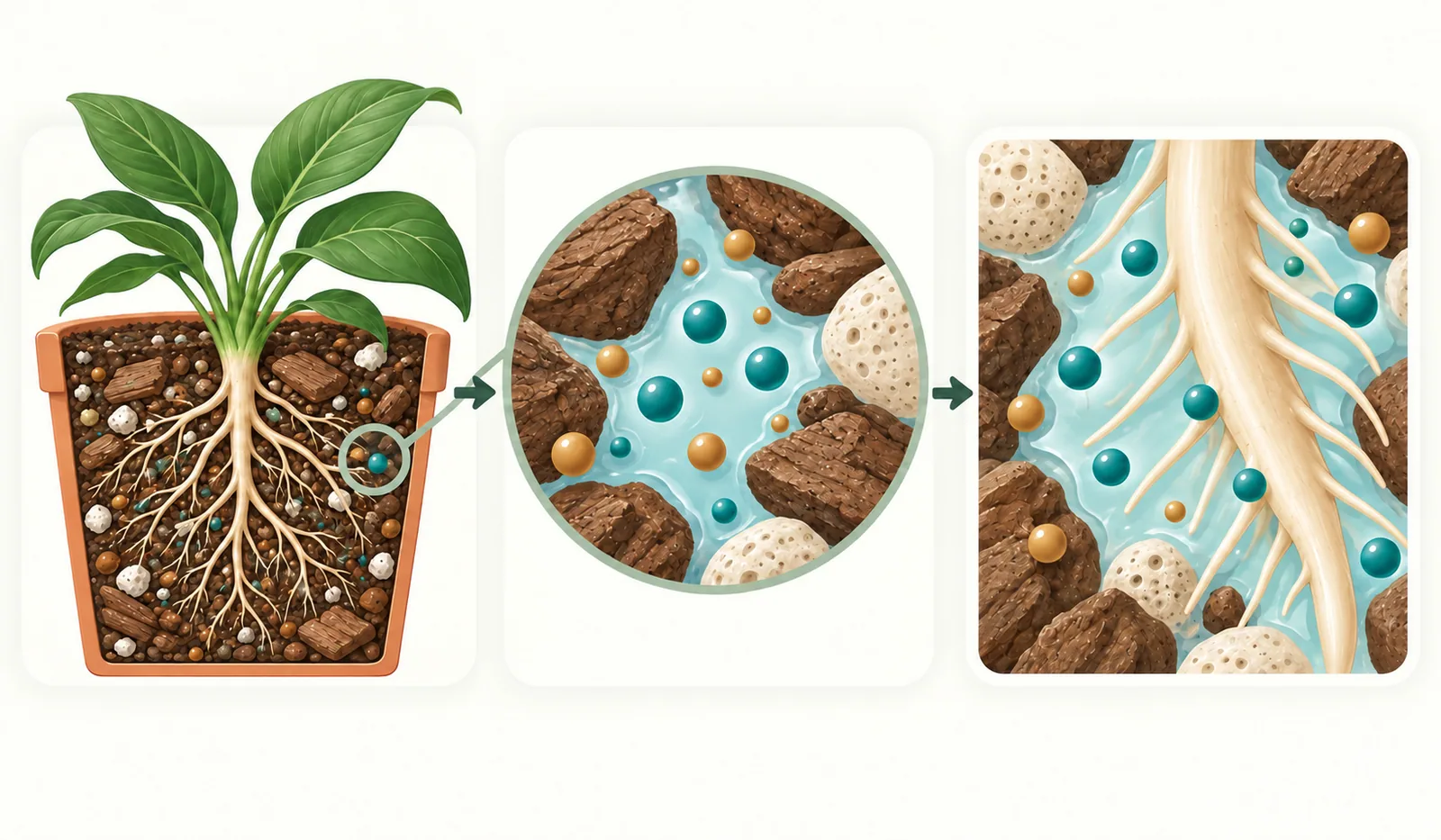
pH affects nutrient availability, not the total amount
Plants take up mineral nutrients from the water around their roots, often as dissolved ions. An element can be present in a growing medium without being in a form that roots can readily use at that moment. pH affects chemical reactions and solubility: some forms remain more readily dissolved, while others may bind with other materials or become less soluble. As a result, two media with similar total nutrient amounts can have different shares available in the root zone.
“Not enough nutrient is present” and “nutrient is present but less available” describe different situations. pH is one factor that affects availability; it does not by itself determine how much a plant absorbs. Plant species, media ingredients, nutrient forms in the fertilizer, irrigation water, and root condition all matter too. For a primer on the roles of nitrogen, phosphorus, and potassium, see What Are N, P, and K?.
Nutrients do not all respond to pH in the same way
A change in pH does not make every nutrient increase or decrease together. The chart below gives each of 12 commonly illustrated mineral nutrients its own row. The horizontal axis is pH, and each curve shows that element’s relative availability, making it easy to compare its response across acidic and alkaline conditions.

A conceptual soil chart helps show broad patterns among elements. Soilless potting media still need to be interpreted with the crop, ingredients and test method. Chlorine and nickel are also essential mineral nutrients, but are not included in this common 12-element chart.
For example, under some plant and growing-medium conditions, a higher root-zone pH can reduce the availability of iron (Fe). Purdue Extension describes crop examples in which high substrate pH limits iron uptake. In acidic soil, iron, manganese, and zinc can also become more soluble; more soluble does not always mean better, since very low pH can make some elements excessive.
Phosphorus (P) shows why a general chart is useful for broad trends but not precise predictions. In a 2025 study, the USDA Agricultural Research Service compared several peat-based soilless media under different lime and nutrient conditions. Soluble phosphorus was lower at higher pH, with a stronger decline when calcium hydroxide was the lime source. Because the lime source also affected the results, this cannot be read as a pH-only effect. The study also found that other nutrients responded differently depending on the media ingredients and material sources. These findings describe particular materials and conditions; they do not establish the same response for every potting mix.
pH targets depend on the growing medium and plant. Broadly, 5.6–5.7 can be an acceptable mildly acidic reading in many growing contexts. UF/IFAS gives 5.5–7.0 for most commercial vegetable crops grown in soil, while USDA research gives about 5.6–6.2 for most floriculture crops grown in soilless media. General soil references can be higher: Oregon State University Extension gives about 6.0–7.0 as ideal for most plants in soil, while listing blueberries at 4.5–5.5 and tomatoes at 6.0–6.8. These ranges apply to different crops and media, and readings should also be interpreted with the test method used.
So, 5.6–5.7 falls within acceptable ranges for many vegetable-soil and soilless-floriculture contexts. Check a specific plant’s preferred range together with its medium and test method. Treat pH as one clue about root-zone chemistry, alongside other test information.
Read a media pH value together with its test method
Growing media are not uniform like a glass of water. A test may first extract soluble materials from a sample and then measure the resulting solution. Common approaches include the saturated media extract (SME), a fixed-ratio water dilution such as 1:2, and the PourThru method, which collects leachate from the pot. The sample, water amount, media-to-water ratio, and other test conditions differ, so the readings and reference ranges are not automatically interchangeable.
When comparing results, check that the same method and sampling conditions were used, and interpret the number with guidance for that method. Field-soil reference values may not apply to soilless potting media, which are made from different materials and tested differently. Confusing a media result with irrigation-water pH can also hide another factor: pH describes the water’s current acid–base condition, while alkalinity describes its ability to neutralize acid and resist changes in pH. They are different measurements.
Some reports also include electrical conductivity (EC). pH describes acidity or alkalinity; EC reflects the overall conductivity associated with dissolved ions and salts in the solution. EC does not identify how much of each individual nutrient is present. These measurements answer different questions, and neither one alone describes the full nutrient condition of a growing medium.
To learn how water moves through potting media, see Water Retention vs. Drainage. Media ingredients also shape root-zone conditions; compare Sphagnum Moss, Bark, Coco Chips, and Potting Mix and Why Does Potting Mix Sink Over Time?.
Leaf changes are clues, not a diagnosis
In some conditions, a higher media pH can reduce iron availability and may be associated with changes such as paler leaves, different-looking veins, or slower growth. Those signs can have several causes. Other nutrient issues, root or water conditions, and different stresses can produce similar appearances. A leaf symptom or a single pH reading cannot identify the cause on its own.
If you are observing a plant, note whether the change is on newer or older leaves, whether the veins look different from the areas between them, and whether it affects one part of the plant or more broadly. Recent changes in the growing medium and growth conditions can add context. These observations can help describe what is happening, but they do not confirm a diagnosis. For another part of the root-zone environment, see What Is Aeration in Potting Media?.
Common points of confusion
- Misconception: The pH number tells you the total amount of nutrient in a potting mix.
What it means: pH describes an acid–base condition that can affect the forms and availability of some nutrients; total nutrient content is a separate question. - Misconception: pH 7 is best for every potted plant.
What it means: Plants and growing media differ, so no single pH value applies to every situation. - Misconception: The lower the pH, the easier it is for a plant to absorb every nutrient.
What it means: Nutrients respond differently to pH, and media and fertilizer conditions also affect the result. - Misconception: Irrigation-water pH is the same as the pH inside a pot.
What it means: A media reading usually comes from an extract or leachate from the root-zone medium; water pH alone cannot replace it. - Misconception: Pale leaves prove there is a pH or iron problem.
What it means: pH can affect nutrient availability, but similar symptoms can have different causes. One visual clue is not enough to identify the cause.
Frequently asked questions
What does pH 7 mean?
In an ordinary aqueous solution, pH 7 is the neutral reference. Values below 7 are acidic and values above 7 are alkaline. Because pH is logarithmic, a one-unit difference represents roughly a tenfold difference in hydrogen-ion activity.
Does a potting mix pH test tell me how much fertilizer or nutrient is left?
No. pH describes an acid–base condition and its possible chemical effects; it is not a nutrient-content list. EC can reflect the overall dissolved-ion or salt condition of a solution, but it does not report the amount of each nutrient separately.
Why can pH affect nutrient uptake?
pH can change the solubility or chemical form of some nutrients. That can change how much of a form roots can access. Elements respond differently, so one direction cannot be applied to all nutrients.
Is there one pH that suits every potted plant?
Many plants grow in near-neutral or slightly acidic conditions, but pH 7 is not automatically the best value for every crop or medium. Soil, soilless media, and specific crops have different reference ranges, which also need to match the test method.
Is pH 5.6–5.7 suitable for most plants?
In many vegetable-soil and soilless-floriculture reference ranges, 5.6–5.7 can be an acceptable mildly acidic reading. A specific plant’s preferred range still depends on the crop, soil or growing medium, and test method; some plants favor higher or lower pH values.
Why do different growing-media pH tests give different readings?
Methods such as SME, fixed-ratio dilution, and PourThru use different sampling and water conditions. The result must be interpreted with the method used. For comparisons, first check whether the method and sampling conditions match.
Do pale or yellow leaves mean the media pH is too high?
Not necessarily. Root-zone pH can affect the availability of some nutrients, but leaf-color changes can have other causes. Appearance and a single pH reading cannot establish which nutrient or condition is involved.
What is the difference between pH and alkalinity?
pH describes the current acid–base condition of a solution. Alkalinity describes the solution’s ability to neutralize acid and resist a change in pH. Water pH alone does not show its alkalinity.
How are pH and EC different?
pH describes acidity or alkalinity. EC, or electrical conductivity, reflects the solution’s overall conductivity associated with dissolved ions and salts. EC does not identify the amount of each individual nutrient.
Is irrigation-water pH the same as growing-media pH?
No. A media pH reading is usually measured from an extract or leachate from the root-zone medium. Media ingredients and buffering, along with irrigation-water alkalinity, affect how the media reading is interpreted and how it may change over time.
Related Terms
- pH: A number describing how acidic or alkaline a solution is, defined as the negative base-10 logarithm of hydrogen-ion activity.
- Hydrogen-ion activity: The effective chemical activity of hydrogen ions used in the definition of pH.
- Root zone: The region occupied by plant roots and the soil or growing medium around them.
- Nutrient availability: The extent to which a nutrient is present in forms that roots can take up and plants can use.
- Alkalinity: A solution’s ability to neutralize acid and resist a decrease in pH.
- Electrical conductivity (EC): A measure of how well a solution conducts electricity. It reflects the overall contribution of dissolved ions and salts, without identifying the amount of each nutrient.
Evidence and attribution
Sources and image rights
These sources were used to check the plant-science concepts and gardening context in this article.
View sources and further reading (16)
- goldbook.iupac.org — P04524
- fieldreport.caes.uga.edu — essential ph management in greenhouse crops ph and plant nutrition
- ag.purdue.edu — ho 237 w.html
- extension.purdue.edu — HO 242 W.pdf
- ask.ifas.ufl.edu — SS316
- aggie-horticulture.tamu.edu — growing media ph
- ars.usda.gov — publication
- ask.ifas.ufl.edu — hs1207
- extension.oregonstate.edu — ec 1657 living land managing soil ph
- link.springer.com — s11104 022 05861 z
- udel.edu — identifying nutrient deficiencies in ornamental plants
- api.drum.lib.umd.edu — content
- landresources.montana.edu — index.html
- ask.ifas.ufl.edu — HS1191
- doi.org — anbo.2001.1540
- pressbooks.lib.vt.edu — 2
Image sources and rights
- Plant Note project-made image · Created by Plant Note; no third-party image license applies — The project-made SVG was adapted as WebP for delivery.
- Plant Note project-made image · Created by Plant Note; no third-party image license applies — The project-made SVG was adapted as WebP for delivery.