
Sphagnum moss, bark, coco chips, and potting mix are all common in containers, but they are not the same kind of thing. Sphagnum moss, bark, and coco chips are usually materials or material forms. Potting mix is usually a blend of several materials. The useful comparison is not “Which one is always best?” but “How will this material create spaces for water, air, and roots in this pot and environment?”
Think of growing media as a root habitat
Roots need water, but root cells also need oxygen. A growing medium contains pores between particles or fibers, and some materials also have pores within their structure. After watering, many pores hold water. As excess water leaves, some pores fill with air again.
That is why water retention and drainage are not opposites. Water retention means that a medium keeps some water that roots may use. Drainage means that excess water can leave. A medium can do both: retain some water while allowing other water to move away.
When comparing a growing medium, start with four questions:
- Is it made of long fibers, coarse pieces, chunks, or a fine mixture?
- Are the pores mostly large, mostly small, or a combination of different sizes?
- After watering, can excess water leave while some air remains around the roots?
- After weeks or months, has the material compacted, settled, broken down, or become difficult to rewet?
Particle size is only a starting point, not an absolute. Particle shape, internal pores, processing, how tightly the material is packed, pot height, and the surrounding conditions can all change the final water-and-air balance. For the role of air-filled pore space, see what aeration means in potting media.

Sphagnum moss: interwoven fibers that can hold water
In many gardening contexts, sphagnum moss means dried, long-fiber Sphagnum moss. It looks like a mass of thin fibers that catch and overlap one another. This is not the same physical form as sphagnum peat moss, which is plant material that has accumulated and partly decomposed in a wetland environment. The names are related, but the materials are in different physical forms.
The fibers and their internal structure can hold water. When the fibers remain loose, spaces between them can also hold air. If the moss is packed tightly, placed in a thick layer, or kept water-filled for a long time, fewer air spaces may remain around the roots. In addition, if it becomes completely dry, it may also take up water less readily or less evenly when rewetted.
So sphagnum moss is not simply a medium that readily absorbs water. Also consider fiber length, compression, pot height, and drainage after watering.
Bark: coarse pieces often create larger pores
Horticultural bark is a processed woody material, often used as pieces or chips. When coarse pieces are stacked loosely, the spaces between them are often larger than the spaces in a fine, powdery medium. These larger pores can provide pathways for water and air to move.
“Bark” is not one fixed specification, however. Tree species, particle size, age, processing, composting or breakdown, and packing can all affect its pore structure and moisture behavior. Coarse bark, fine bark, and bark that has already become powdery each have different physical properties. As woody material breaks down and settles, its original spaces can change.
In orchid and other epiphytic-plant growing contexts, coarse bark is often used to support movement through the root zone.
Coco chips: one coconut material can have several forms
Coco chips are coarse pieces made from coconut husk. Related coconut materials may also appear as long fibers, fine coir, or coir pith. They may all be described with the word coir, but their physical form and pore structure are not necessarily the same.
Coarser coco chips generally leave more visible spaces between pieces while still holding some water on or within the fibers. Finer coir or coir pith can have a different balance between water retention and aeration. Processing, how much fiber remains, compression, and batch quality all affect the result. The name “coir” alone cannot tell you that a material will dry quickly or never stay too wet.
Chemical properties such as soluble salts, pH, or cation exchange can also vary among materials, but this comparison is about physical form and root-zone water and air. It does not turn a material label into a preparation instruction or a product recommendation.
Potting mix: usually a blend, not one raw material
Potting mix is usually a container-growing medium made from several materials. Depending on the mix, it may contain peat, coco coir, composted bark, perlite, vermiculite, compost, or other components. The blend is intended to provide some combination of physical support, water retention, drainage, aeration, and sometimes nutrient-holding or nutrient-supplying functions.
The terms potting soil, potting mix, and growing medium are not used with identical precision on every label or in every source. A container product called potting soil does not necessarily contain field soil. Conversely, some products may contain actual soil. The name alone cannot tell you the particle size, pore distribution, or drying speed.
When looking at a bag of potting mix, the more useful questions are what materials are listed, what the particles look like, and how the medium behaves after watering and after it has been used for a while. Why potting media need drainage explains why excess water leaving the container matters for the root zone.
A side-by-side comparison
The table gives broad tendencies, not a fixed ranking. The same material name can behave differently when particle size, processing, packing, pot height, or environmental conditions change.
| Material | What it broadly is | Common physical tendency | What you should not infer directly |
|---|---|---|---|
| Sphagnum moss | Usually dried, long-fiber Sphagnum moss | Fibers can hold water; loose fibers can also leave air spaces | That it is the same as sphagnum peat moss, or that more moisture is always better |
| Bark | Processed woody pieces or chips | Coarse pieces often create larger pores and more air space; fine or broken-down bark can behave differently | That every bark product dries quickly or stays structurally coarse |
| Coco chips | Coarse pieces of coconut husk; related coir materials may be finer | Coarse pieces often leave larger spaces while retaining some water; fine coir can hold water differently | That coco chips, long-fiber coir, and coir pith are interchangeable |
| Potting mix | A blend of several materials for containers | Water, air, support, and settling behavior depend on the blend and particle distribution | That “potting soil” has one fixed recipe or necessarily contains field soil |
These materials can also appear together in one mix. Combining materials can be a way to change the distribution of water, air, and support, but the outcome still depends on the components, their particle sizes, how they are packed, the container, and the environment; mixing alone cannot guarantee an ideal medium. For another material comparison, see perlite, vermiculite, and akadama.
Why the material name is not enough
The key idea is pore space. Larger connected pores often let excess water drain more readily, leaving air behind; smaller pores tend to retain more water through capillary forces. Particle shape and distribution, mixing, packing, and container height can all change the final balance of water and air.
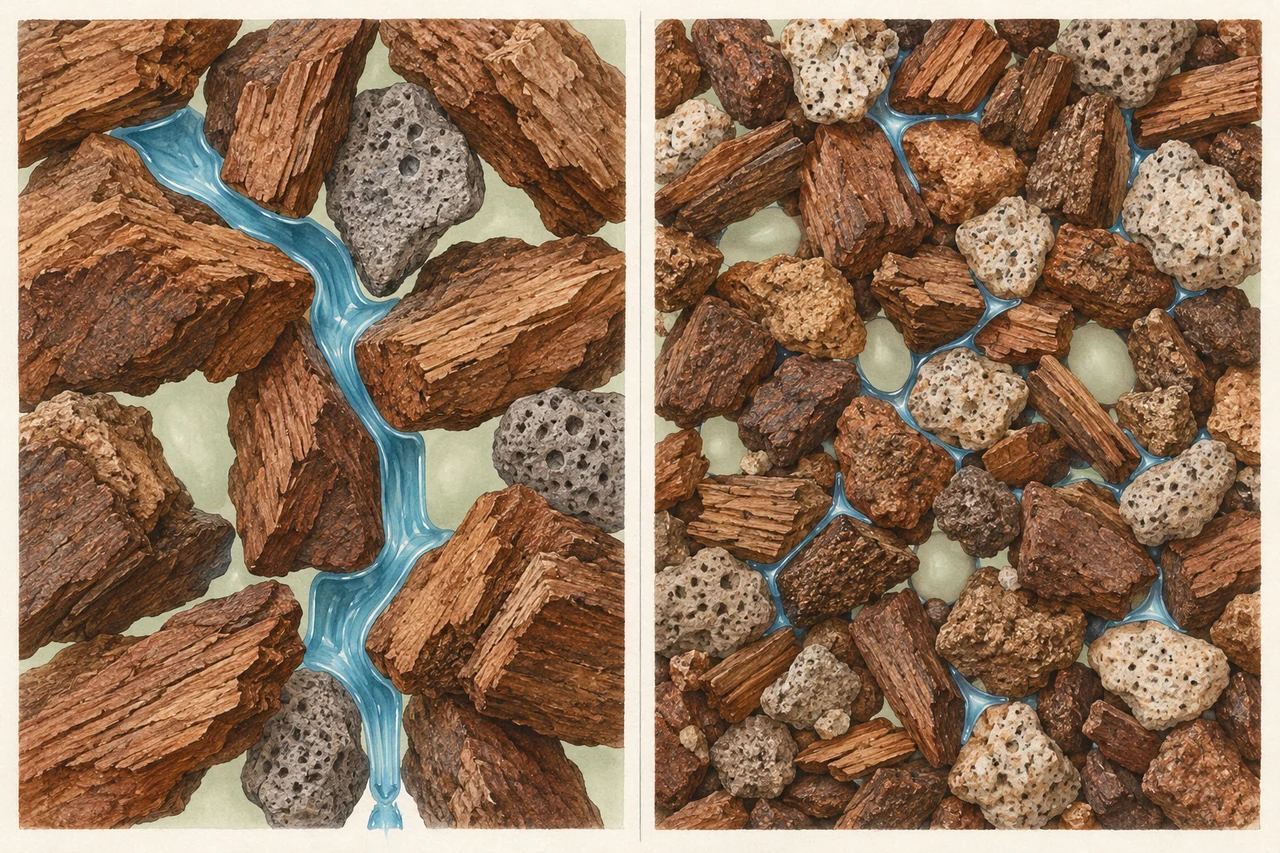
Total porosity is the overall amount of space in the medium. Air-filled porosity is the portion occupied by air after some excess water has drained. Water-holding capacity describes how much water remains in the medium, but water retained by a material is not automatically all available to the plant. These terms describe connected ideas, not interchangeable promises.
The container matters too. A taller or shorter pot, drainage holes, pot material, light, temperature, humidity, airflow, season, watering method, and root volume can change what happens after the same medium is watered. The lower part of a container may remain closer to saturation for longer, so “this material drains” and “this pot is dry” are not the same statement.
Media can change with use. Sphagnum moss may be pressed down, bark may break down, coco pieces may become fragmented, and a mixed potting medium may settle or form denser areas. As the pore structure changes, water and air may move differently even if the watering habit has not changed.
Observe what the medium is doing in a real pot
You do not need to begin with a fixed watering calendar to learn how a medium behaves. Observe the changes in the container:
- After watering, does excess water have a route out? Does the pot remain heavy for a long time? A fast flow from the drainage hole is only one pathway, not a complete quality ranking.
- Is the surface dry while the center or bottom may still be moist? Light, airflow, pot height, and pore structure can make these areas dry at different rates.
- Has a loose medium become fine, compacted, clumped, or sunken? That may indicate that the pore structure has changed.
- Are the original pieces or fibers still recognizable? Bark can become powdery, coco chips can fragment, and sphagnum moss can flatten.
- Have the container and environment changed too? Pot material, light, temperature, humidity, airflow, and season can all alter drying observations. Does pot material affect how fast potting mix dries?
These are observation clues for understanding the root-zone environment. They are not, by themselves, a diagnosis of root damage, a reason to prescribe a repotting action, or a watering formula that applies to every plant.
Common mix-ups
- ✕ Sphagnum moss is the same as sphagnum peat moss; both can be called sphagnum moss.
- ✓ Dried long-fiber sphagnum moss and partly decomposed sphagnum peat are different physical forms. Check the material description rather than relying on the shared word.
- ✕ Bark is always drier than sphagnum moss, and coco chips never stay wet.
- ✓ Coarse or fine structure, processing, compaction, pot height, and the environment all change how water and air are distributed.
- ✕ Potting mix is one fixed recipe, and potting soil must contain field soil.
- ✓ Potting mix is usually a blend for containers. Labels and ingredients vary, and the common term “potting soil” does not settle the question by itself.
- ✕ Fast drainage means that the root zone must be healthy or perfectly balanced.
- ✓ Drainage describes excess water leaving. You must still consider water retained elsewhere, air-filled pore space, compaction, the container, and the plant’s root environment.
- ✕ A dry surface means the whole container is dry.
- ✓ The surface, center, and bottom can have different moisture conditions.
Frequently Asked Questions
Are sphagnum moss and sphagnum peat moss the same?
They should not be treated as the same physical material. In gardening, sphagnum moss often means dried, long-fiber Sphagnum moss. Sphagnum peat moss is peat formed from plant material that has accumulated and partly decomposed in a wetland environment. Their names are related, but their form, processing, and pore behavior differ. Product labels and sources still need to be checked.
Is wetter sphagnum moss always better?
No. Sphagnum moss can hold water, but roots also need air. If the spaces between fibers remain filled with water for too long, less air may be available around the roots. The relevant observation is the water-and-air condition throughout the container, not simply whether the moss feels wet.
Does bark always dry faster than sphagnum moss?
Coarse bark often creates larger pores and may let water move more readily, but fine, partly decomposed, or tightly packed bark can behave differently. The fiber length and packing of sphagnum moss also change its drying pattern. “Bark dries faster” is a common tendency in some comparisons, not a fixed result for every bark material.
Are coco chips the same as coco coir or coir pith?
Not necessarily. They can all come from coconut husk, but coarse chips, long fibers, and fine coir pith are different physical forms. Coarse pieces often leave larger spaces, while fine material may hold water differently. The words used on labels can overlap, so the visible form and material description matter.
Does potting soil really contain soil?
Not always. In English gardening sources and product labels, potting soil is often used as a broad term for a container medium. A mix may contain peat, coco coir, bark, perlite, vermiculite, compost, or actual soil. You cannot determine the contents from the two words alone.
Does air-filled porosity by itself tell you how well a medium is aerated?
No. Air-filled porosity describes the share of the medium’s volume occupied by air after excess water drains. Aeration also depends on whether those pores connect in ways that allow gases to move. A high air-filled volume alone does not guarantee an effective gas-exchange path.
Which of the four materials is best?
There is no single answer that works independently of the plant, roots, container, and growing environment. A more useful comparison asks about particle or fiber form, pore space, water retention, drainage, aeration, support, and how the material changes over time. It then observes the medium in the actual pot instead of assigning a universal ranking.
Why is the surface dry while the inside of the pot is still wet?
The surface is exposed to light, airflow, and room conditions, so it may dry sooner than the center or bottom. Pot height and pore structure can also leave the lower part of a container wetter. Surface color alone does not represent the moisture condition of the whole pot.
Does potting media change after being used for a while?
Yes. Organic materials such as bark, coco coir, and sphagnum moss may break down, become powdery, settle, or compact. That changes the size and arrangement of pores, which can change water and air movement. Pot material, roots, watering, and season also contribute to what you observe.
Related terms
- Growing medium / potting medium: Material, or a blend of materials, that supports roots and holds water and air in a container.
- Sphagnum moss: Usually dried, long-fiber Sphagnum moss in this gardening context; do not automatically equate it with sphagnum peat moss.
- Sphagnum peat moss: Peat formed from partly decomposed wetland plant material; it is a different physical form from long-fiber sphagnum moss.
- Bark: Woody material used in a growing medium; species, particle size, age, and processing can vary.
- Coco chips: Coarse pieces of coconut husk; they are not automatically the same as fine coir or coir pith.
- Water-holding capacity: The ability of a material or medium to retain water; retained water is not necessarily all available to roots.
- Drainage: The movement of excess water out of the medium and container.
- Air-filled porosity: The portion of a medium’s volume occupied by air after excess water drains; this amount alone does not show whether pores are connected.
- Aeration: Gas exchange around roots. It is related to, but not interchangeable with, air-filled porosity.
- Compaction: A state in which fibers or particles are pressed closer together, changing pore space.
- Rewetting: The process of taking up water again after a material has dried; a fully dry material may not rewet evenly.
Read Next
Evidence
References
These sources were used to check the plant-science concepts and gardening context in this article.
View sources and further reading (16)
- yardandgarden.extension.iastate.edu — potting media components and handling
- extension.umd.edu — growing media potting soil containers
- ask.ifas.ufl.edu — EP623
- content.ces.ncsu.edu — 18 plants grown in containers
- extension.okstate.edu — containers and media for the nursery
- extension.okstate.edu — houseplant care
- extension.oregonstate.edu — fall2017hortnews.pdf
- nursery-crop-extension.mgcafe.uky.edu — soilless substrate management nursery crops
- directives.nrcs.usda.gov — Subpart T Urban Agriculture.pdf
- eastern.tennessee.edu — UT PB1618 Growing media for greenhouse production.pdf
- aggie-horticulture.tamu.edu — growing media
- ucanr.edu — print
- yardandgarden.extension.iastate.edu — growing orchids indoors
- hemp.ces.ncsu.edu — greenhouse media for growing hemp cuttings
- extension.purdue.edu — HO 287 W.pdf
- acsess.onlinelibrary.wiley.com — vzj2013.05.0081