Potting mix can sink after its particles settle, change over longer use, or shrink as it dries. A lower surface does not automatically mean compaction. Start with the timing: did the level drop after the first watering, change gradually over time, or pull away from the pot wall as a peat-based mix dried?
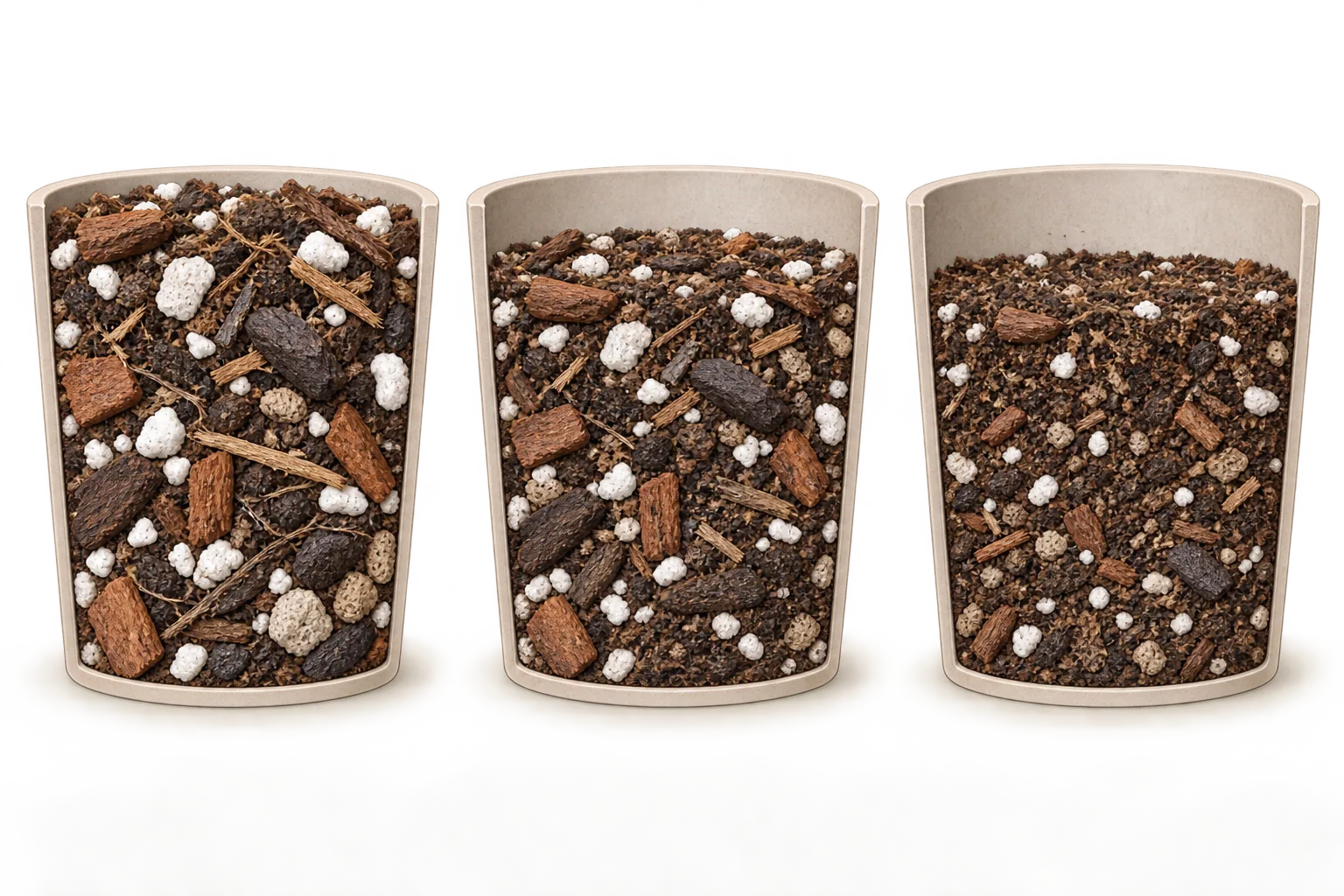
A lower surface can have several explanations
Settling describes a drop in the mix’s surface level as particles rearrange within the pot. Components of a new mix may not be fully settled when first added. After an initial watering, they can shift into a more settled arrangement, so the surface may sit lower. That does not mean every watering compacts the mix.
Compaction is a change caused by pressure: particles are pressed closer together, bulk density can increase, and some air-filled pores may become smaller or fewer. Pressing down firmly while filling a pot, for example, can affect the pore structure. The surface does not have to drop visibly for compaction to occur.
Changes over time can also affect particle size and volume. Organic components such as peat, bark, coir, or compost may break down, and particle-size distributions can also change. How much and how quickly the medium changes depends on the material and its condition. Mineral components do not break down in the same way, but a mix containing them can still settle as other components change or particles rearrange. To compare common ingredients, see Sphagnum moss, bark, and coco chips in potting media; for differences among a few mineral and mineral-like ingredients, see Perlite, vermiculite, and akadama.
Drying shrinkage is different from compaction. As a peat-based medium loses moisture, the material may contract and pull away from the pot wall.
| When the change appears | Process to compare |
|---|---|
| The surface drops after filling and an initial watering | Newly added particles settling into place |
| The mix was pressed during filling | Pressure changing particle packing and pores, even without an obvious surface drop |
| Volume and particle appearance change during longer use | Changes in organic components, particle sizes, and packing |
| A peat-based mix pulls away from part of the pot wall as it dries | Drying shrinkage, distinct from pressure-driven compaction |
How particles and pores affect water and air
Potting mix is made of solid particles and the spaces between them. These spaces, called pores, may hold water or air. Roots need both. When pressure compacts a mix, some of the larger air-filled pores may be reduced, which can change how water and air move through the root zone. The result depends on the mix and the pot.
Finer particles alone do not mean a mix will necessarily become wetter or absorb less water. Different materials and particle sizes can change pore distribution, and pot shape, filling method, and the medium’s moisture at the time can also affect the result. In a study of commercial pine bark, aging was associated with a lower proportion of coarse particles, less air space, and more water retained after drainage.
For a closer look at how water and air occupy pores, read How are water retention and drainage different?. What is growing-media aeration? explains why air-filled pores matter around roots, and Why does potting mix need drainage? covers how excess water leaves a container.
Container dimensions also affect the balance of water and air after drainage. Does pot size affect roots? adds the relationship between the container, media volume, and root system.
Observe the mix without treating one clue as a diagnosis
A drop in surface level is an observation, not an explanation. It may help to note the level relative to the pot rim, whether particles look smaller than before or their size distribution appears different, whether the mix seems to form tighter clumps, and whether its appearance after watering has changed. Each clue can have more than one explanation, and none alone establishes what is happening throughout the pot.
Surface height, particle appearance, and changes noticed after watering describe the medium. They do not by themselves diagnose root condition or plant health, measure the air and water throughout the root zone, or point to a single watering schedule or treatment.
Common misunderstandings
- ✕ A lower surface proves that the mix is compacted.
- ✓ Settling describes a change in surface height; compaction describes particles pressed closer together and a changed pore structure. They can occur together or separately.
- ✕ Only pressure can make potting mix sink.
- ✓ Initial settling, changes in organic components and particle-size distribution, and—in peat-based media—drying shrinkage may also affect the surface level.
- ✕ All organic components break down or become finer at the same rate.
- ✓ Materials and their condition vary, so their changes do too.
- ✕ Finer particles always make a mix hold more water, or always make it dry faster.
- ✓ Water and air conditions depend on the materials, pore arrangement, container, and moisture state; one visual clue cannot establish the direction of every change.
- ✕ Every watering compacts every potting mix, or fine particles always move to the bottom.
- ✓ An initial watering can help newly added components settle. Neither that observation nor a finer appearance makes downward movement or repeated compaction a universal rule.
- ✕ A gap between the mix and pot wall proves that the whole pot is dry or compacted.
- ✓ Peat-based media may shrink as they dry. A local gap alone cannot establish the moisture of the whole mix or the condition of its roots.
Frequently asked questions
Why does potting mix sink after watering?
Components in a newly filled pot may rearrange and settle after an initial watering. Different materials settle by different amounts. A gradual change over longer use may also involve changes to organic components, but surface height alone cannot distinguish among these explanations.
Does a lower surface mean the mix is compacted?
Not necessarily. Settling after filling or watering, volume loss as organic material changes, and drying shrinkage in peat-based media can all lower the surface. Compaction more directly refers to particles being pressed closer together by pressure; it can change pores even when the surface height looks much the same.
Do all organic potting materials break down quickly?
No single rate applies to all materials. Their source, particle size, processing, and condition affect how they change. A material name alone cannot predict that it will reach a particular state within a set time.
Does finer potting mix always hold more water or drain more slowly?
No. Particle-size distribution can affect air space and container capacity, but these are different measures. In a study of commercial pine-bark substrates, aging was associated with less air space and greater container capacity. Those findings apply to the pine-bark materials and conditions studied, not to every mix.
Can a hard surface or slower watering diagnose low oxygen around roots?
No. A surface clue does not measure pores or oxygen throughout the mix. The ingredients, pot dimensions, and distribution of water and air after watering all affect what can be observed.
Does a gap between the mix and pot wall mean compaction?
Not necessarily. Peat-based media may contract as they dry and pull away from part of the pot wall. That possible shrinkage is different from compaction, and a gap alone cannot show that the whole mix is dry or establish root condition.
How can pressure during potting affect the root zone?
Pressure can press particles closer together and reduce some larger air-filled pores. This may change air movement and drainage conditions, but the effect depends on the mix and the container. A visible surface change is not required for pore structure to change.
How far can potting mix sink before it needs repotting?
There is no universal depth threshold. A similar drop can follow initial settling, longer-term changes in the mix, or drying shrinkage in peat-based media. Record the level relative to the pot rim, when it changed, and any changes in particle appearance and moisture rather than using centimetres alone.
Related terms
- Settling: A drop in the medium’s surface level as particles rearrange within a container.
- Compaction: A pressure-related change in which particles are pressed closer together and the pore structure changes.
- Pores: Spaces between or within solid particles that may be occupied by water or air.
- Air space (air-filled porosity): The portion of pores occupied by air under a given moisture and drainage condition.
- Organic component: A medium ingredient derived from organic material; depending on its nature and condition, it may break down over time, while particle-size distributions can also change.
- Drying shrinkage: A reduction in material volume as it loses moisture. Peat-based media may shrink as they dry; this is not the same as pressure-driven compaction.
- Container capacity: The water retained by a medium in a container after drainage under specified conditions. It is distinct from total porosity and does not mean all retained water is available to a plant.
Read next
Evidence
References
These sources were used to check the plant-science concepts and gardening context in this article.