Start by asking where the light comes from
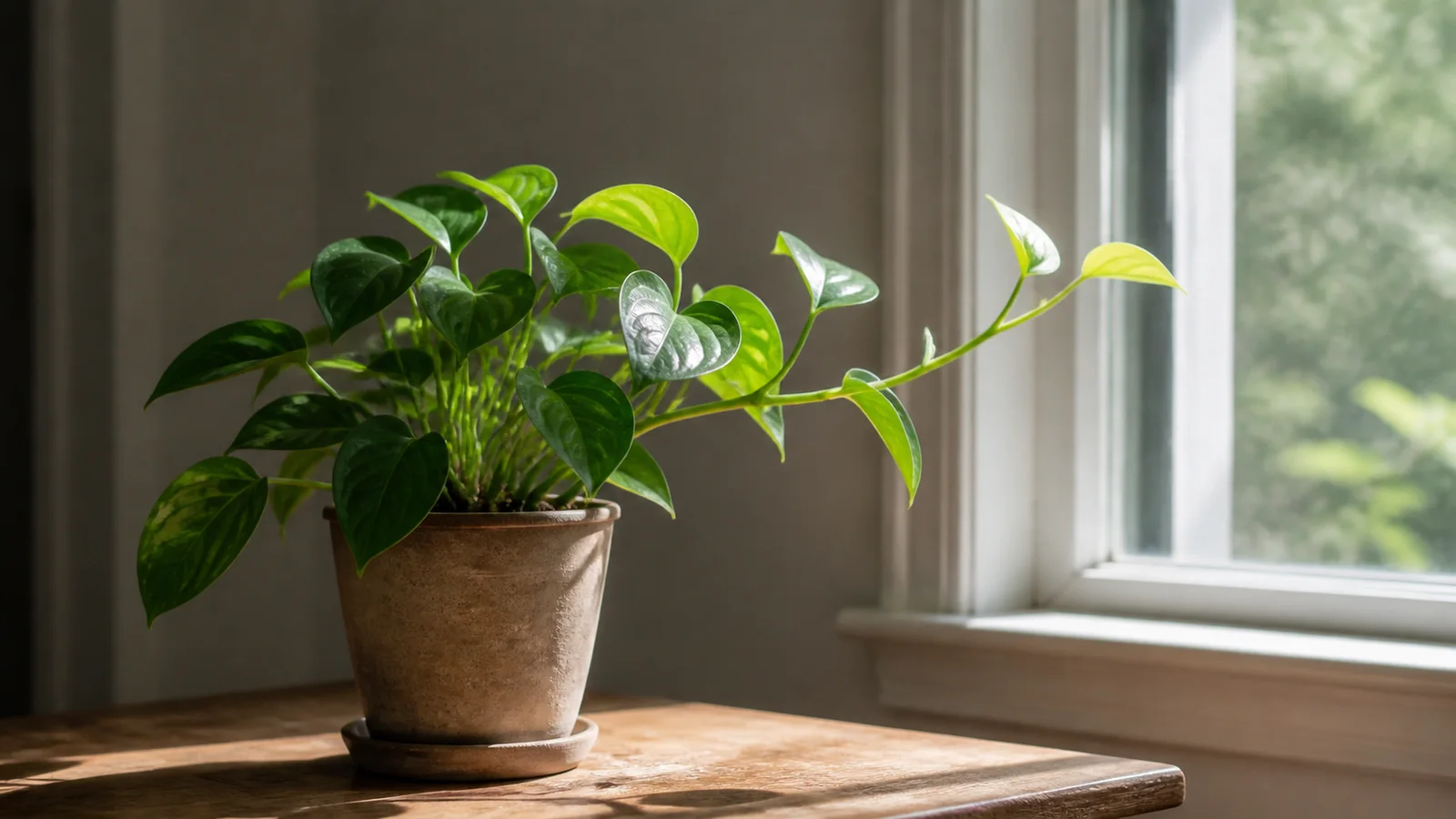
When a houseplant leans toward a window, the most common first explanation is not that the plant is trying to escape. Indoors, the window is often the brightest and most directional light source in the room. New stems, petioles, and soft shoots may gradually grow toward the brighter side.
This growth response to the direction of light is called phototropism. In an everyday houseplant setting, the room side is often dimmer, the window side is brighter, and new growth can slowly angle toward the window.
The window is not pulling the plant
More precisely, the plant is not being pulled by the window. In a young stem or shoot, light from one side can make the two sides grow at different rates. A common explanation is that the shaded side elongates more than the lit side, so the young shoot bends toward the light source.
That is why the effect is easiest to see in new shoots, soft petioles, young stems, and seedlings. Older stems that have hardened usually do not bend back as quickly or as completely as fresh growth.
For the deeper plant biology behind this response, read the article on phototropism.
Leaning and legginess are related, but not the same
A plant leaning toward the window is first a clue about light direction. It does not automatically mean the plant is dying, and it does not always prove that the total light level is too low.
However, if the leaning appears together with long internodes, thin stems, wider spaces between leaves, paler color, or smaller new leaves, then low light and leggy growth should also be on the observation list.
Phototropism is mainly about direction. Leggy growth is mainly about stretched structure: longer internodes, weaker stems, and a looser overall shape. The two can happen together, especially under weak one-sided indoor light, but they are not the same concept.
Rotation can help balance shape, but it does not create more light
Some people rotate potted plants so different sides face the window over time. This can help the plant develop a more balanced shape, and it can also help you notice whether new growth keeps tracking the same light direction.
But rotation is not a guaranteed correction. If the whole room position provides too little usable light for that plant, rotating the pot only lets different sides take turns receiving insufficient light. It is better to treat rotation as a small balancing and observation tool, not as the answer to every leaning plant.
Grow lights follow the same principle. Position, distance, duration, intensity, spectrum, and plant type all affect the result. This article explains the observation logic and does not recommend equipment or give a fixed lighting schedule.
Some leaning is not caused by light
A plant may lean for reasons other than window light. Branch weight, climbing or trailing growth habits, an unstable pot, weak support, uneven pruning, recent movement, or a shifted potting mix center of weight after watering can all affect plant shape.
A safer observation order is to look at the light direction first, then compare that with the plant’s structure and the location of new growth.
Useful questions include:
- Is the main light coming from one side of the room?
- Is new growth leaning more clearly than older leaves or older stems?
- Are there also long internodes, thinner stems, or wider leaf spacing?
- After rotation, does new growth keep turning toward the same light source?
- Is the plant naturally vining, climbing, arching, or trailing?
These questions help separate a light-direction clue from support, weight, or growth-habit factors. You do not need to force the plant into one simple diagnosis.
Common confusions
- ✕ A plant leaning toward the window means it is failing.
- ✓ It often means the window is the main light source. To judge low light, also look at internodes, leaf color, leaf spacing, and new growth.
- ✕ Rotating the pot will definitely make the plant grow straight.
- ✓ Rotation can make light exposure more even, but it cannot replace enough usable light or make old hardened stems become fully straight.
- ✕ Phototropism and legginess are the same thing.
- ✓ Phototropism is about growth direction. Legginess is about long internodes, weak stems, and a loose plant shape. They may appear together.
- ✕ A side grow light automatically fixes leaning.
- ✓ Supplemental lighting depends on position, distance, intensity, duration, spectrum, and plant type. One setup cannot be promised as a universal fix.
Frequently Asked Questions
Does a houseplant leaning toward the window mean it needs more light?
Not always. Leaning at least shows that the window direction is an important light source and that new growth may be responding to one-sided light. If you also see long internodes, thin stems, wider leaf spacing, paler color, or smaller new leaves, then low light and leggy growth become more likely observation points.
Will a leaning stem straighten by itself?
Soft new growth may change direction as later growth develops, but older stems that have hardened usually do not shorten or fully straighten on their own. A more realistic focus is whether future new growth becomes more balanced.
How often should I rotate a houseplant?
This article does not give a fixed number of days because plant type and room position vary too much. A conservative approach is to make small rotations during watering or regular plant checks and observe whether the newest growth still leans toward one direction.
Why does the plant lean if it cannot move?
Plants do not move toward a window like animals move across a room. Instead, growing tissues can elongate unevenly on different sides. That uneven growth gradually angles new stems, petioles, or shoots toward the light source.
Do all plants lean clearly toward windows?
No. Seedlings, soft new shoots, vines, and many herbaceous plants may show direction changes clearly. Woody, compact, or slow-growing plants may respond less visibly or more slowly.
Does it matter whether a grow light is placed above or beside the plant?
It can matter. A side light can still create directional growth toward the source, while more even overhead light may reduce one-sided leaning. But supplemental lighting also depends on intensity, distance, duration, spectrum, and plant type, so this article does not provide a device recommendation or lighting formula.
Related Terms
- Phototropism: a plant growth response to the direction of light.
- Positive phototropism: growth toward a light source.
- Auxin: a plant hormone involved in growth regulation and cell elongation.
- Internode: the stem section between two nodes; internodes often become longer in leggy growth.
- Leggy growth: stretched, thin, loose growth often associated with unsuitable light conditions.
- Supplemental lighting: artificial light used to add plant-usable light, with results depending on the light source and plant needs.
Read Next
Evidence
References
These sources were used to check the plant-science concepts and gardening context in this article.