Sunlight is not food; it is energy for making organic compounds
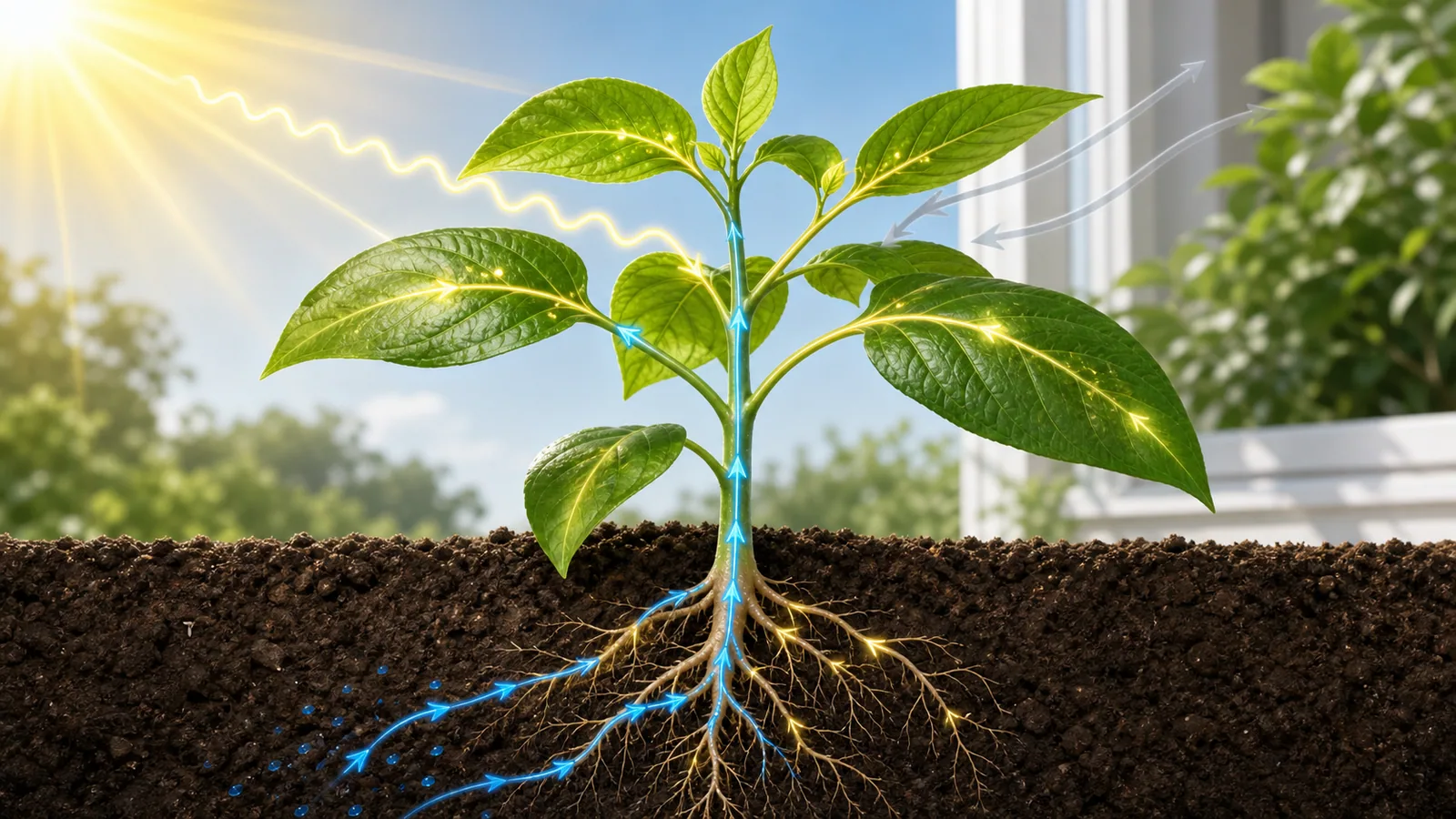
Plants need sunlight, but not because they eat sunlight as food. A more accurate explanation is that sunlight acts like the energy supply for a factory. It allows leaves to use photosynthesis to turn water and carbon dioxide from the air into sugars and other organic compounds the plant can use.
Those organic compounds are important. Plants can use them in respiration, new leaf growth, root growth, flower and fruit development, and temporary storage. Light itself is not the raw material, but without enough light energy, the manufacturing process is limited.
What happens inside the leaf
Photosynthesis is often simplified like this:
water + carbon dioxide + light energy -> sugars and other organic compounds + oxygenThis equation is not for memorizing chemistry. It helps separate the roles. Water and carbon dioxide are materials. Light energy supplies the energy. Sugars and other organic compounds are useful products. Oxygen is released.
More deeply, photosynthesis is usually connected to cells that contain chloroplasts. Chloroplasts are cell structures closely involved in photosynthesis. Chlorophyll is an important pigment that absorbs light energy. Leaves are often treated as the main photosynthetic organs because many leaf cells are suited for receiving light, exchanging gases, and carrying out this process.

Light is not the only condition. Water, carbon dioxide, temperature, and leaf condition also affect photosynthesis. That is why plant growth cannot be judged only by whether the plant “gets sun.” The whole environment must allow leaves to work steadily.
Light is also an environmental signal
Sunlight is not only an energy source. It is also an environmental signal.
Plants cannot walk, but they can sense where light comes from and adjust new growth. A houseplant leaning toward a window is one of the easiest everyday examples of phototropism.
Plants also use photoperiod—the timing and duration of light and darkness—to sense day and night and, in some cases, seasons. For certain plants, day length, night length, or the spectrum or wavelength mix of light can affect flowering, dormancy, or growth rhythm. The key idea is that light gives plants both energy and information.
When light is too low, plant shape often changes first
Low light does not always make a plant “sick” in one obvious way. More often, the plant’s shape slowly changes. New stems may stretch, spaces between leaves may become longer, leaves may sit farther apart, the plant may lean toward a window, or new leaves may become smaller.
These signs can put light on the observation list, but they are not a complete diagnosis. Water, roots, temperature, season, plant type, and growth stage can also affect appearance. A safer approach is: when a plant becomes stretched, loose, or strongly one-sided, check how much light the leaves actually receive.
Shade-tolerant plants still need light. “Shade tolerant” means they can handle lower light better than many other plants, not that they can live with no usable light.
More light is not always better
If plants need light, does stronger light always mean healthier plants? No.
Plants are adapted to different environments. Some prefer open, bright sites. Some naturally grow under tree shade or do well near indoor windows with indirect light. A plant that has been kept indoors or in shade can be stressed if it is suddenly placed under strong direct sun and heat.
The principle is this: plants need usable light, but the suitable amount depends on plant type, location, season, shading, temperature, and the whole growing environment.
Common confusions
- ✕ Plants eat sunlight.
- ✓ Plants use light energy to make sugars and other organic compounds. Light is energy, not food being eaten.
- ✕ Shade-tolerant plants do not need light.
- ✓ Shade tolerance means a plant can adapt to lower light, not to no light.
- ✕ Stronger light always makes plants grow better.
- ✓ Different plants have different light ranges; too much light and heat can stress leaves.
- ✕ Indoor lamps always provide enough light for plants.
- ✓ Human brightness and plant-usable light are not the same thing. Light intensity, spectrum, and duration all matter.
Frequently Asked Questions
Do plants eat sunlight?
No. Plants use light energy during photosynthesis to turn water and carbon dioxide into sugars and other organic compounds. Sunlight is more like an energy source than a food material.
What happens if a plant has no sunlight?
If a plant lacks enough usable light for a long time, its ability to make organic compounds is limited. Growth may slow, become weak, change color, or change shape. Different plants tolerate low light differently.
Why does a plant grow toward a window?
Light acts as a direction signal. When most light comes from one side, new growth may lean or bend toward the brighter side. This response is related to phototropism.
Do shade-tolerant plants still need usable light?
They still need light. A better phrase is “shade-tolerant plants can handle weaker light.” They may not need strong direct sun, but they still need enough usable light for photosynthesis and growth.
Can indoor lights fully replace sunlight?
Not automatically. Ordinary indoor lights are usually designed for human vision, not plant growth. They may not provide enough intensity, spectrum, or duration; plant type, location, and the wider environment also matter.
Is stronger sunlight always healthier for plants?
No. Plants have different light ranges. Some plants prefer bright open areas, while others prefer filtered light. A plant moved suddenly from shade to strong direct sun may be stressed.
Related Terms
- Photosynthesis: the process in which plants use light energy to turn water and carbon dioxide into sugars and other organic compounds.
- Chloroplast: a cell structure closely involved in photosynthesis.
- Chlorophyll: a light-absorbing pigment that often makes leaves green.
- Light intensity: how much light reaches the leaf.
- Light quality: the wavelength mix of light, such as proportions of red and blue light.
- Phototropism: a plant growth response toward or away from a light source.
Read Next
Evidence
References
These sources were used to check the plant-science concepts and gardening context in this article.
View sources and further reading (6)
- openstax.org — 8 1 overview of photosynthesis
- openstax.org — 8 2 the light dependent reactions of photosynthesis
- openstax.org — 8 3 using light energy to make organic molecules
- openstax.org — 30 6 plant sensory systems and responses
- extension.umn.edu — lighting indoor plants
- extension.umd.edu — lighting indoor plants