
Start with one simple distinction
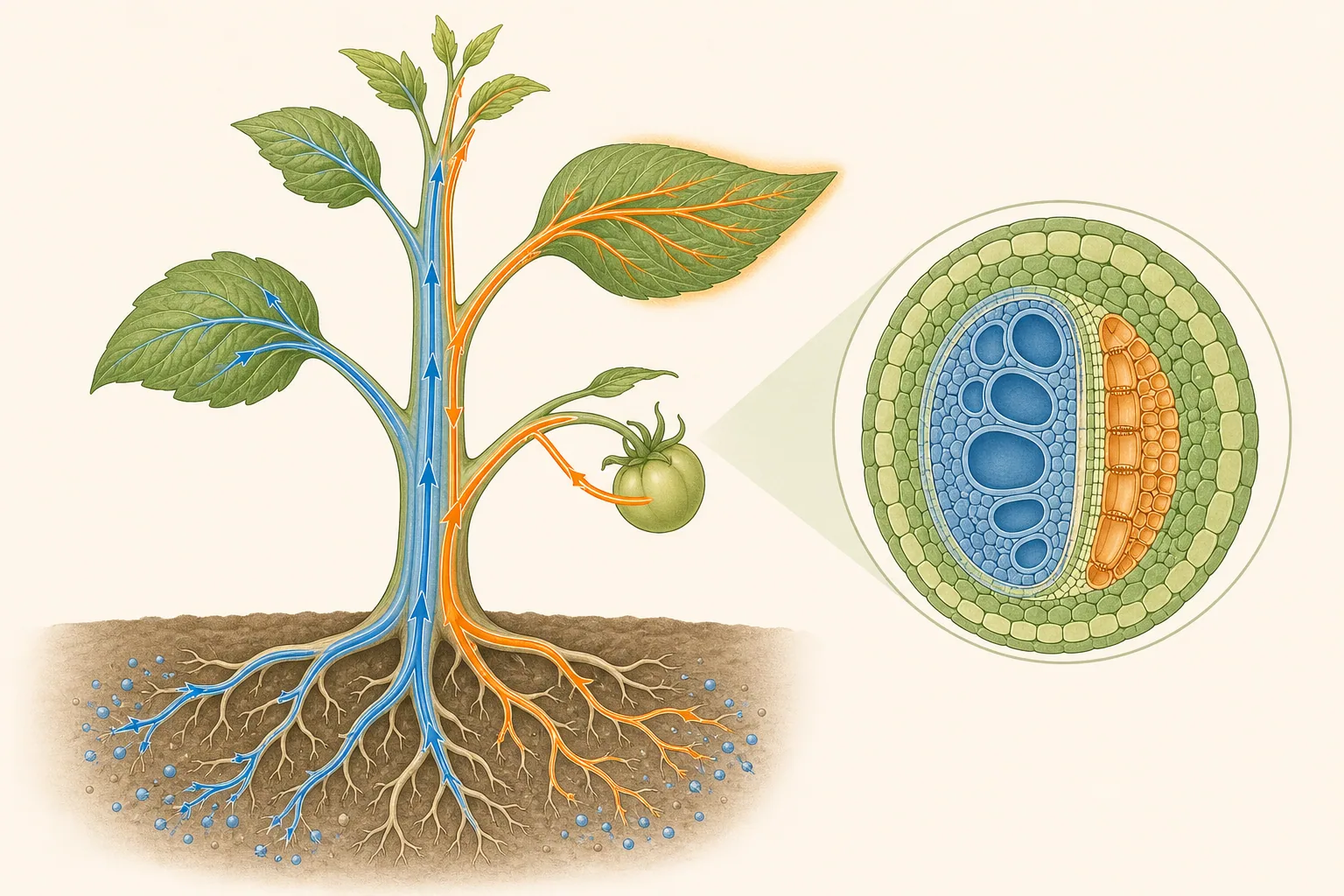
Xylem and phloem are both types of vascular tissue. A useful first model is to think of them as two main routes in the same plant-wide transport network: xylem mainly carries water and dissolved minerals, while phloem mainly distributes sugars and other organic products made by the plant.
To place both routes in the plant’s wider resource-distribution system, see how plants transport nutrients.
They are tissues made of different kinds of cells. They occur in roots, stems, leaves, and veins, and their arrangement changes from one plant organ to another.
Xylem: the main long-distance water route
Xylem mainly transports water and minerals dissolved in that water. In many vascular plants, water enters through the roots, moves through xylem in the roots and stems, and continues into the leaf veins and leaf tissues. When water evaporates from leaves into the air through transpiration, that water loss is connected to the long-distance pathway from roots to shoots. For a deeper explanation of this route, see How Does Water Move from Roots to Leaves?.
Xylem is not an empty tube. It is a tissue made of several types of cells. Vessel elements and tracheids are the main water-conducting cell types. As these cells mature, they commonly lose their cell contents and retain strengthened, lignified walls that help form a water-conducting pathway. These strong walls can also contribute to support.
This is why “wood” should not be treated as a perfect synonym for xylem. Wood is mainly the secondary xylem of woody plants, but xylem also occurs in the roots, stems, and veins of herbaceous plants.
The sugars carried by phloem come from plant-produced organic material, including products of photosynthesis. What Is Photosynthesis? provides that larger context. A celery-in-colored-water demonstration, by contrast, is mainly useful for showing a water pathway associated with xylem; it does not directly show where sugars move through phloem.
Phloem: distributing organic products
Phloem mainly transports products of photosynthesis, including sugars such as sucrose, along with other organic solutes. Phloem sap can contain more than one kind of dissolved substance, so “phloem transports sugar” is a useful entry point, not a complete list. These materials may move from leaves to roots, young shoots, young leaves, flowers, fruits, seeds, or storage organs. Receiving tissues may use them for growth and respiration or store them for later use.
Plant biology often describes this movement with the terms source and sink. A source is a tissue that exports photosynthetic products; a mature leaf is a common example. A sink is a tissue that receives, uses, or stores those products. Roots, shoot tips, young leaves, developing fruits, seeds, and storage organs can often act as sinks, but an organ’s role can change with development and current demand. Some storage organs can also act as sources when they release stored materials.
The main conducting cells of phloem include sieve-tube elements and their closely associated companion cells. Sieve-tube elements join to form sieve tubes through which phloem sap can move. They remain living cells at maturity, although their internal contents are reduced; companion cells support their metabolism and help with loading and unloading materials.
This is why phloem should not be reduced to “the tube that sends sugar downward.” To understand the direction, first ask where the sources and sinks are.
For how source and sink roles change, and how roots, shoots, and fruits use the sugars they receive, read How Do Plants Move Sugar?.
How to Determine the Direction of Transport
- The main long-distance xylem pathway usually runs from roots through stems toward leaves and other aboveground organs. It is linked to transpiration and water-potential gradients.
- Phloem movement runs from source to sink. A mature leaf may send products downward to roots, upward to a growing shoot tip, or sideways to a fruit or storage organ.
Long-distance phloem movement can be introduced with a simplified pressure-flow model. Sugars are loaded at the source, water enters the phloem from nearby xylem, and the resulting higher pressure at the source helps drive bulk flow toward a sink. At the sink, materials are unloaded for use or storage and pressure is lower. Energy may be needed for loading, unloading, and maintaining the cells.
Where are xylem and phloem found in a vascular bundle?
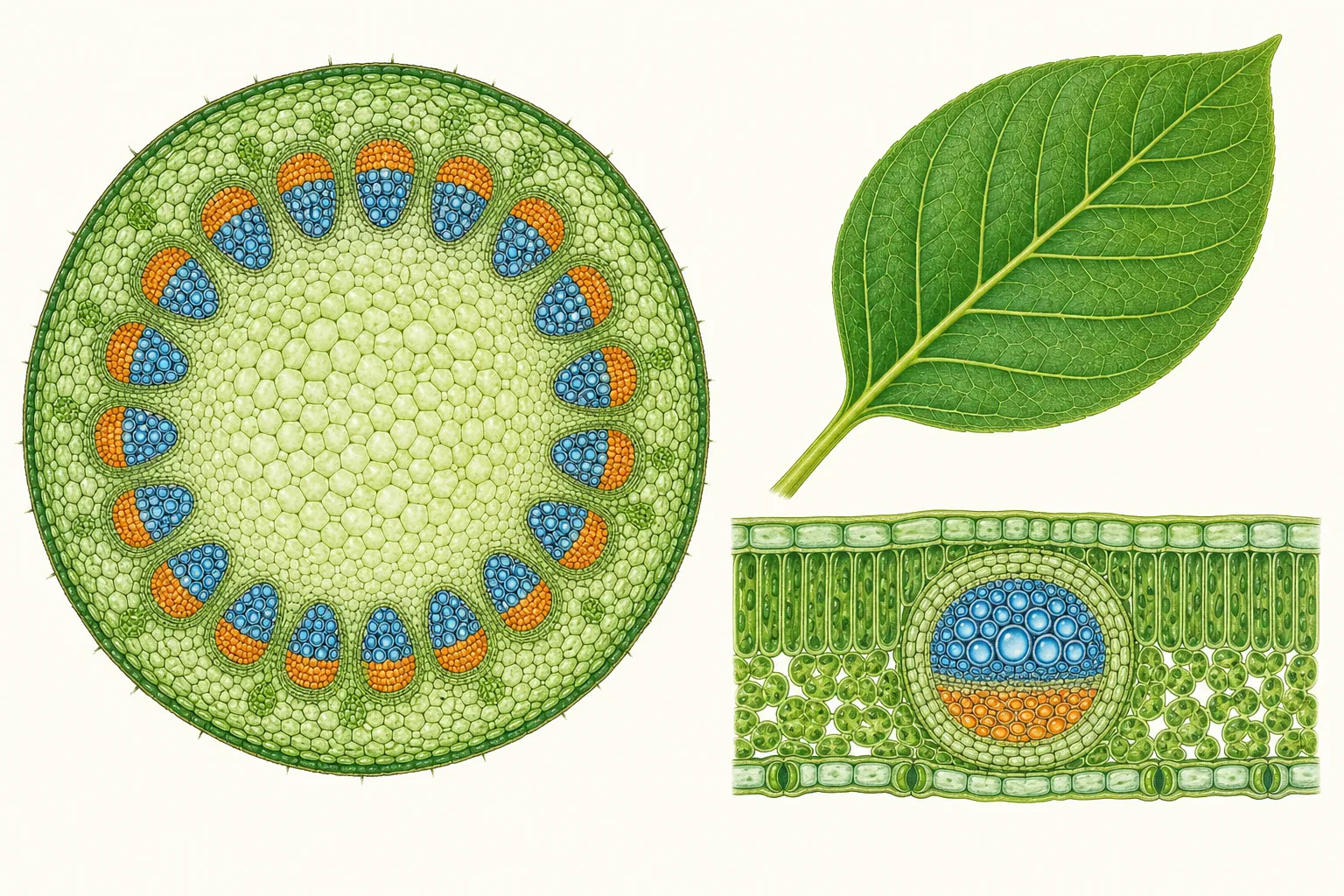
In a typical stem vascular bundle, xylem is often closer to the center of the stem and phloem is closer to the outside. In plants with secondary growth, the vascular cambium may lie between them. What Is a Vascular Bundle? explains how these tissues fit into the larger structure.
Root vascular tissue is often concentrated in a central vascular cylinder. In leaves, veins form a branching vascular network and usually contain both xylem and phloem. Their relative position within a leaf vein also depends on the plant and the section being examined. To connect these visible structures with the rest of the leaf, see What Do Leaf Veins Do?. Stems also provide support as well as transport routes; What Do Stems Do? gives that broader view.
What can you observe in a plant or a pot?
You usually cannot identify xylem and phloem directly in a fine vein with the naked eye, but several observations can connect visible structures with the transport model.
Look at how a leaf’s midrib connects to the petiole, then branches into side veins and smaller veins. These lines are visible clues to the leaf’s vascular network. A celery-in-colored-water demonstration may show color moving through some vascular strands, which is mainly used to illustrate the xylem water route. A woody stem cross-section can suggest the relative regions of xylem, vascular cambium, and tissues toward the outside, but the naked eye or a single section cannot easily reveal how all substances are transported throughout the plant.
You can also compare leaves at different developmental stages. A mature leaf that is actively photosynthesizing may often act as a source, while a young leaf, shoot tip, root, or developing fruit may often act as a sink. This is an observation clue for learning source-and-sink relationships, not an absolute rule for every species, season, or plant condition.
These observations are meant to connect structure with function. A leaf color, a stem surface, or one staining result cannot describe the whole transport system.
Common mix-ups
- ✕ Xylem is wood, and phloem is bark.
- ✓ Wood is mainly secondary xylem. Bark contains several tissues outside the vascular cambium, including phloem in woody plants, so neither word is a complete synonym for the other.
- ✕ Xylem transports only water, phloem transports only sugar, and each tissue has only one cell type.
- ✓ Water and minerals are the main long-distance xylem cargo, while sugars and other organic solutes are the main phloem cargo. Both tissues contain multiple kinds of cells.
- ✕ Xylem always moves upward, and phloem always moves downward.
- ✓ The main root-to-shoot xylem pathway is usually upward. Phloem follows source-to-sink relationships, so its route may be upward, downward, or sideways.
- ✕ The entire xylem is made of dead cells.
- ✓ The main water-conducting cells commonly lose their contents at maturity, but xylem also contains other cells, including living parenchyma cells.
- ✕ Leaf veins contain only xylem.
- ✓ Leaf veins usually contain both xylem and phloem, together with surrounding and supporting cells.
- ✕ If potting media are wet, xylem must be moving water normally.
- ✓ Water transport also depends on roots, oxygen, water potential, transpiration, and the wider environment. Surface wetness alone is not enough to describe the whole system.
Frequently asked questions
Which is more important, xylem or phloem?
Neither replaces the other. Xylem mainly connects the long-distance water and mineral pathway, while phloem mainly distributes sugars and other organic products. Plants depend on the two transport systems working together.
Is sugar transported in phloem the same as fertilizer?
No. Phloem can carry sugars and other organic products made by the plant, whereas fertilizer is an external source of mineral elements. They describe different materials and roles in plant nutrition.
Why can’t phloem simply be called a downward pathway?
Because phloem follows source-to-sink relationships. A mature leaf may send products to roots below, a growing shoot above, or a fruit to the side. The route depends on the positions and demands of sources and sinks.
Are all xylem cells dead?
No. Vessel elements and tracheids, the main water-conducting cells, commonly lose their cell contents when mature. Xylem also includes other cell types that may remain alive, such as parenchyma cells. “The main conducting cells are commonly non-living at maturity” is more accurate than “all xylem is dead.”
Is wood the same thing as xylem?
Not exactly. Wood is mainly the secondary xylem of woody plants. Xylem also occurs in herbaceous roots, stems, and leaf veins, where it does not necessarily form what we normally call wood.
Can celery in colored water show both xylem and phloem?
The demonstration mainly helps show the result of colored water moving through xylem-associated water-conducting tissues. It does not directly show phloem sugar transport. The two tissues have different functions and transport mechanisms.
How does water reach the top of a tree without a heart?
Transpiration lowers water potential at the leaf end. Together with cohesion between water molecules and interactions between water and xylem walls, this helps create tension that pulls a continuous water column upward. Roots are not a single central heart pump; root pressure can contribute in some situations, but it does not by itself explain all water movement in a tall plant.
Related terms
- Vascular tissue: the plant tissue category that includes xylem and phloem.
- Xylem: vascular tissue mainly associated with transporting water and dissolved minerals and providing support.
- Phloem: vascular tissue mainly associated with transporting sugars and other organic solutes.
- Vessel elements and tracheids: major water-conducting cell types in xylem.
- Sieve-tube elements and companion cells: phloem cells that work together in transport and cellular support.
- Source: a tissue that exports photosynthetic products, often a mature leaf.
- Sink: a tissue that receives, uses, or stores photosynthetic products, such as a root, young shoot, fruit, or seed.
- Vascular cambium: a growth tissue that can produce new xylem inward and phloem outward in plants with secondary growth. It is not the same as either xylem or phloem.
Keep exploring
XYLEM × PHLOEM
Watch cells form and follow water and sugar
Each topic is one continuous animation. Topics never switch automatically; pause or scrub to inspect the process.
A new wall grows inside the same cell, separating two daughters.
Vessels: clear the lumen, retain support
Each vessel element is one cell in a vessel. It expands, deposits secondary wall inside the original wall, and gains support through lignification, helping it resist water tension. Pits are thinner side-wall regions, not the loss of an entire wall.
Programmed cell death clears the protoplast. End-wall perforations connect neighboring cells into a water pathway. This diagram shows simple perforations; their form varies. Xylem also contains living parenchyma, so the whole tissue is not dead.
Sieve tubes: lose nuclei but remain alive
Maturing sieve elements lose their nuclei and vacuoles, retaining a plasma membrane, thin cytoplasm and some organelles. Their end walls persist as sieve plates with pores through which sugar-rich sap flows.
Companion cells retain nuclei and connect to sieve elements through plasmodesmata, small channels crossing adjacent cell walls. They support metabolism and transport. Enucleation and pore formation overlap during development; losing a nucleus is not a switch that opens the pores.
A conceptual woody-eudicot model. Sizes, rates and cell counts are illustrative, not measured proportions.
Model scope and evidence
Periclinal division adds radial cells; subsequent expansion increases volume. Real thickening also involves anticlinal divisions that add cells around the circumference. The tracked cells are representative: xylem and phloem production does not follow a universal alternating sequence, and one division does not produce three cells.
Mature vessel elements are dead, but xylem also includes living cells. Sieve-tube elements retain a living membrane and thin cytoplasm; companion cells retain nuclei. Loading and unloading take different routes and are not universally active. One sieve pathway follows one pressure gradient at a time. Mature pathways keep operating as new tissue develops.
OpenStax — Stems · OpenStax — Water and solute transportEvidence
References
These sources were used to check the plant-science concepts and gardening context in this article.
View sources and further reading (12)
- botit.botany.wisc.edu — Vascular Tissue System.html
- propg.ifas.ufl.edu — 08 celltypes phloem.html
- openstax.org — 30 2 stems
- openstax.org — 30 5 transport of water and solutes in plants
- openstax.org — 30 1 the plant body
- openstax.org — 30 2 stems
- open.lib.umn.edu — 6 1 plant cells and tissues
- open.lib.umn.edu — 5 2 inside stems
- milnepublishing.geneseo.edu — vascular plant anatomy primary growth
- lima.osu.edu — plant anatomy
- organismalbio.biosci.gatech.edu — plant transport processes i
- organismalbio.biosci.gatech.edu — plant transport processes ii