
The upright, trunk-like part of a banana plant is made mostly of leaf sheaths layered around one another. It is called a pseudostem. An orchid pseudobulb has a similar-sounding name, but it is a swollen section of a true stem. To tell these structures apart, look at what each is made of and how it connects to the rest of the plant—not just at its shape or name.
The banana pseudostem is made of overlapping leaf sheaths
A banana leaf has a sheath, a petiole, and a blade. The sheath is the basal part of the leaf that wraps around structures inside the plant. Many sheaths overlap tightly to form the thick, upright pseudostem. It supports the leaves and can support the flowering and fruiting structures, but it is not a woody trunk like that of a tree.
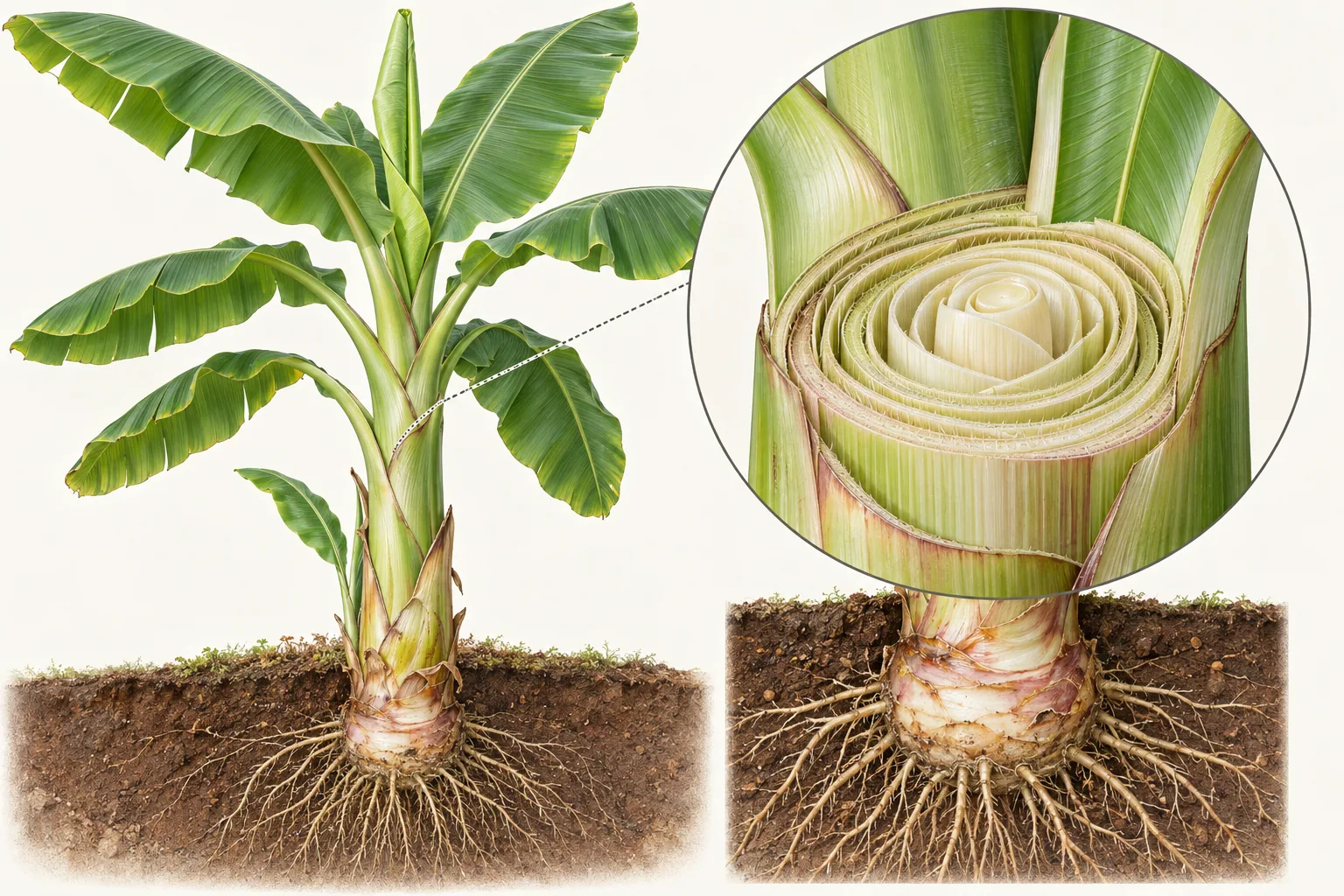
Below ground, the banana plant has an underground stem. Cultivation sources often call it a corm, while some sources also use rhizome for this structure. Its growing point can produce roots, new shoots, and pseudostems. When the plant flowers, the inflorescence axis develops from the growing region below ground and pushes upward through the center of the pseudostem. What looks like a flower stalk emerging from the “trunk” does not mean the pseudostem itself has become the stalk.
An orchid pseudobulb is a swollen stem
Some sympodial orchids grow by producing successive growths along a rhizome near the surface of the growing medium. In some orchids, a stem segment in one of these growths swells into a pseudobulb. Cattleya and Oncidium orchids are familiar examples. A pseudobulb can store water and nutrients, but it is not a banana-like pseudostem made from leaf sheaths or a true bulb made of thickened leaves.
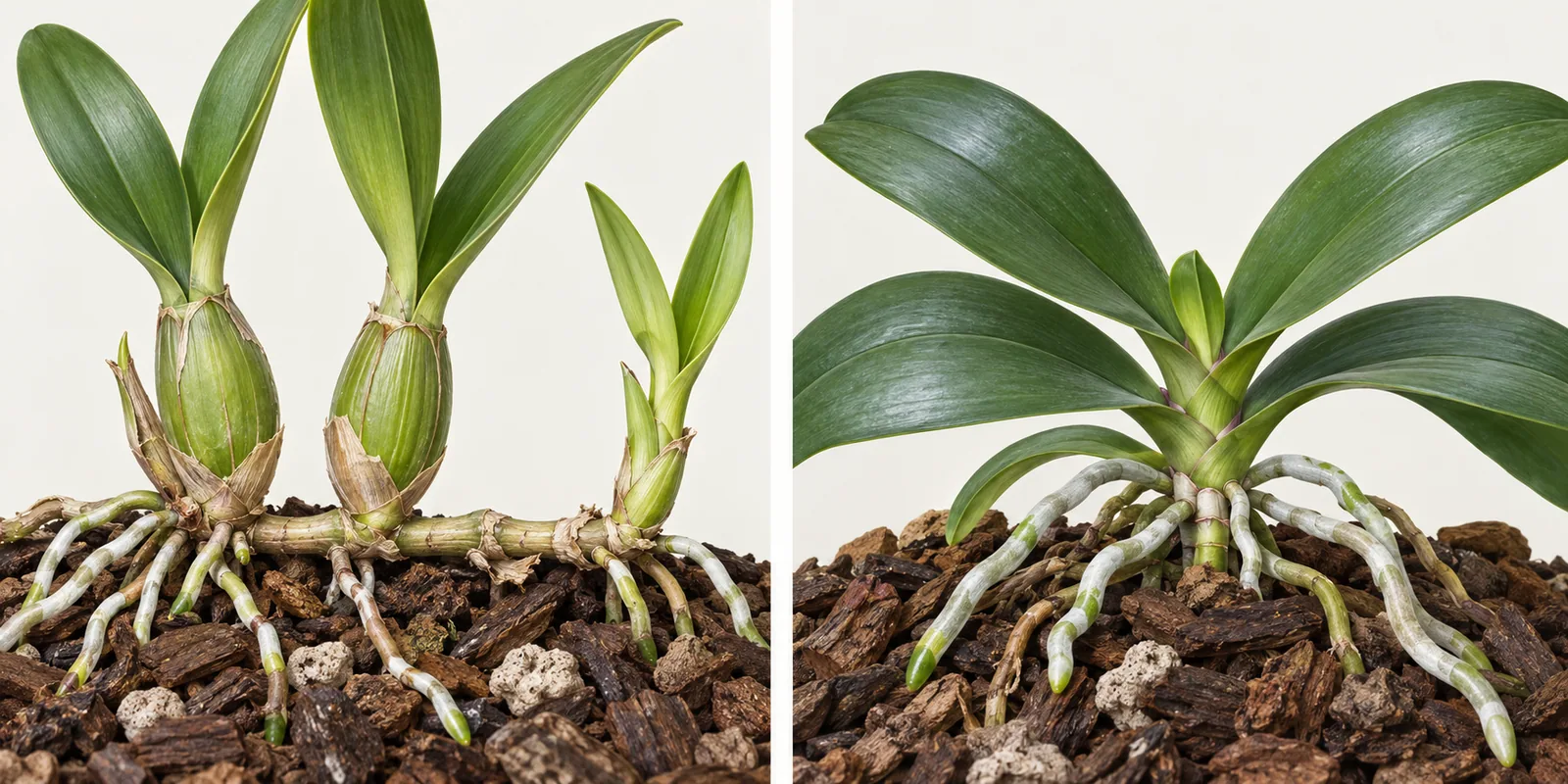
Phalaenopsis orchids have monopodial growth. Their leaves emerge in succession around a short central stem, and they usually have no obvious pseudobulb. Orchid stems are not always round and bulb-like: in some species they form slender, cane-like segments. The forms of pseudobulbs and other stems vary continuously, so there is no single size or shape that neatly separates them across all orchids.
Other plants can form pseudostems, too
Bananas are not the only plants with pseudostems. Ginger leaf sheaths can also overlap to form an upright pseudostem. In grasses, leaf sheaths may first create a column-like, stem-shaped appearance as the plant grows; the true stem later lengthens inside it. These structures differ, but they show why a part that looks like a stem is not necessarily a single true stem.
When comparing plant structures, ask two questions: Is the upright part made of overlapping leaf sheaths, or is it tissue from a stem? How does it connect to an underground stem, a bud, or the next growth? Those clues are more reliable than asking only whether it looks like a trunk. For some plants, you still need to know the species and its growth form; appearance alone may not settle the question.
Common Confusions
- ✕ A banana pseudostem is one thick, true stem.
- ✓ A banana pseudostem is formed mainly by overlapping leaf sheaths. Its underground stem and inflorescence axis are separate structures.
- ✕ An orchid pseudobulb is also a pseudostem made from stacked leaf sheaths.
- ✓ A pseudobulb is a swollen stem segment in some orchids; it forms differently from a banana pseudostem.
- ✕ Every orchid has a pseudobulb.
- ✓ Some orchids, including Phalaenopsis, usually have no obvious pseudobulb. Monopodial and sympodial describe different growth forms.
- ✕ Any thick or ball-shaped plant part can be identified as a pseudobulb by appearance alone.
- ✓ Orchid stems vary in form, with intermediate shapes between familiar examples.
Frequently asked questions
Is the trunk-like part of a banana plant a true stem?
The thick upright part above ground is formed mainly by tightly overlapping leaf sheaths and is called a pseudostem. It supports the leaves and flowering and fruiting structures, but it is not a woody trunk. The plant’s underground stem is at its base.
Where is the true stem of a banana plant?
The banana plant’s underground main stem is at its base, where it produces roots, new shoots, and pseudostems. Cultivation sources often call this part a corm; some also use the term rhizome. The names can vary between sources, so consider the structure’s position and function as well as the label. The inflorescence axis develops from this growing region and rises through the pseudostem.
Does the banana inflorescence grow from the pseudostem?
The inflorescence axis travels upward through the center of the pseudostem, but it begins at the growing region below ground. The pseudostem supports it and provides a passage; it is not the inflorescence axis itself.
Is an orchid pseudobulb a pseudostem?
No. A pseudobulb is the name for a swollen stem segment in some orchids. A banana pseudostem is formed by leaf sheaths wrapping around one another. The names are similar, but they refer to different structures; a pseudobulb is not a true bulb made of thickened leaves, either.
Do Phalaenopsis orchids have pseudobulbs?
They usually have no obvious pseudobulb. Their leaves grow in succession around a short central stem, a monopodial growth form. Many orchids with pseudobulbs grow sympodially instead.
Related terms
- Pseudostem: A stem-like structure formed by overlapping leaf sheaths or similar parts.
- Leaf sheath: The basal part of a leaf that wraps around a stem or structures inside the plant.
- Underground stem: A stem that grows below the soil and can produce buds, roots, or above-ground growth.
- Rhizome: A stem that extends along or below the ground. The names used for underground stems can vary between plant groups.
- Corm: A thickened underground stem. Banana cultivation sources often use this term for the plant’s underground stem.
- True bulb: An underground storage organ made of fleshy leaf bases; it is different from an orchid pseudobulb.
- Pseudobulb: A swollen stem segment found in some orchids.
- Inflorescence axis: The axis that bears the flowers or branches of an inflorescence.
- Monopodial / sympodial growth: Monopodial growth continues along one main axis; sympodial growth continues through successive growth units. These terms describe growth forms, not pseudostems or pseudobulbs.
Read next
Evidence
References
These sources were used to check the plant-science concepts and gardening context in this article.