
Stems do not get thicker by simply stretching outward
Tree trunks, shrub branches, and older woody shoots can become thicker year after year. This is not like a balloon being inflated from the inside. In many woody plants, the stem becomes thicker because the plant keeps adding new tissues from the sides.
Growing taller and growing thicker are not the same process. Length growth mainly happens near shoot tips and root tips. Thickening growth often happens along the sides of stems or roots. In plant biology, growth that increases the girth of a stem or root is called secondary growth.
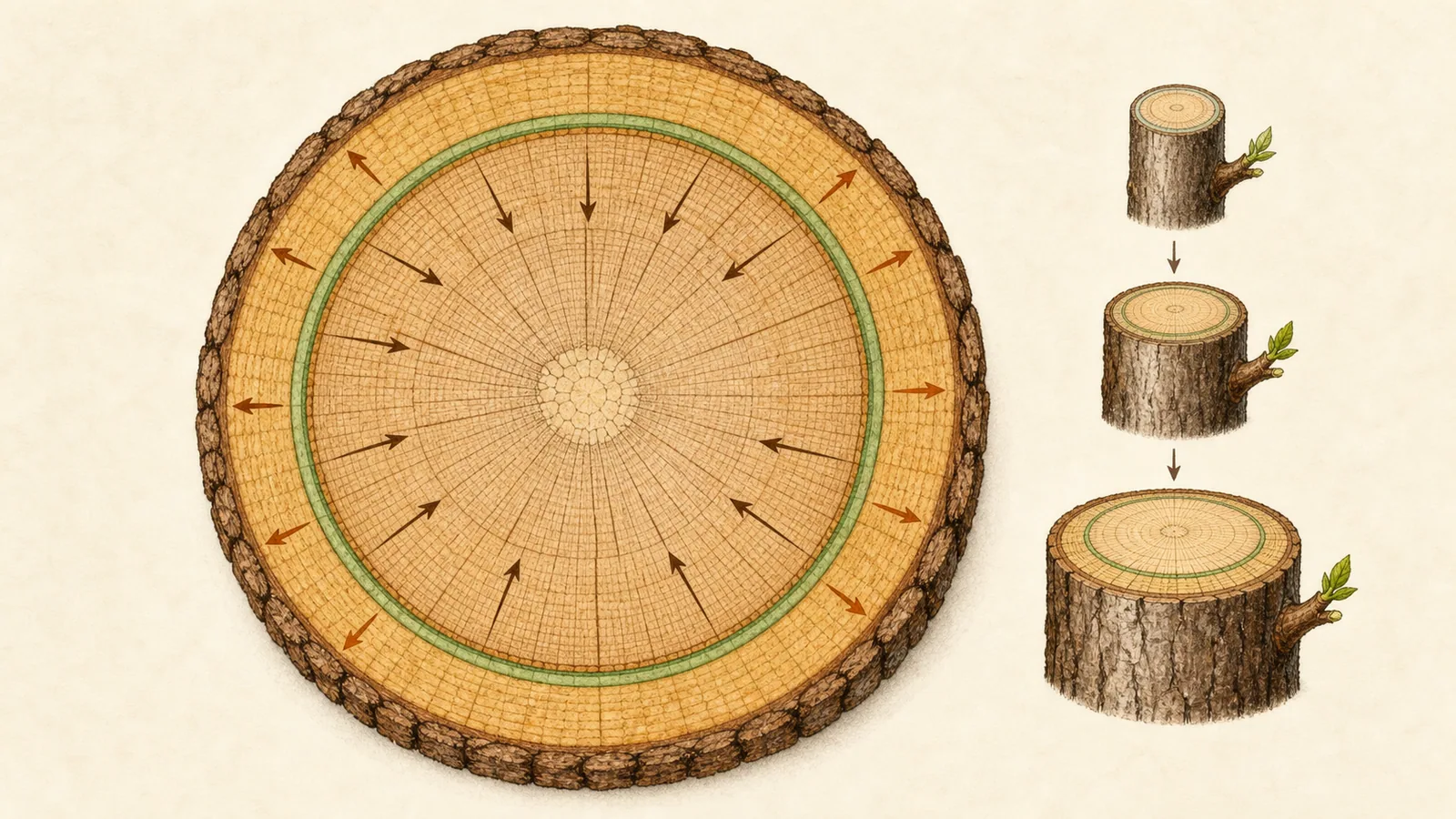
The cambium is a thin growth layer
To understand stem thickening, start with the cambium. A cambium is a type of meristem, which means it is plant tissue that can keep dividing and producing new cells.
In many woody stems, the vascular cambium forms a very thin cylinder-like layer between xylem and phloem. It is not a thick piece of wood. It is a narrow but important growth zone.
When the vascular cambium is active, it produces new xylem toward the inside and new phloem toward the outside. As a beginner model, you can think of it this way: the inward production of xylem builds more and more hard woody tissue, while the outward phloem and protective outer tissues are related to the formation of bark.
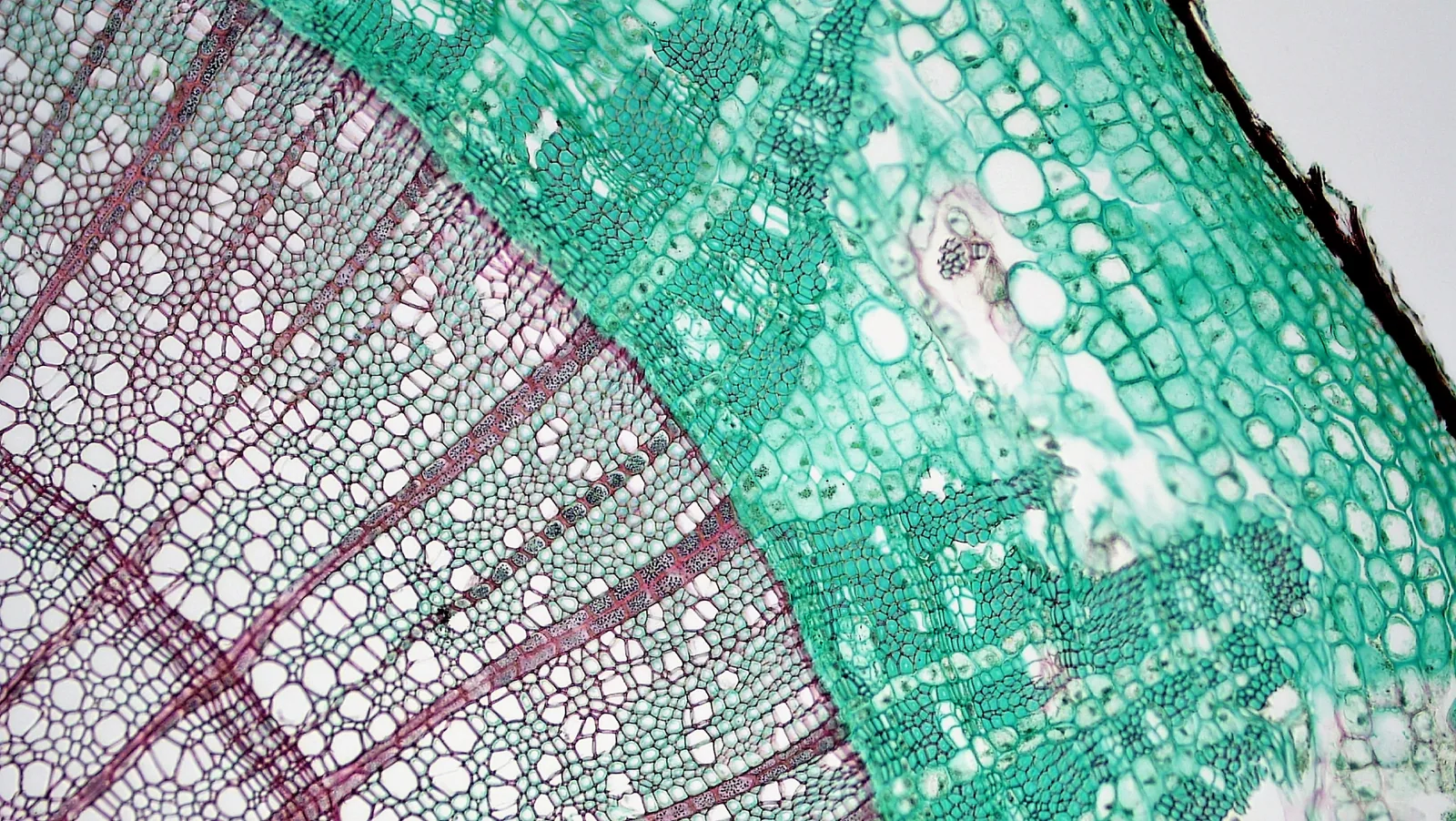
How xylem, phloem, wood, and bark connect
Xylem and phloem are both vascular tissues. Xylem is mostly associated with water and mineral transport, and it also helps support the plant. Phloem transports sugars and other organic materials made by leaves.
When a woody plant has clear secondary growth, the large amount of secondary xylem that accumulates inside the stem is the main source of what we commonly call wood. This is why the inside of a trunk can become hard and strong. To explore how visible growth bands form and why each one does not necessarily represent a year, read How Do Tree Rings Form?.
Bark should not be simplified as “just phloem.” A safer beginner explanation is this: bark includes the tissues outside the vascular cambium, including secondary phloem and protective outer tissues. Older outer tissues may crack, shed, or form different surface textures, which is why bark looks so different from one tree species to another.
Not all stems thicken in the same way
Typical secondary growth is common in many woody dicots and gymnosperms, including many trees, shrubs, and woody vines. Their stems can gradually increase in diameter because the cambium continues to make new tissues.
Most herbaceous plants mainly show shoot elongation, leaf growth, and flowering. Their stems may become slightly thicker or firmer during growth, but they usually do not build up large amounts of wood year after year like tree trunks do. This is why herbs such as basil or mint may have older, firmer shoots but do not become ordinary woody trunks.
Monocots need special caution. Corn, rice, bamboo, palms, yucca, and dracaena should not all be explained with the same “ordinary tree trunk with annual rings” model. Many monocots have vascular bundles scattered through the stem rather than arranged in a continuous cambium ring. Some large monocots can become thick, but their thickening does not follow the typical woody dicot model.
How to observe this safely in garden plants
A simple observation is to compare new shoots and older branches on the same woody plant. New shoots are often thinner and have softer outer surfaces. Older branches may be thicker, harder, and more bark-like on the outside. A pruned branch cross-section may show a firmer woody interior.
You can also compare an herbaceous plant with a woody shrub. Herbaceous stems are often softer, more watery, and easier to bend. Woody branches are usually harder and provide stronger support. This comparison helps show why some stems accumulate woody tissues while others do not do so in a major, long-term way.
These observations are not cultivation prescriptions. Stem thickness depends on plant type, age, light, water, season, and whole-plant condition. It should not be reduced to “add this and the stem will thicken” or “cut here and it will definitely get thicker.”
Common confusions
- ✕ Growing taller and getting thicker are the same process.
- ✓ Length growth is mainly related to primary growth near shoot and root tips. Thickening is often related to secondary growth from lateral meristems such as the cambium.
- ✕ Wood means every hard part inside a plant.
- ✓ For beginner learning, wood can be understood as mainly accumulated secondary xylem, but plants also have other support tissues.
- ✕ Bark is the same thing as phloem.
- ✓ Bark is better understood as the whole set of tissues outside the vascular cambium, including phloem and protective outer tissues.
- ✕ All stems get thicker like tree trunks.
- ✓ Typical secondary growth is common in many woody plants. Most herbaceous plants and many monocots should not be forced into the same tree-trunk model.
- ✕ Annual rings explain every plant stem.
- ✓ Annual rings are clues formed in many woody plants with seasonal growth, but not all plants have clear annual rings.
Frequently Asked Questions
Is stem thickening the same as growing taller?
No. Growing taller mainly involves growth near the shoot tip, which extends the stem. Stem thickening often involves the cambium producing new tissues along the side of the stem, increasing its diameter.
Where is the cambium?
In a typical woody stem, the vascular cambium lies between xylem and phloem, like a very thin growth layer. It produces new xylem inward and new phloem outward.
Is xylem the same as wood?
For a beginner explanation, the large amount of secondary xylem accumulated in woody plants is the main source of wood. In more complete plant biology, xylem includes different cell types and is not just the piece of wood we see in daily life.
Is bark just phloem?
Not exactly. Phloem is an important part of the bark region, but bark usually means all tissues outside the vascular cambium, including secondary phloem and protective outer tissues.
Do herbaceous stems get thicker?
Some herbaceous stems can become slightly thicker or firmer as they grow, but most do not accumulate large amounts of secondary xylem year after year like woody trunks do. A safer statement is that they usually do not show obvious typical secondary growth.
Why do palms or bamboo not show annual rings like ordinary tree trunks?
Palms, bamboo, and many other monocots have stem structures that differ from typical woody dicots. Many monocots lack a continuous vascular cambium ring, so the ordinary tree-trunk annual-ring model should not be applied directly.
Can fertilizer or pruning guarantee thicker stems?
No. Stem thickness depends on plant type, age, light, water, season, and whole-plant condition. This article explains plant structure and growth principles, not a guaranteed method for making stems thicker.
Related Terms
- Primary growth: growth that mainly lengthens roots and shoots.
- Secondary growth: growth that increases the thickness or girth of stems or roots.
- Meristem: plant tissue that can keep dividing and producing new cells.
- Lateral meristem: a meristem along the sides of a plant organ, related to thickening growth.
- Vascular cambium: a cambium between xylem and phloem that produces secondary xylem and secondary phloem.
- Xylem: vascular tissue mostly associated with water transport, mineral transport, and support.
- Phloem: vascular tissue that transports sugars and other photosynthesis products.
- Wood: in beginner terms, mainly accumulated secondary xylem.
- Bark: the set of tissues outside the vascular cambium, including phloem and protective outer tissues.
Read Next
XYLEM × PHLOEM
Watch cells form and follow water and sugar
Each topic is one continuous animation. Topics never switch automatically; pause or scrub to inspect the process.
A new wall grows inside the same cell, separating two daughters.
Vessels: clear the lumen, retain support
Each vessel element is one cell in a vessel. It expands, deposits secondary wall inside the original wall, and gains support through lignification, helping it resist water tension. Pits are thinner side-wall regions, not the loss of an entire wall.
Programmed cell death clears the protoplast. End-wall perforations connect neighboring cells into a water pathway. This diagram shows simple perforations; their form varies. Xylem also contains living parenchyma, so the whole tissue is not dead.
Sieve tubes: lose nuclei but remain alive
Maturing sieve elements lose their nuclei and vacuoles, retaining a plasma membrane, thin cytoplasm and some organelles. Their end walls persist as sieve plates with pores through which sugar-rich sap flows.
Companion cells retain nuclei and connect to sieve elements through plasmodesmata, small channels crossing adjacent cell walls. They support metabolism and transport. Enucleation and pore formation overlap during development; losing a nucleus is not a switch that opens the pores.
A conceptual woody-eudicot model. Sizes, rates and cell counts are illustrative, not measured proportions.
Model scope and evidence
Periclinal division adds radial cells; subsequent expansion increases volume. Real thickening also involves anticlinal divisions that add cells around the circumference. The tracked cells are representative: xylem and phloem production does not follow a universal alternating sequence, and one division does not produce three cells.
Mature vessel elements are dead, but xylem also includes living cells. Sieve-tube elements retain a living membrane and thin cytoplasm; companion cells retain nuclei. Loading and unloading take different routes and are not universally active. One sieve pathway follows one pressure gradient at a time. Mature pathways keep operating as new tissue develops.
OpenStax — Stems · OpenStax — Water and solute transportEvidence and attribution
Sources and image rights
These sources were used to check the plant-science concepts and gardening context in this article.
View sources and further reading (9)
- botit.botany.wisc.edu — Vascular Tissue System.html
- propg.ifas.ufl.edu — 08 celltypes phloem.html
- openstax.org — 30 5 transport of water and solutes in plants
- openstax.org — 30 2 stems
- organismalbio.biosci.gatech.edu — plant development ii primary and secondary growth
- milnepublishing.geneseo.edu — secondary growth
- labs.plb.ucdavis.edu — Chapter5nf.pdf
- arboretum.harvard.edu — bark from abstract art to aspirin
- commons.wikimedia.org — File:Woody Dicot Stem Secondary Phloem and Cambium in Four Year Liriodendron (35914297313).jpg

Image sources and rights
- No attribution required under CC0; source retained for traceability. Suggested credit: Berkshire Community College Bioscience Image Library / Wikimedia Commons · CC0 1.0 — The source JPEG was prepared as WebP for delivery.