As an orchid seed germinates, it commonly forms a small mass of tissue called a protocorm, then gradually develops leaves and roots. In the wild, many orchids depend on suitable fungi for resources during this early growth. Inside each tiny seed is an embryo that follows its own developmental sequence.
Looking at a flowering Phalaenopsis orchid, it can be hard to picture these tiny beginnings. Following the seed through the protocorm stage to a seedling reveals how an orchid gradually develops its organs.
What is inside a tiny orchid seed?
Orchid seeds often look like fine dust. Under magnification, the seed coat and the embryo inside it become visible. The embryo is the part that develops into a new plant. In a mature orchid seed, clearly separate leaves and roots are usually not yet visible. The guide to seed structure introduces these basic parts.
Many plants have seeds with well-developed endosperm, a tissue that supplies stored resources during germination. Mature orchid seeds usually lack this kind of supply tissue, although their embryos can contain small reserves such as oils. Continued early growth requires resources from outside the seed. The article on endosperm and seed reserves explains how these sources of support differ.
Seed shape and the proportion occupied by the embryo vary among orchids. The illustration below draws on developmental research on Phalaenopsis amboinensis. In this species, the oval embryo fills a substantial part of the seed’s central space.
From seed to protocorm, then leaves and roots
As the seed takes up water, the embryo swells. The seed coat splits, revealing a small rounded body of tissue. This stage is called a protocorm. As it grows, it develops a region that will produce the shoot, including the stem and leaves.
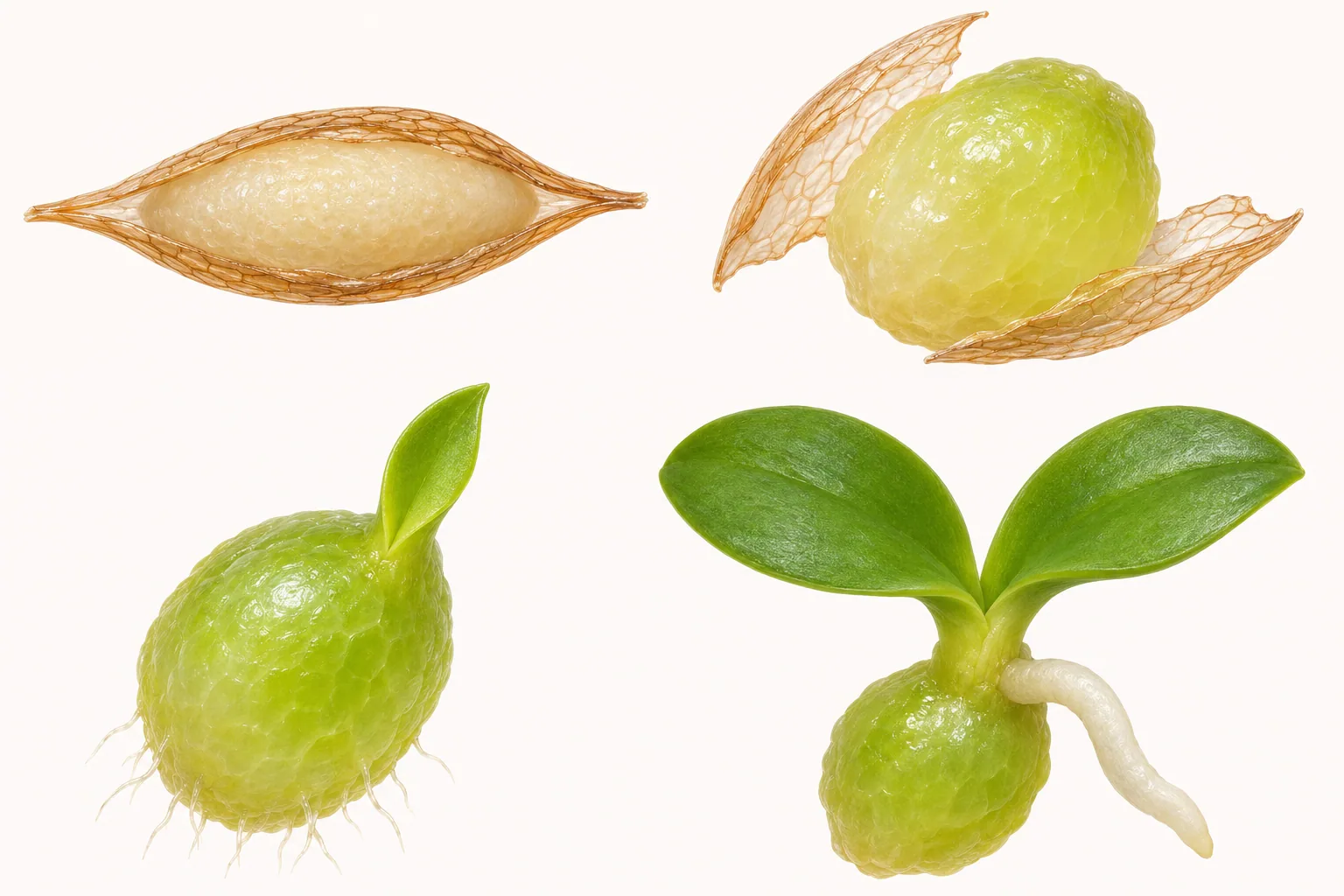
Three changes help make sense of the sequence. The protocorm first enlarges, then develops a distinct growing region and a leaf at one end. Fine rhizoids, hair-like outgrowths from its surface, may also appear. As true roots form, the seedling gradually develops a more complete set of leaves, a short stem, and a root system.
This transition helps explain the distinctive early development of orchids. The timing, appearance, and pace of leaf and root formation vary among species. Some terrestrial orchids also spend a long time underground as protocorms. The illustrated sequence shows how the stages relate to one another, while the course of growth depends on the species and its environment.
How do fungi support early growth?
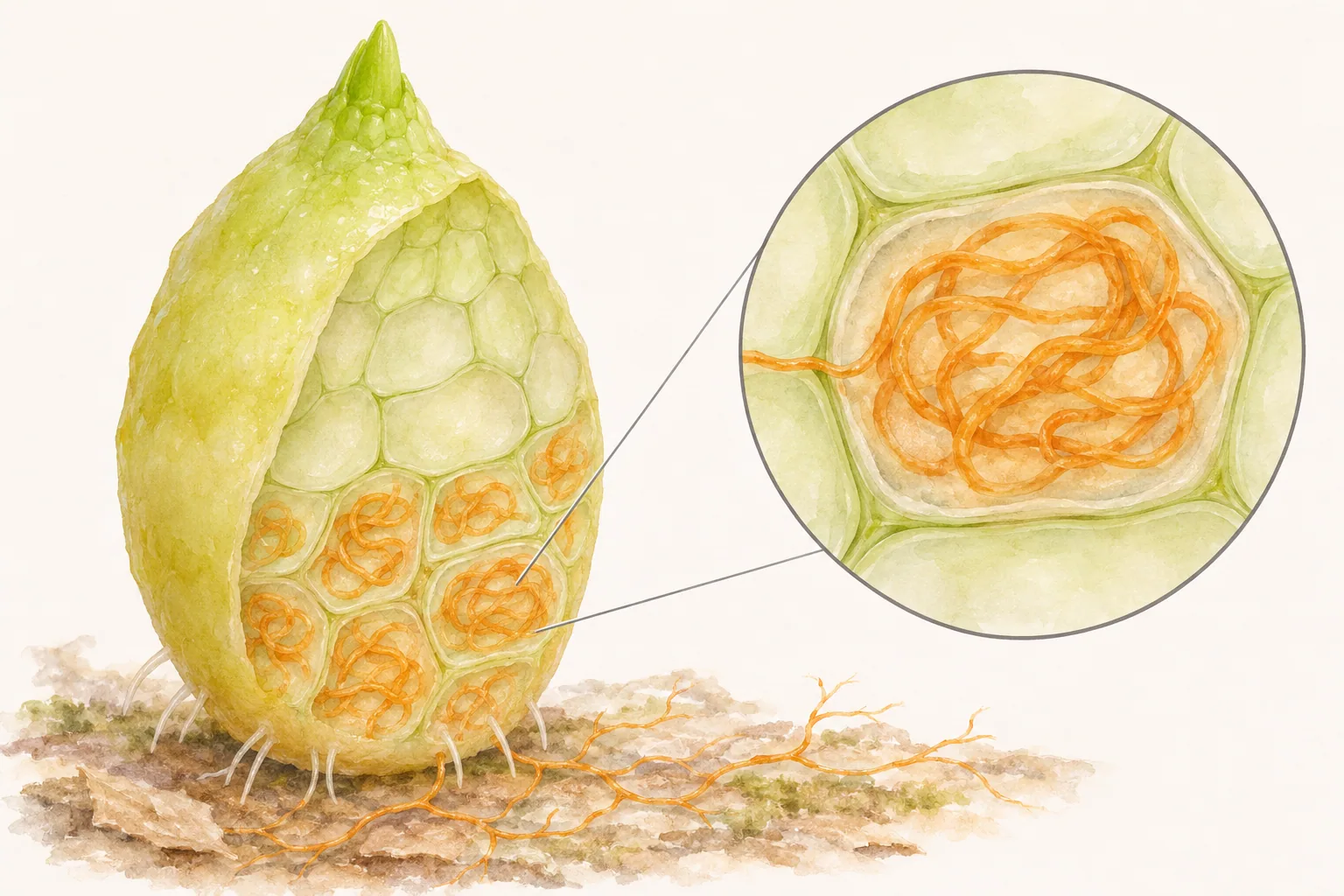
A very young protocorm has limited capacity to make the carbon compounds it needs for growth. In the wild, suitable fungi can supply carbon and some nutrients to support this development. Fungi form fine threads called hyphae. Those that form mycorrhizal associations with orchids are called orchid mycorrhizal fungi.
After entering certain protocorm cells, hyphae coil into small bundles called pelotons. Researchers have observed these coils in cells near the base of the protocorm. Isotope tracing has also shown that carbon and nitrogen supplied by fungi enter orchid tissues. Transfer occurs across the interface with living hyphae and as aging pelotons break down.
A suitable fungal partner is important for continued development. In studies of Dendrobium, some fungi supported growth from seed through to seedling, while others were associated only with earlier changes. A swollen embryo and a developing seedling therefore represent different points in the process.
As green leaves and roots develop, a seedling gradually gains more capacity for photosynthesis and uptake from its surroundings. Its association with fungi may continue, with the relationship varying by orchid species and growing environment.
How can orchid seedlings grow in a culture flask?
In artificial culture, a suitable growing medium supplies sugars and mineral nutrients. Together with a controlled environment, this can allow some orchid seeds to continue developing without a fungal partner. This method is called asymbiotic germination.
It helps explain the young orchids often seen growing in flasks. The nutrients and conditions inside the vessel meet some of their early needs.
For a closer look at the materials from which plants can be grown in culture, see plant tissue culture. Seedlings raised from seeds and plants regenerated from pieces of plant tissue have different starting points.
How do protocorms, PLBs, and pseudobulbs differ?
These similar names refer to structures with different origins and developmental roles. Finding out where a structure came from helps identify it.
| Structure | Origin and role |
|---|---|
| Protocorm | An early structure formed as an orchid seed germinates, which goes on to develop into a seedling |
| Protocorm-like body (PLB) | A similar-looking structure regenerated from plant tissues in culture, which can develop into a plant |
| Pseudobulb | A swollen part of the stem in some orchids, able to store water and other resources |
A protocorm and a protocorm-like body may look very similar. Records of their origin help tell them apart. A pseudobulb is identified by its place in the orchid’s stem system. Phalaenopsis orchids have short stems and lack typical pseudobulbs.
What should you look for in germination records?
When reading research photographs or culture records, first locate the seed coat, swollen embryo, emerging leaf, and true roots. Then check the species and growing conditions in the caption. Photographs may use different magnifications, so their scale bars are essential for judging size.
If a record simply says that seeds have germinated, check which change the author used as the criterion. Some studies count germination from embryo swelling, while others separately record the stages when leaves and roots form. Following the progression from seed germination to seedling makes it easier to understand what is happening within a batch of seeds.
Common points of confusion
- ✕Orchid seeds lack endosperm, so they contain no stored resources at all.
- ✓The embryo can still contain reserves such as oils. Continued early development also needs resources from outside the seed.
- ✕Fine hairs on a protocorm mean that it has already grown roots.
- ✓These hairs are outgrowths from the protocorm surface. True roots form during later development.
- ✕A rounded body of tissue can be identified as a protocorm grown from seed.
- ✓Protocorm-like bodies can have a similar appearance. Their origin is needed to identify them.
Frequently asked questions
Do orchid seeds need contact with fungi before any changes can begin?
Some seeds can take up water, swell, or split their seed coats first. In the wild, continued development into a seedling usually requires resources from suitable fungi. The beginning of germination and the establishment of a seedling therefore need to be observed as separate stages.
Are protocorms always green?
Their color varies with species, developmental stage, and environment. The Phalaenopsis study used here recorded protocorms that were yellowish early on and later turned green. Some terrestrial orchids remain underground as protocorms for extended periods.
What are the fine hairs on a protocorm?
These surface outgrowths are called rhizoids. They help the protocorm interact with its surroundings, and in some orchids they can also provide sites for fungal association. True roots need to be identified separately.
What is the relationship between a protocorm and a pseudobulb?
They occur in different developmental contexts. A protocorm is an early structure between the seed and seedling stages. A pseudobulb is a swollen part of the stem found in some orchids.
Do protocorm-like bodies in tissue culture grow from seeds?
Protocorm-like bodies can regenerate from plant tissues in culture. Their shape resembles that of a protocorm, so identifying them requires knowing the starting material.
How does a flask without fungi supply early resources?
A suitable artificial culture medium supplies sugars and mineral nutrients. These work together with the culture environment to support development. Orchid species differ in their requirements, so the conditions inside the flask need to be considered together.
Related terms
- An embryo is the part of a seed that can develop into a new plant.
- A protocorm is an early structure formed during orchid germination, before a recognizable seedling gradually develops.
- A peloton is a coil of fungal hyphae inside certain orchid cells.
- Asymbiotic germination is germination supported by supplied nutrients and culture conditions, without a fungal partner.
Evidence
References
These sources were used to check the plant-science concepts and gardening context in this article.