
An ovule is not an enlarged plant “egg.” It is a structure made of several tissues and attached inside the ovary. The embryo sac develops within the ovule, and the egg cell is only one cell inside that embryo sac.
In a common flowering-plant developmental pathway, a megaspore mother cell first forms in the nucellus of the ovule. Meiosis produces megaspores. One functional megaspore then undergoes mitosis, nuclear movement, and cellularization to build the embryo sac that contains the egg cell. In other words, meiosis does not directly make a mature egg cell. It produces the starting cell of the female gametophyte in which the egg cell will differentiate.
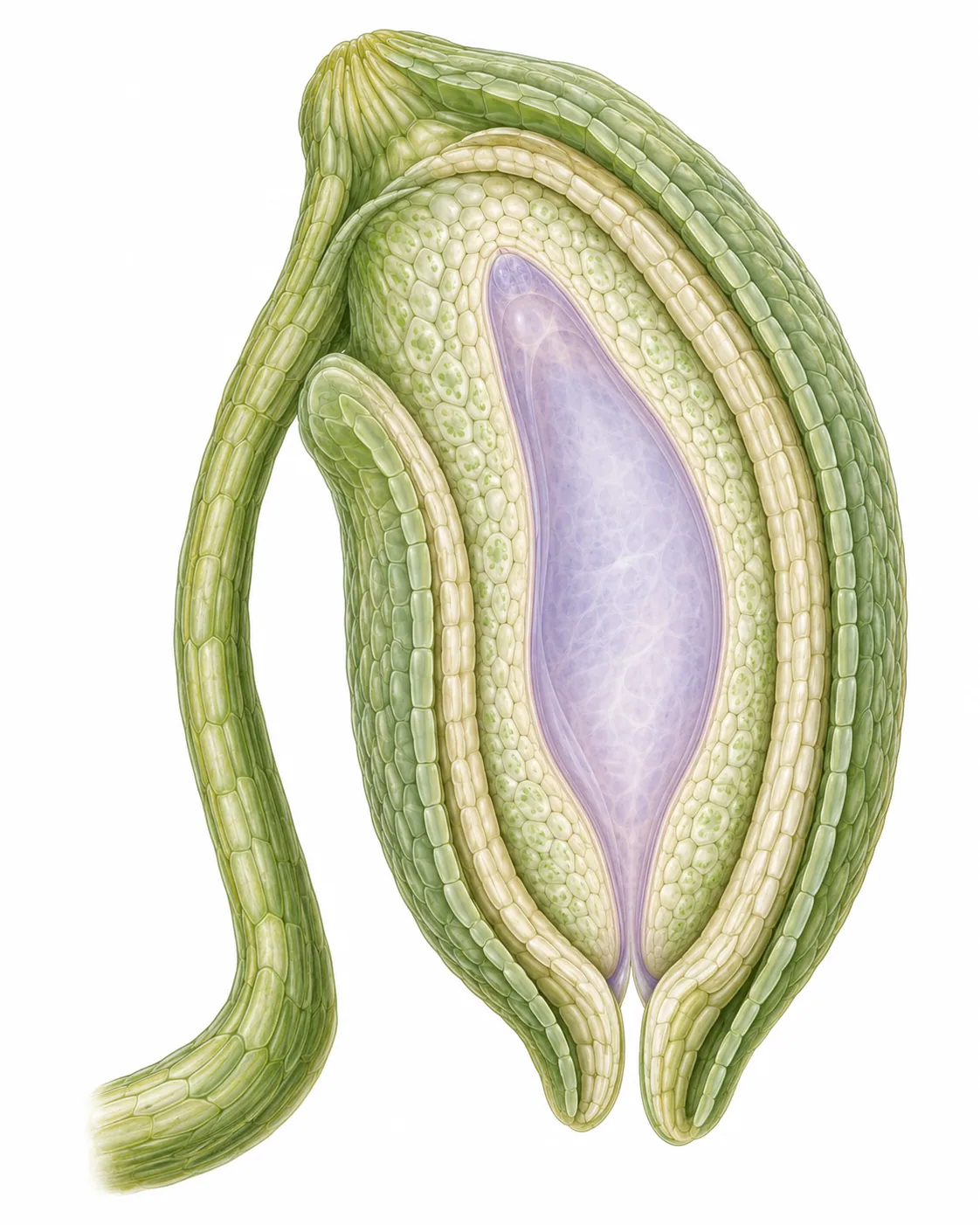
A closer look inside an ovule
The ovule surrounds the embryo sac
Ovules arise from placental tissue inside the ovary. One ovule is enlarged here to show its interior.
- IntegumentsThe surrounding tissues leave a small opening: the micropyle.
- NucellusMaternal tissue inside the integuments, where the embryo sac develops.
- Embryo sacThe lavender region inside. The egg cell is one part of this female gametophyte.
- MicropyleThe small opening between the integuments at the lower end of this image.
- FuniculusThe connection to the ovary placenta, extending along one side of this curved ovule.
Trace the Route from Ovary to Egg Cell
Start with the parts of a flower. The ovary sits near the base of a carpel or pistil, and ovules arise from placental tissue inside it. A stalk called the funiculus commonly connects each ovule to that placenta. At a closer scale, several structures become important:
- The funiculus connects the ovule to the ovary placenta.
- One or more integuments grow around the ovule but leave a small opening called the micropyle.
- The nucellus, inside the integuments, is maternal tissue in which megaspores form and the embryo sac develops.
- The chalaza, near the end opposite the micropyle, is the region where the nucellus, integuments, and funiculus meet.
- The embryo sac lies within the nucellus. It is the female gametophyte produced from the functional megaspore.
The funiculus, integuments, and nucellus are mostly diploid tissues of the parent plant. The embryo sac represents the haploid female gametophyte generation. The egg cell develops near the micropylar end of that embryo sac. Ovule, embryo sac, and egg cell are therefore three nested but distinct levels.
Not every ovule has exactly two integuments, nor does every ovule curve into the same shape. The diagram uses a common arrangement to make the relationships visible, not as a single blueprint for all flowering plants.
Step 1: Meiosis Produces Megaspores
A cell in the nucellus differentiates into a megaspore mother cell, often abbreviated MMC. It is diploid, written as 2n. After one complete round of meiosis, the MMC commonly produces four haploid megaspores, each written as n.
In Arabidopsis and the common monosporic model, the four megaspores usually form a row. The one nearest the chalazal end continues as the functional megaspore, while the other three, nearer the micropylar end, usually degenerate. This differs from the common male pathway inside an anther, where all four microspores can generally continue developing. Compare this sequence with how pollen forms: meiosis occurs on both sides, but the products follow different developmental patterns.
This stage is called megasporogenesis. It reduces the chromosome-set number from 2n to n, but it has not yet produced a mature egg cell.
Follow one cell as an embryo sac develops
From a megaspore mother cell to seven cells and eight nuclei
The Polygonum type is a common embryo-sac development pattern: one functional megaspore undergoes three mitoses and cellularization, forming seven cells with eight nuclei before the polar nuclei fuse.
Paused. Choose a stage or drag the progress slider.
01 / 06
Locate the megaspore mother cell
The megaspore mother cell lies in the nucellus. Here, 2n means two chromosome sets in this cell, not a label for the whole ovule.
The third mitosis, nuclear migration and cellularization overlap; the steps separate them for closer observation.
Antipodals: 3 cells, 3 nuclei
Central cell: 1 cell, 2 polar nuclei
Egg: 1 cell, 1 nucleus
Synergids: 2 cells, 2 nuclei
3 + 1 + 1 + 2 = 7 · 3 + 2 + 1 + 2 = 8
Playback settings and reset
Step 2: One Functional Megaspore Builds the Embryo Sac
The next stage is megagametogenesis: the functional megaspore develops into an embryo sac. This article follows the common Polygonum type, a developmental pattern in which one functional megaspore undergoes three mitoses and cellularization to form seven cells with eight nuclei before the polar nuclei fuse. The name describes a developmental pattern; it is not restricted to plants in the knotweed family.
During this process, the nuclear count increases from 1 to 2, then 4, then 8. These divisions increase the number of nuclei before the whole space has been partitioned into separate cells.
A large vacuole develops as the embryo sac grows, and nuclei move toward the micropylar and chalazal ends. Some nuclei later move toward the center. Cellularization and differentiation then produce a common mature arrangement:
- At the micropylar end, one egg cell and two synergid cells form the egg apparatus.
- A large central cell occupies much of the middle and can initially contain two polar nuclei.
- Three antipodal cells commonly occur at the chalazal end.
That makes seven cells, yet the central cell can hold two polar nuclei, which is why this stage is often described as a “seven-celled, eight-nucleate” embryo sac. The two polar nuclei may fuse before fertilization. Counts reported for different mature moments can therefore differ without contradicting one another.
The Egg Cell Is Only One Part of the Mature Embryo Sac
The egg cell lies near the micropylar end, associated with the two synergids. The synergids are not two extra eggs. They help guide and receive the pollen tube. The central cell is not another egg either. During double fertilization, it fuses with the other sperm cell and begins the pathway that forms endosperm. Continue with what happens after pollen lands on a stigma and what endosperm does for those later events.
The hierarchy is easier to remember from outside to inside:
From outside to inside
- Ovule: the complete structure, including the funiculus, integuments, nucellus, and embryo sac
- Embryo sac: the female gametophyte inside the ovule, made of several specialized cells
- Egg cell: one female gamete at the micropylar end of the embryo sac
A Common Model, Not One Fixed Script for Every Plant
The Polygonum type is monosporic: only one product of meiosis contributes to the embryo sac. Other monosporic patterns also exist. In some groups, two or four products of meiosis contribute instead. The number of integuments, thickness of the nucellus, final cellular arrangement, and persistence of particular cells also vary.
Timing varies as well. In many familiar model plants, a fertilization-ready embryo sac is present before the pollen tube arrives. In other plants, ovule or female gametophyte development can continue around or after pollination. Experiments in tobacco, for example, show that pollination can promote female gametophyte development in immature flowers. The outside appearance of a flower bud therefore cannot prove that its egg cells are already mature.
After fertilization, the zygote formed from the egg cell, the endosperm pathway begun by the central cell, and the seed coat derived from the integuments develop along different tracks. Follow how an ovule becomes a seed for the next stage.
Common Mix-Ups
- ✕ An ovule is the plant’s egg.
- ✓ An ovule is a complete structure; the egg cell is one cell in the embryo sac inside it.
- ✕ The embryo sac is an empty cavity in the nucellus.
- ✓ The embryo sac is the female gametophyte, with specialized cells including the egg, synergids, central cell, and antipodals.
- ✕ Meiosis directly produces a mature egg cell.
- ✓ Meiosis produces megaspores; a functional megaspore must still undergo mitosis, nuclear movement, cellularization, and differentiation.
- ✕ Four megaspores always leave only one survivor in every flowering plant.
- ✓ That is the common monosporic pattern; bisporic, tetrasporic, and other pathways also occur.
- ✕ Seven cells can only contain seven nuclei.
- ✓ The central cell of a common embryo sac can contain two polar nuclei, producing a seven-celled, eight-nucleate stage.
- ✕ An embryo sac is always fully mature before pollination.
- ✓ Developmental timing differs among species, and some female gametophytes continue developing after pollination.
Frequently Asked Questions
Is an ovule the same as an egg cell?
No. An ovule is a complete structure attached inside the ovary. It includes integuments, nucellus, and an embryo sac. The egg cell is only one cell within that embryo sac.
Is the embryo sac empty?
No. “Sac” is a traditional name, not a description of an empty pocket. A mature embryo sac is the female gametophyte and contains several specialized cells. The common Polygonum type includes an egg cell, two synergids, one central cell, and three antipodals.
Why does only one of four megaspores usually remain?
In the common monosporic pathway, one product is selected as the functional megaspore and the others usually degenerate. Developmental signals and surrounding ovule tissues help regulate that selection. Other types of embryo sac development do not necessarily follow this route.
How can seven cells contain eight nuclei?
At some mature stages, the large central cell contains two polar nuclei. Counting the nuclei in the egg cell, synergids, central cell, and antipodals gives eight. If the polar nuclei fuse before fertilization, the number visible at a later moment changes.
Does every ovule contain exactly one egg cell?
The common sexual Polygonum-type embryo sac usually contains one egg cell. Flowering plants also have other embryo sac types and exceptional reproductive systems such as apomixis, so this is not an absolute rule for every plant.
Where does the pollen tube enter an ovule?
The common route is through the micropyle, after which the pollen tube reaches the micropylar end of the embryo sac and releases sperm cells. A few plant groups use routes that do not pass through the micropyle.
Must the embryo sac form before pollination?
Not always. Many model plants are close to mature before pollination, but some plants continue ovule or female gametophyte development around or after pollination. A flower’s appearance alone cannot establish embryo-sac maturity.
Related Terms
- Ovary placenta: tissue inside the ovary from which ovules arise.
- Funiculus: the stalk connecting an ovule to the placenta.
- Chalaza: the region where the nucellus, integuments, and funiculus meet, near the end opposite the micropyle.
- Nucellus: maternal tissue inside the integuments where megaspores form and the embryo sac develops.
- Integuments: maternal tissues surrounding the nucellus; after fertilization, they contribute to the seed coat.
- Micropyle: the opening left by the integuments and the usual entry point for a pollen tube.
- Megaspore mother cell: a diploid cell in the nucellus that undergoes meiosis to produce megaspores.
- Functional megaspore: the haploid megaspore that continues developing into the embryo sac in the common monosporic pathway.
- Embryo sac / female gametophyte: the haploid generation formed from the functional megaspore inside an ovule.
- Synergid cells: two cells associated with the egg cell that help guide and receive the pollen tube.
- Central cell: the large central cell of the embryo sac, involved in double fertilization and endosperm formation.
- Antipodal cells: commonly three cells at the chalazal end of the embryo sac; their persistence and roles vary among plants.
Read Next
Evidence
References
These sources were used to check the plant-science concepts and gardening context in this article.