Endosperm is a support tissue that commonly develops inside the seeds of flowering plants. It forms after fertilization alongside the embryo, and it can receive, store, or transfer resources that help the embryo develop and support the earliest stages of germination and seedling establishment.
That does not mean all of a seed’s reserves are packed into endosperm. Mature corn and wheat grains retain a large endosperm, while many beans transfer most of their reserves into the embryo’s cotyledons before the seed matures. Some seeds have little or almost no endosperm. To understand how a seedling gets its start, it helps to separate three structures: the embryo, the endosperm, and the cotyledons.
The embryo and endosperm come from different events in double fertilization
In a flowering plant, a pollen tube delivers two sperm cells into an ovule. One fuses with the egg cell to form a zygote, which develops into the embryo. The other fuses with the central cell and starts the development of the endosperm. Together, these two fusion events are called double fertilization. How an ovule becomes a seed follows the larger process from pollination onward.
In the most common flowering-plant model, the central cell contributes two maternal sets of chromosomes and the sperm contributes one paternal set. The resulting endosperm is therefore usually triploid, or 3n. “Usually” matters: embryo sacs and central cells vary among plants, so some species form diploid endosperm or endosperm with still higher ploidy.
Endosperm is therefore neither an organ inside the embryo nor a second embryo. The embryo can grow into the new plant; the endosperm has a supporting role, and the two tissues have different origins and developmental fates. For a closer look at the plant-to-be inside a seed, see what a seed embryo is.
A mature seed may keep reserves in the endosperm or move them into cotyledons
Where a mature seed stores its reserves depends on the species.
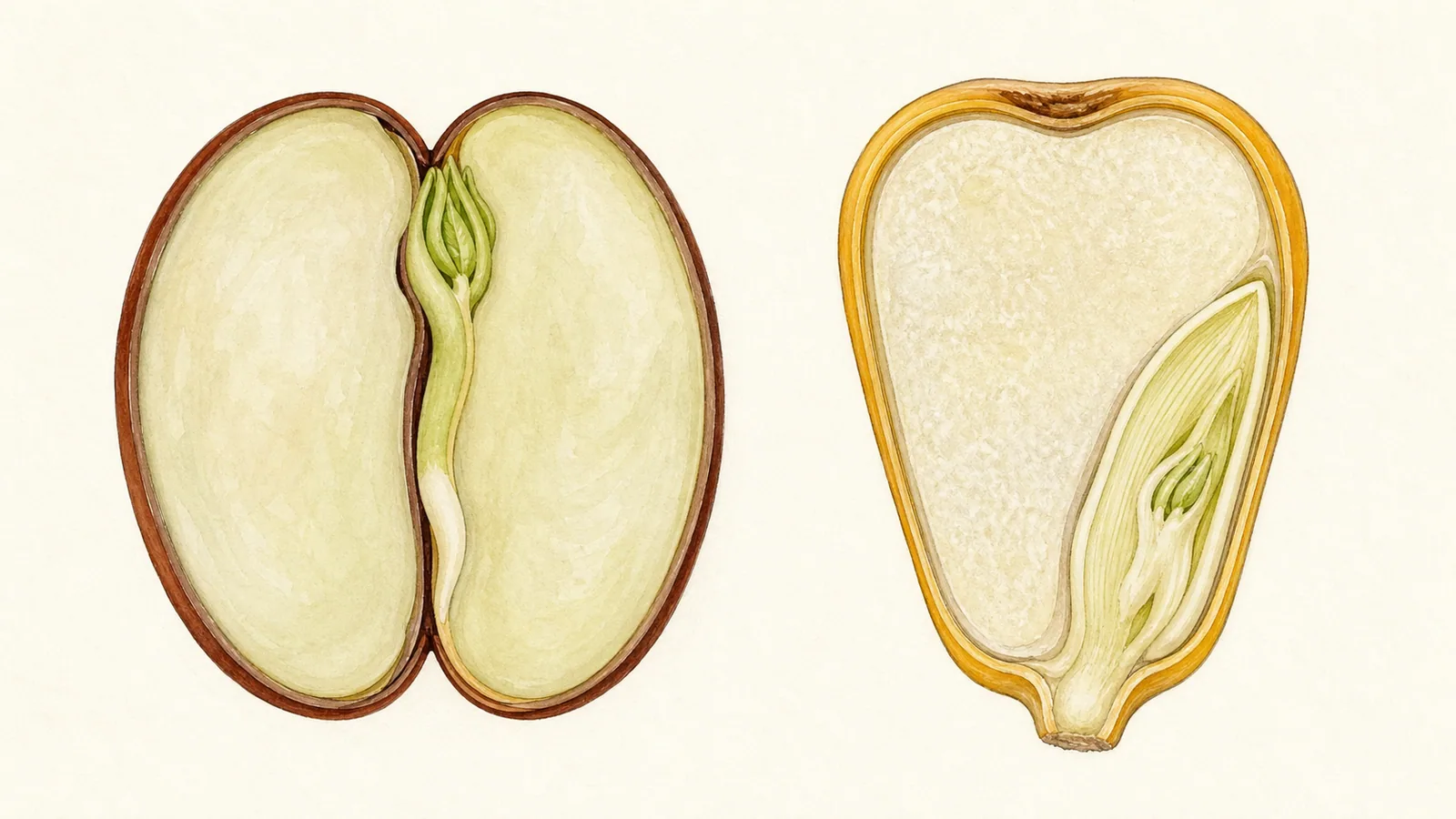
- A large endosperm remains. In grasses such as corn and wheat, endosperm still fills much of the mature grain, with the embryo positioned along one side.
- Most reserves move into cotyledons. In many beans, two thick cotyledons occupy most of the mature seed. Much of the endosperm was absorbed earlier in development.
- Many other arrangements exist. Eudicots such as tomato can also retain endosperm at maturity. “Monocots have endosperm; dicots do not” is not a reliable classification rule.
A cotyledon, sometimes called a seed leaf, belongs to the embryo. Endosperm is a separate product of fertilization. Either tissue may store or transfer resources, but they are not the same structure. This guide to cotyledons compares their roles in different kinds of seeds.
Seed reserves must be broken down before a seedling can use them
Seed reserves can include carbohydrates such as starch, storage proteins, and oils. Their proportions and storage locations vary among species. They cannot be turned directly into roots or leaves. The seedling must first break down large stored molecules into smaller compounds that cells can transport and metabolize.
When a dry seed takes up water—a process called imbibition—its cells rehydrate and respiration and other metabolic processes resume. Enzymes such as amylases break starch into smaller sugars. Proteases split storage proteins into peptides and amino acids. Lipases and later metabolic steps help make the carbon and energy stored in oils available for growth. Different reserves require different enzymes, and they do not all simply turn into glucose.
Reserve mobilization starts after water uptake and continues into early seedling establishment. In the strict physiological sense, germination often ends when the radicle breaks through the tissues enclosing the embryo. The resource story in this article extends beyond that point into the seedling’s early growth.
How does a grass seed transfer endosperm reserves to its embryo?
Barley and corn provide a useful grass-seed model. Three structures are especially important:
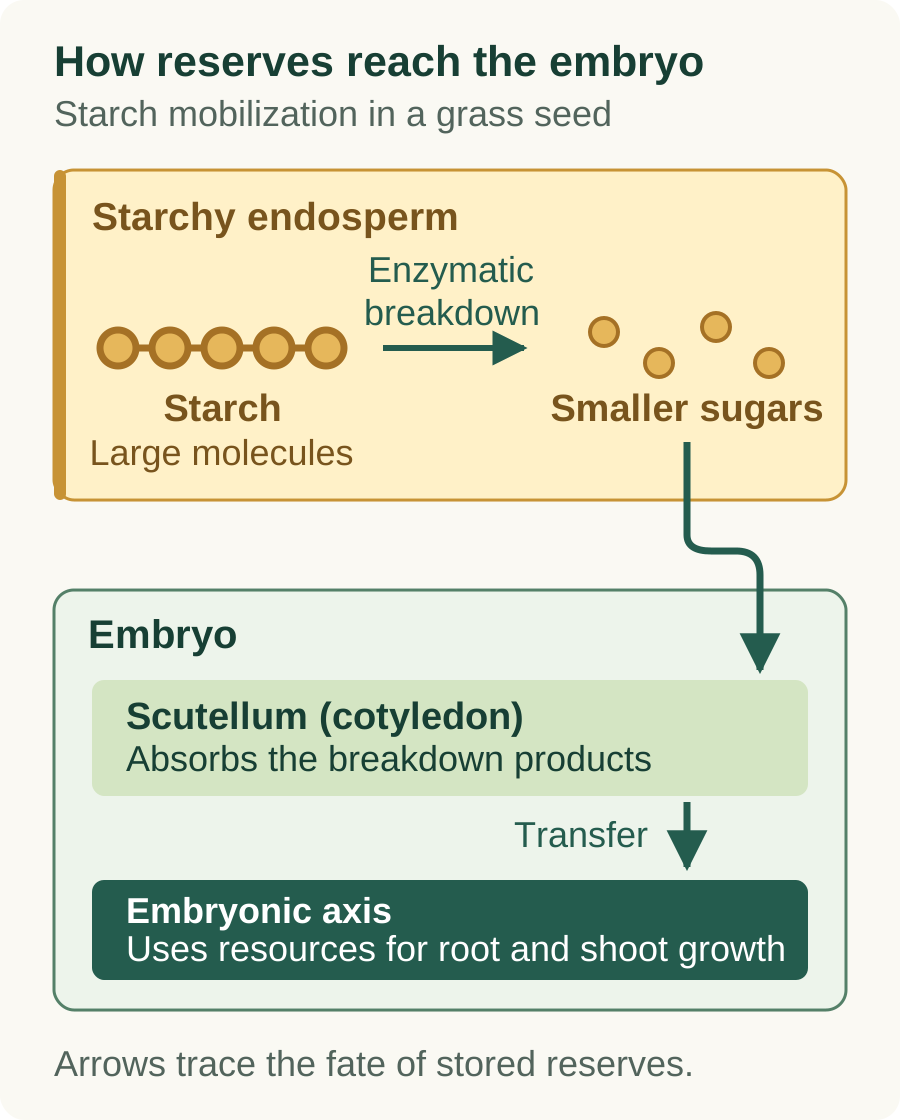
- The starchy endosperm occupies most of the grain. Most of its cells are dead at maturity and contain starch granules and storage proteins.
- The aleurone layer surrounds the starchy endosperm and remains living endosperm tissue. Its thickness differs among cereal species.
- The scutellum lies beside the endosperm. It is the grass embryo’s specialized cotyledon, so it belongs to the embryo rather than the endosperm.
After the seed takes up water, signals from the embryo stimulate tissues including the aleurone layer to produce and release hydrolytic enzymes. These enzymes enter the starchy endosperm and break its reserves into smaller products. The scutellum absorbs and transfers those products toward the growing embryonic axis. Experiments also show that the scutellum itself can release some enzymes, so this process should not be pictured as the work of only one tissue.
A seedling does not stop using its reserves the moment a leaf appears
Early in germination, the embryo has too little green surface area to support growth by photosynthesis alone, so it relies mainly on reserves already in the seed. As cotyledons or true leaves expand, chloroplasts mature, and light becomes available, photosynthesis makes an increasing contribution.
This transition is more like a relay with an overlap than a power switch. Reserve mobilization and photosynthesis often operate at the same time for a while. Species, seed size, whether the cotyledons emerge and turn green, burial depth, and the light environment can all change their relative contributions. There is no universal day—or universal first-leaf stage—when every seedling stops relying on stored reserves.
In a garden or classroom observation, you can watch for the radicle emerging, cotyledons or true leaves expanding, and the original seed tissues gradually shrinking. These are clues that seedling establishment is under way. They cannot by themselves tell you that every reserve has been exhausted, nor can they guarantee that later growth will succeed. Continue with how a seed germinates and what makes a plant a seedling for the visible stages around this transition.
Orchid seeds show that not every seed carries a large reserve
Orchid seeds are usually extremely small, with a thin seed coat and a poorly differentiated embryo. They lack, or have almost no, endosperm. In nature, their germination and early protocorm growth commonly depend on suitable orchid mycorrhizal fungi, which supply early resources including carbon and nitrogen.
This does not mean all seeds need fungi. A large endosperm or thick storage cotyledons are only some of the strategies plants use to cross the earliest stages of growth. The corn and bean models cannot be applied to every plant.
Here, endosperm means the tissue formed through double fertilization in flowering plants. The tissue that supplies a gymnosperm embryo has a different developmental origin. To compare pines with flowering plants, see gymnosperm and angiosperm reproduction.
Common points of confusion
- ✕ Endosperm is part of the embryo.
- ✓ The embryo and endosperm arise from different fusion events in double fertilization. The embryo can become the new plant; the endosperm provides support.
- ✕ Every endosperm is triploid.
- ✓
3nis the most common model, but variations in embryo-sac structure can produce other ploidy levels. - ✕ Monocot seeds all have a large endosperm, while dicot seeds have none.
- ✓ Corn and beans are useful contrasts, not a classification law. Other reserve arrangements occur within both broad groups.
- ✕ A seedling completely stops using seed reserves as soon as its first leaf appears.
- ✓ Reserve mobilization and photosynthesis usually overlap for some time.
- ✕ Endosperm reserves move unchanged into the seedling.
- ✓ Enzymes and metabolism must break down and transform large stored molecules before growing tissues can use them.
Frequently Asked Questions
Is endosperm part of the embryo?
No. The embryo and endosperm are distinct tissues produced by different events in double fertilization. The embryo develops into the new plant, while the endosperm receives, stores, or transfers resources that support embryo development and early seedling growth.
Is endosperm always triploid?
No. In the most common flowering-plant model, two maternal genome copies and one paternal genome copy form 3n endosperm. However, the number and arrangement of polar nuclei in the central cell vary among plants, so diploid and higher-ploidy endosperms also occur.
Does every mature seed have endosperm?
No. Some mature seeds retain a large endosperm. Others transfer most reserves into cotyledons while the seed is developing. Most orchid seeds lack, or have almost no, endosperm.
What is the difference between a cotyledon and endosperm?
A cotyledon is part of the embryo; endosperm is a separate product of fertilization. Cotyledons may store reserves, absorb products released from endosperm, or turn green after emergence. The two tissues can work together, but they do not share the same origin.
Does endosperm store only starch?
No. Seed reserves may include carbohydrates such as starch, storage proteins, and oils. Their composition and location differ among species.
Does a seedling still use seed reserves after its leaves appear?
It may. As photosynthesis in green tissues increases, stored reserves can continue contributing for a time. This gradual handoff does not follow one fixed number of days in every plant.
How can orchid seeds germinate with almost no endosperm?
In nature, orchid seeds usually rely on suitable orchid mycorrhizal fungi for early resources. They first form a protocorm and, depending on the species and its way of life, may later develop green photosynthetic organs. This is a distinctive orchid strategy, not a model for all large seeds.
Related terms
- Endosperm: A tissue formed through double fertilization in flowering plants that supports embryo development and early seedling growth.
- Embryo: The young structure inside a seed that can develop into a new plant.
- Cotyledon: A seed leaf belonging to the embryo; it may store, absorb, or transfer resources during early growth.
- Double fertilization: The flowering-plant process in which two sperm cells participate in the separate formation of the embryo and endosperm.
- Imbibition: Water uptake that rehydrates a dry seed.
- Reserve mobilization: The breakdown, conversion, and transport of stored molecules toward growing tissues.
- Aleurone layer: Living cells at the outer edge of a grass endosperm that can help release hydrolytic enzymes.
- Scutellum: The specialized cotyledon of a grass embryo, positioned beside the endosperm and involved in absorbing and transferring resources.
- Protocorm: An early structure formed after an orchid seed germinates and before a typical seedling develops.
Read Next
Evidence and attribution
Sources and image rights
These sources were used to check the plant-science concepts and gardening context in this article.
View sources and further reading (8)
Image sources and rights
- Plant Note project-made image · Created by Plant Note; no third-party image license applies — Created in SVG and served in its original format.