
The powder that rubs off a mature anther is not material scraped from its surface. Each pollen grain has gone through a series of developmental stages inside the anther. A pollen mother cell first undergoes meiosis to produce microspores. Each microspore then grows, divides, and builds a pollen wall. Only when both the pollen and the surrounding anther wall are ready does the anther open at a particular place and release its pollen.
Two processes therefore run at the same time: cells inside the anther’s pollen sacs are developing into pollen, while the surrounding anther wall is preparing to open. These processes have to stay coordinated for mature pollen to leave the anther at an appropriate time.
Pollen Forms Inside an Anther, Not on Its Surface
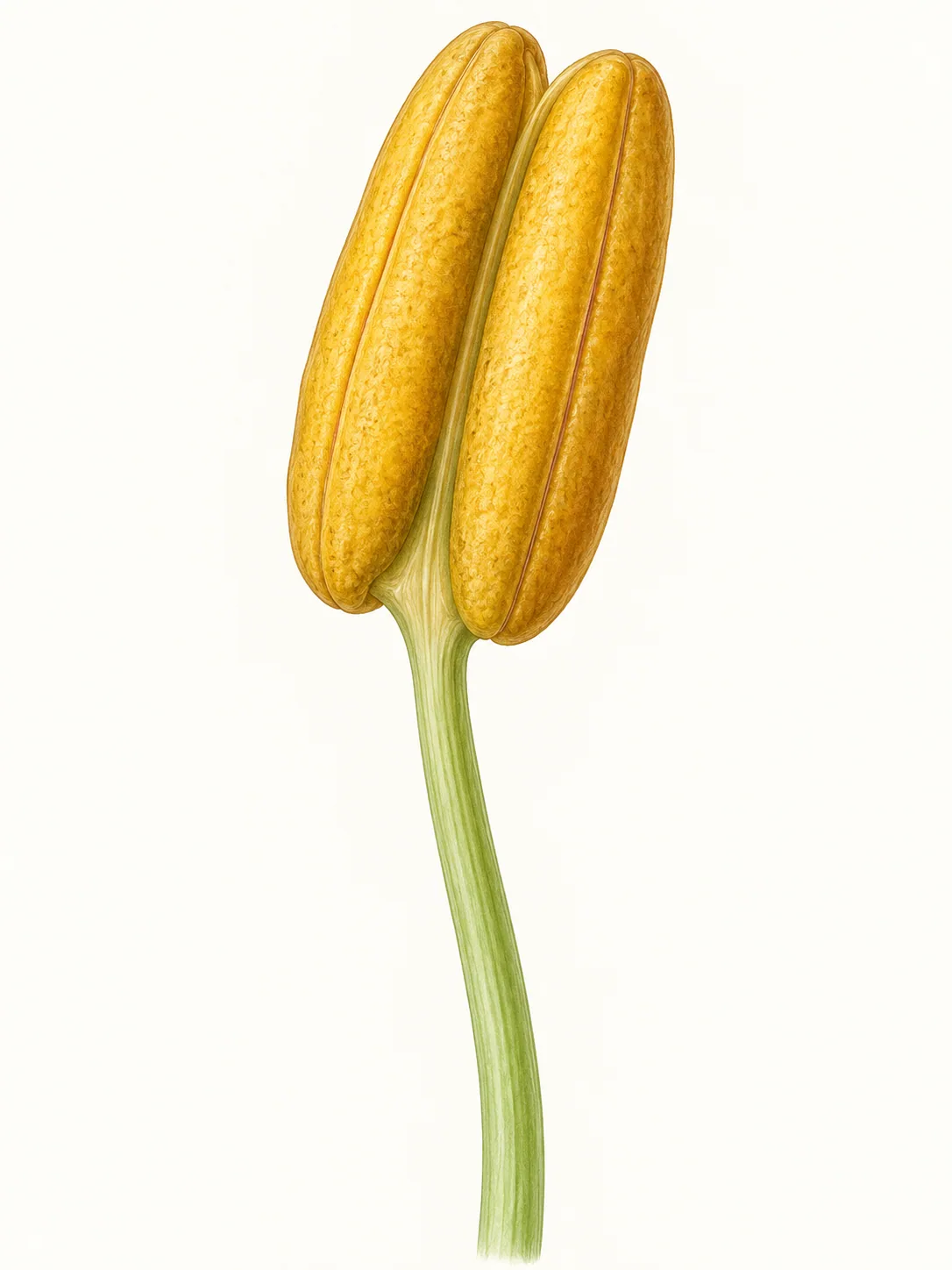
A stamen usually consists of a filament and an anther. The filament supports the anther, while pollen forms inside compartments called microsporangia, more simply known as pollen sacs.
A cross-section of a typical young flowering-plant anther is often drawn with two lobes, each containing two pollen sacs. This four-sac arrangement is a useful teaching model, but it is not a rule for every plant. The number, shape, and arrangement of these compartments vary. Think of the diagram as a map of one common kind of pollen-producing structure, not a blueprint that every flower must follow.
Nor is each pollen sac just an empty pouch. Developing pollen cells are surrounded by several layers of anther tissue. The innermost of these is the tapetum, which supplies nutrients and materials needed to build the pollen wall. The tapetum later breaks down on schedule.
Pollen forms inside. Where does the anther open?
Pollen forms inside while the anther wall prepares to open. These developmental tracks overlap; we show them separately to make the changes easier to follow.
1 / 8 · LocateWhole stamen → section plane
Locate the anther before looking inside
The filament supports the anther at its base. The blue plane marks a transverse section: next we look inside at this height, not split the anther down its center.
- Anther: two joined thecae
- Filament: attached at the base
- Section plane: the next view
Reduced motion is on: step selection shows the completed frame. You can still scrub to inspect intermediate states.
Model scope and sources
This common angiosperm model has two thecae, four pollen sacs and longitudinal dehiscence, with a basally attached filament. Proportions, cell arrangement, nuclear division and pollen-wall formation are simplified. These are not microscopy images or a quantitative simulation. The flat tetrad arrangement is for clarity, not a universal pattern.
Anther-wall and pollen development overlap. Step seven returns our attention to the wall; it does not mean wall development starts only then. Dehiscence follows one common model, with species-specific variation; pollen trajectories are illustrative.
Anatomy and development: Marchant & Walbot · pollen development · anther opening mechanics.
Step 1: Meiosis Produces Four Microspores
Pollen development begins with a pollen mother cell, also called a microsporocyte or male meiocyte. This cell is diploid: it has two sets of chromosomes, written as 2n. After one complete round of meiosis, a pollen mother cell usually produces four haploid microspores. Each microspore has one set of chromosomes, written as n.
At first, the four new microspores commonly remain enclosed together as a tetrad. A temporary callose wall surrounds them. When this wall is broken down, the four cells separate and become free microspores in the pollen sac.
The crucial point is not that one cell has simply been cut into four ordinary pieces. Meiosis reduces the chromosome-set number from 2n to n. The full alternation of generations in plants includes more stages, but this is the transition to remember here: the pollen mother cell belongs to the diploid phase, while the microspores begin the haploid phase.
Step 2: Each Microspore Develops into a Pollen Grain
A free microspore grows, forms an outer and inner pollen wall, and undergoes an unequal mitotic division. That division produces one larger vegetative cell and one smaller generative cell:
- The vegetative cell later grows the pollen tube, creating the route that carries sperm cells.
- The generative cell later divides by mitosis to form two sperm cells.
This is why a pollen grain is not simply a plant sperm cell. More accurately, it is a tiny male gametophyte. It contains the vegetative cell that forms the pollen tube and either a generative cell or two sperm cells.
Different plants release pollen at different points in this sequence. In some species, a shed pollen grain contains a vegetative cell and a generative cell that has not yet divided. This is called two-celled pollen; the generative cell divides into two sperm cells later, often while the pollen tube is growing. In other species, that division happens before release, so the pollen grain already contains one vegetative cell and two sperm cells. This is called three-celled pollen. Either can be a normal, mature stage at which pollen is shed.
Revisit the interactive demonstration.
To compare the female pathway, explore how an ovule forms an embryo sac and egg cell and follow how megaspores and pollen develop different cellular arrangements.
Step 3: The Anther Wall Opens at a Predetermined Site
Mature pollen is only half of the story. The tissues around it must also be prepared for release. In the common model of an anther that opens lengthwise, several changes work together:
- The tapetum and some of the middle layers break down at the appropriate time.
- The endothecium, a layer in the anther wall, develops bands or networks of secondary thickening. These act rather like reinforcing strips running in different directions across a thin sheet.
- The septum between neighboring pollen sacs breaks down, and the stomium, the site where the anther is meant to open, becomes a weak line.
- As the anther loses water, its tissues shrink by different amounts. The wall bends, the stomium opens, and pollen can escape.
An anther therefore does not merely become so dry that it bursts at random. Water loss supplies an important mechanical force, but it works with endothecium thickening and the carefully timed changes in the septum and stomium. The name for this controlled opening process is anther dehiscence.
Revisit the interactive demonstration.
Not Every Anther Opens Along a Long Slit
Longitudinal dehiscence is common: a slit opens along the long axis of the anther. Plants have other arrangements, however. Some anthers open across their width, some release pollen through small pores near the tip, and others open with flap-like structures. Poricidal anthers, found in some plants in the nightshade family, are a familiar example of pollen leaving through small pores.
If an anther does not develop a long slit, that does not by itself mean it has failed to release pollen. Its normal opening mechanism depends on the species.
What Can You Observe on a Flower?
If a flower has large enough anthers, use a magnifying glass to compare flowers at different opening stages on the same plant. An earlier anther may still be closed. A later one may show a slit or pore, with released pollen more visible on its surface.
This kind of observation can show when an anther opens, what the opening looks like, and whether pollen is visible. It cannot show by eye alone whether the pollen is viable, nor can it guarantee that pollination, fertilization, seed development, or fruit development will follow.
Humidity may affect the timing of dehiscence in some plants. In controlled experiments on Arabidopsis thaliana, high humidity delayed anther opening, and dehiscence resumed more quickly when humidity fell. This is evidence from a particular model plant under controlled conditions, not a universal diagnosis or gardening prescription for every species.
Common Mix-Ups
- ✕ Pollen is a plant sperm cell.
- ✓ A pollen grain is the male gametophyte. It contains a vegetative cell and either a generative cell or two sperm cells.
- ✕ One pollen mother cell directly produces four complete pollen grains.
- ✓ Meiosis first produces four microspores. Each microspore must still grow, form its wall, and undergo mitosis.
- ✕ Mature pollen that can be shed always has three cells.
- ✓ Some plants shed two-celled pollen, while others shed three-celled pollen.
- ✕ An anther simply dries out and bursts at random.
- ✓ Water loss works with wall thickening and changes in the septum and stomium so that the anther opens at a specific site.
- ✕ Every anther has four pollen sacs and opens along a slit on its side.
- ✓ Four sacs and longitudinal dehiscence are a common teaching model; pollen-sac arrangements and opening mechanisms vary among plants.
Frequently Asked Questions
Is pollen the same as plant sperm?
No. A pollen grain is a male gametophyte. It contains a vegetative cell that will form the pollen tube and either a generative cell or two sperm cells. A sperm cell is only one part of the pollen grain’s contents.
How many pollen grains can one pollen mother cell produce?
In a simplified normal sequence, one pollen mother cell undergoes meiosis to produce four microspores, and each microspore can develop into one pollen grain. This ratio cannot be used to calculate a fixed pollen count for an entire flower, because the number of mother cells and the course of development vary.
Is a microspore the same as a pollen grain?
Not quite. A microspore is the haploid cell produced after meiosis and the starting point for a pollen grain. It must grow, build its pollen wall, and complete its first pollen mitosis before it becomes a pollen grain with a vegetative cell and a generative cell.
Why is mature pollen sometimes shown with two cells and sometimes three?
Plants release pollen at different stages. Two-celled pollen contains a vegetative cell and a generative cell. Three-celled pollen contains a vegetative cell and two sperm cells. Either arrangement can be normal at the time pollen is shed.
Does an anther split open as soon as it dries?
Not by drying alone. Water loss provides an important mechanical force, but the anther must first develop endothecium thickening and the appropriate changes in its septum and stomium. Together, these changes allow it to open at a particular site.
Do all anthers open along a slit on the side?
No. Longitudinal slits are common, but anthers can also open transversely, through pores, or with valve-like flaps. Poricidal anthers often release pollen from small pores near their tips.
Does visible pollen mean fertilization will definitely happen?
No. Visible pollen only shows that an anther has released it. Pollen must still be transferred to a suitable stigma, germinate, grow a pollen tube, and complete fertilization. Follow those next stages in What Happens After Pollen Lands on a Stigma?.
Related Terms
- Anther: the part at the top of a stamen where pollen forms and is released.
- Microsporangium: the compartment inside an anther where microspores and pollen develop; also called a pollen sac.
- Pollen mother cell: a diploid cell that undergoes meiosis to produce four haploid microspores; also called a microsporocyte or male meiocyte.
- Microspore: a haploid cell produced by meiosis in a pollen mother cell and the developmental starting point of a pollen grain.
- Tetrad: the group of four newly formed microspores before they separate.
- Male gametophyte: the haploid generation represented by a pollen grain, containing a vegetative cell and either a generative cell or sperm cells.
- Tapetum: the innermost anther-wall layer next to developing pollen. It supplies nutrients and pollen-wall materials, then breaks down on schedule.
- Endothecium: an anther-wall layer that develops secondary thickening and helps the anther open.
- Stomium: the weak region where a mature anther is set to open.
- Anther dehiscence: the process by which a mature anther opens and releases pollen.
Read Next
Evidence
References
These sources were used to check the plant-science concepts and gardening context in this article.
View sources and further reading (13)
- pmc.ncbi.nlm.nih.gov — PMC9709990
- pmc.ncbi.nlm.nih.gov — PMC3569878
- pmc.ncbi.nlm.nih.gov — PMC8252261
- pmc.ncbi.nlm.nih.gov — PMC2802943
- nature.com — s41477 024 01818 5
- openstax.org — 26 3 angiosperms
- open.lib.umn.edu — 14 1 gametogenesis
- pmc.ncbi.nlm.nih.gov — PMC4794635
- academic.oup.com — 493682
- pmc.ncbi.nlm.nih.gov — PMC8566645
- pmc.ncbi.nlm.nih.gov — PMC12107150
- kids.moa.gov.tw — view.php
- teric.naer.edu.tw — DoDownload