From pollen to double fertilization
Advanced: chromosome sets (n, 2n, 3n)
While this is open, each label in the diagram gains a line showing its chromosome sets. Using a typical diploid plant as the example, n means one set.
- In the pollen, the vegetative nucleus and the sperm cells are n. In the embryo sac, the egg cell, synergids, antipodal cells and each polar nucleus of the central cell are n.
- Sperm cell (n) + egg cell (n) → zygote (2n), which develops into the embryo.
- Sperm cell (n) + the central cell's two polar nuclei (n + n) → primary endosperm cell (3n), which develops into the endosperm. In some plants the two polar nuclei have already fused before fertilization.
- The integuments, stigma and style are tissues of the parent plant (2n); the integuments become the seed coat. So the embryo, endosperm and seed coat of one seed carry different numbers of chromosome sets.
This holds for most flowering plants, with some exceptions. In the evening primrose family (Onagraceae) the embryo sac has a single polar nucleus and the endosperm is 2n; water lilies and some other early-diverging flowering plants also often have 2n endosperm; and some plants have endosperm with more than three sets. Gymnosperms have no double fertilization that forms endosperm; the nutritive tissue in their seeds is mainly the female gametophyte (n).
A qualitative model: proportions, timing and cell shapes are simplified. See the model conditions below.
Model conditions
Shows an anatropous ovule and a seven-celled, eight-nucleate embryo sac, both common in flowering plants. The pollen is drawn as bicellular, with the generative cell dividing into two sperm cells inside the tube; in about a third of species, such as grasses and Arabidopsis, pollen already carries two sperm cells when it is shed. In Arabidopsis, the best-studied example, either sperm cell can fuse with the egg, though a few plants, such as Plumbago, show a preference. The polar nuclei may fuse before fertilization (as in Arabidopsis) or stay separate until then (often in rice and wheat). In some plants incompatible pollen is stopped on the stigma; in others its tube stops in the style. The time from pollination to fertilization ranges from minutes to more than a year; lengths, cell sizes and speed are not to scale.
When pollen lands on a stigma, the story is not finished. In many flowering plants, that moment is only the entrance to the next steps: the pollen has to be accepted, hydrate, germinate, and grow a pollen tube before sperm cells can reach an ovule.
So “pollen reached the stigma” does not mean fertilization has already happened. It also does not guarantee a seed or fruit. Pollination is like delivering a message to the right receiving surface; pollen tube growth and fertilization are the steps that move the message inward.
The Stigma Is More Than a Sticky Landing Place
The stigma is the pollen-receiving surface at the top of a pistil or carpel. It may help pollen attach, hydrate, and begin responding, but it is not just a piece of tape that accepts every pollen grain.
Some pollen may be incompatible, or it may come from the wrong kind of plant. Some flowering plants also have self-incompatibility systems, which can stop pollen from the same plant or a genetically similar plant from continuing. After pollen lands, the stigma still has to allow the process to continue.
That is why pollination and fertilization should be kept separate. Pollination means pollen has reached the stigma. Fertilization is the later union of sperm cell and egg cell. A crucial journey happens between the two.
Compatible Pollen Hydrates and Grows a Pollen Tube
When compatible pollen lands on a receptive stigma, it usually hydrates, becomes active, and germinates. This is not germination like a seed producing a seedling. It means the pollen grain produces a very thin pollen tube.
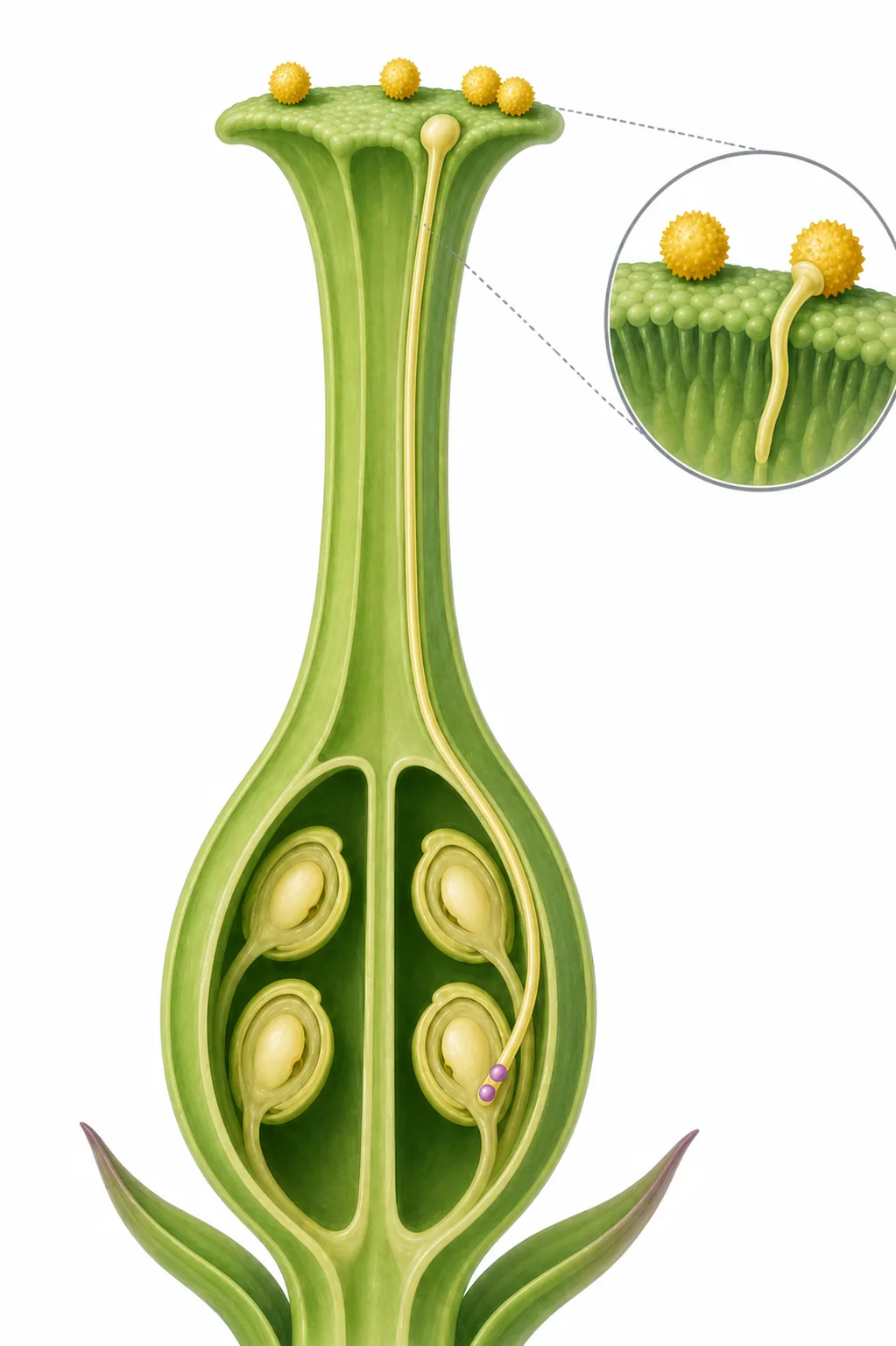
The pollen tube is a growing channel made by the pollen grain. It passes through the stigma and style toward the ovary. The sperm cells do not swim down the style on their own; they are carried inside the pollen tube. This is one of the easiest places to accidentally import an animal-reproduction idea into plant reproduction.
Pollen tube growth depends on water, oxygen, chemical signals, and support from tissues in the style. Different plants have different style lengths, ovule positions, and growth rates, so the time it takes to reach an ovule also varies.
In most plants, a pollen grain is shed with one vegetative cell and one generative cell. The nucleus of the vegetative cell, called the vegetative (or tube) nucleus, moves along with the pollen tube, and the generative cell divides into two sperm cells inside the tube. In about a third of species, including grasses, the pollen already carries two sperm cells when it is shed.
The Pollen Tube Heads Toward an Ovule
The ovary contains ovules, and each ovule contains cells involved in fertilization. After the pollen tube reaches the ovary, it often grows along the placenta (the tissue in the ovary that bears the ovules) and the funiculus (the small stalk that attaches an ovule) to reach an ovule, then enters through a small opening called the micropyle.
Inside the ovule is a structure called the embryo sac. It holds the egg cell and the central cell, with two synergid cells beside the egg. Once inside, the pollen tube grows into one of the synergids, where its tip bursts and releases two sperm cells.
An ovule is not a finished seed yet. It is the structure that can develop into a seed after fertilization. The ovary usually contributes to the fruit after fertilization and development. This is the point where flower structure connects to seed and fruit formation.
The sequence can be read this way:
- Pollen lands on the stigma.
- Compatible pollen germinates and produces a pollen tube.
- The pollen tube grows down the style toward the ovary.
- The pollen tube enters an ovule through the micropyle and releases two sperm cells in a synergid.
- After fertilization, the ovule can begin developing toward a seed.
Flowering Plants Have a Special Step: Double Fertilization
Flowering plants, or angiosperms, have a distinctive process called double fertilization. The name sounds technical, but the basic idea is not hard: the pollen tube delivers two sperm cells, and each one fuses with a different cell.
One sperm cell fuses with the egg cell and begins the embryo. The embryo is the early body plan of the next plant. The other sperm cell fuses with the central cell and forms endosperm, a nutritive tissue used by the developing embryo in many seeds.
Double fertilization does not mean that two embryos form. It means one fertilization event starts the embryo, while the other starts the endosperm. The two sperm cells do not have fixed roles: in Arabidopsis, a small plant in the mustard family that is the best-studied example, either one can fuse with the egg cell. To see how many chromosome sets each cell carries, open the advanced section of the animation above.
What happens to the endosperm next depends on the plant. Seeds of corn and wheat keep a large endosperm when mature. In plants such as common beans and shepherd’s purse, the endosperm is absorbed as the seed develops and its nutrients are stored in the cotyledons; see What Are Cotyledons?. To follow how a fertilized ovule becomes a seed, read How Does an Ovule Become a Seed?.
Why Pollination Does Not Always Lead to Seeds or Fruit
There are several checkpoints between pollen and seed formation. Pollen may not be accepted by the stigma. The stigma may no longer be receptive. Pollen may fail to germinate. A pollen tube may stop growing in the style. The ovule may not be ready for fertilization. Even after fertilization, early development can still be affected by the plant species and its environment.
Flowering, pollination, fertilization, seed formation, and fruit development are connected but separate steps. Seeing pollen on a stigma points to the next questions: whether the pollen tube grows, whether fertilization happens, and whether early development continues. Seeing an open flower also does not mean fertilization has already happened.
A useful starting point is to locate the anther, stigma, style, ovary, and ovules, then treat “what happens after pollination” as a process instead of a single instant.
Common Mix-Ups
- ✕ Once pollen reaches the stigma, fertilization has already happened.
- ✓ Pollen on the stigma is pollination. Fertilization still depends on pollen germination, pollen tube growth, and sperm cells reaching the ovule area.
- ✕ The whole pollen grain falls down through the style.
- ✓ The pollen grain usually stays on the stigma and grows a pollen tube downward.
- ✕ Every pollen grain on a stigma succeeds.
- ✓ Incompatible pollen may be rejected, and pollen tube growth can stop.
- ✕ Double fertilization means two embryos form.
- ✓ In angiosperms, one sperm cell starts the embryo, and the other starts the endosperm.
- ✕ One sperm cell always targets the egg cell and the other always targets the central cell.
- ✓ In the best-studied plants, the two sperm cells do not have fixed roles.
- ✕ Successful pollination guarantees fruit.
- ✓ Pollination is followed by fertilization and early development steps, and seeds or fruit may still fail to mature.
Frequently Asked Questions
Does pollen fertilize the flower as soon as it lands on the stigma?
No. Pollen landing on the stigma is pollination. Before fertilization can happen, compatible pollen must hydrate, germinate, grow a pollen tube, and deliver sperm cells toward an ovule.
What is a pollen tube?
A pollen tube is a thin tube produced by a germinating pollen grain. It grows through the stigma and style toward the ovary and carries sperm cells toward an ovule.
Where does the pollen tube grow?
In flowering plants, the pollen tube usually grows through the style toward the ovary, then approaches or enters an ovule. The exact distance and timing vary among plant species.
How do sperm cells get out of the pollen tube inside the ovule?
The pollen tube usually enters the ovule through the micropyle and grows into one synergid of the embryo sac. Its tip bursts there and releases two sperm cells, which fuse with the egg cell and the central cell. That synergid then breaks down.
What is double fertilization?
Double fertilization is a feature of angiosperms. The pollen tube delivers two sperm cells: one fuses with the egg cell and begins the embryo; the other fuses with the central cell and forms endosperm.
Is self-pollen always accepted?
No. Some plants can self-pollinate, but others have systems that prevent self-pollen or genetically similar pollen from continuing. The rules differ among plant species.
If someone places pollen on a stigma by hand, will fruit definitely form?
No. Even when pollen is placed on the stigma, compatibility, stigma receptivity, pollen tube growth, ovule condition, and environment can all affect what happens next.
Related Terms
- Pollination: the transfer of pollen to a stigma.
- Stigma: the pollen-receiving surface of a pistil or carpel.
- Style: the structure connecting the stigma and ovary; pollen tubes often grow through it.
- Ovary: the basal part of a pistil or carpel that contains ovules.
- Ovule: the structure that can develop into a seed after fertilization.
- Pollen tube: the tube produced by germinating pollen; it carries sperm cells.
- Micropyle: a small opening in the ovule where the pollen tube often enters.
- Embryo sac: the female gametophyte inside the ovule; the common type contains an egg cell, two synergids, a central cell, and three antipodal cells.
- Synergids: two cells beside the egg cell that receive the pollen tube, where it bursts and releases the sperm cells.
- Central cell: the largest cell of the embryo sac; it contains the polar nuclei and forms the endosperm after fertilization.
- Transmitting tissue: tissue in the style that the pollen tube grows through and that supplies it with nutrients and signals.
- Fertilization: the union of sperm cell and egg cell.
- Zygote: the cell formed when a sperm cell fuses with the egg cell; it develops into the embryo.
- Double fertilization: the angiosperm process in which two sperm cells participate in embryo and endosperm formation.
- Endosperm: nutritive tissue used by the developing embryo in many seeds.
Related Reading
Evidence
References
These sources were used to check the plant-science concepts and gardening context in this article.
View sources and further reading (20)
- openstax.org — 32 2 pollination and fertilization
- openstax.org — 32 1 reproductive development and structure
- openstax.org — 26 3 angiosperms
- extension.oregonstate.edu — print
- umass.edu — understanding pollen pistil interaction basis towards improving reproductive yields in
- ucanr.edu — 90444.pdf
- openstax.org — 26 2 gymnosperms
- pmc.ncbi.nlm.nih.gov — PMC4934421
- sciencedaily.com — 140502172105.htm
- pmc.ncbi.nlm.nih.gov — PMC3014542
- journals.biologists.com — Chemical signaling for pollen tube guidance at a
- pmc.ncbi.nlm.nih.gov — PMC3108811
- pmc.ncbi.nlm.nih.gov — PMC7586128
- pmc.ncbi.nlm.nih.gov — PMC139410
- pmc.ncbi.nlm.nih.gov — PMC7400472
- pmc.ncbi.nlm.nih.gov — PMC2516219
- pmc.ncbi.nlm.nih.gov — PMC3873414
- academic.oup.com — 592683
- bp.ueb.cas.cz — 01.pdf
- pubmed.ncbi.nlm.nih.gov — 26166301