The plant epidermis contains many different structures
The plant epidermis is the tissue of cells at the outer surface of a plant organ, where it meets the environment. It is often a single layer of epidermal cells around a leaf, young stem, or root, protecting the tissues underneath. But the epidermis is not a lifeless plastic sheet, and it does not look or work the same way in every organ.
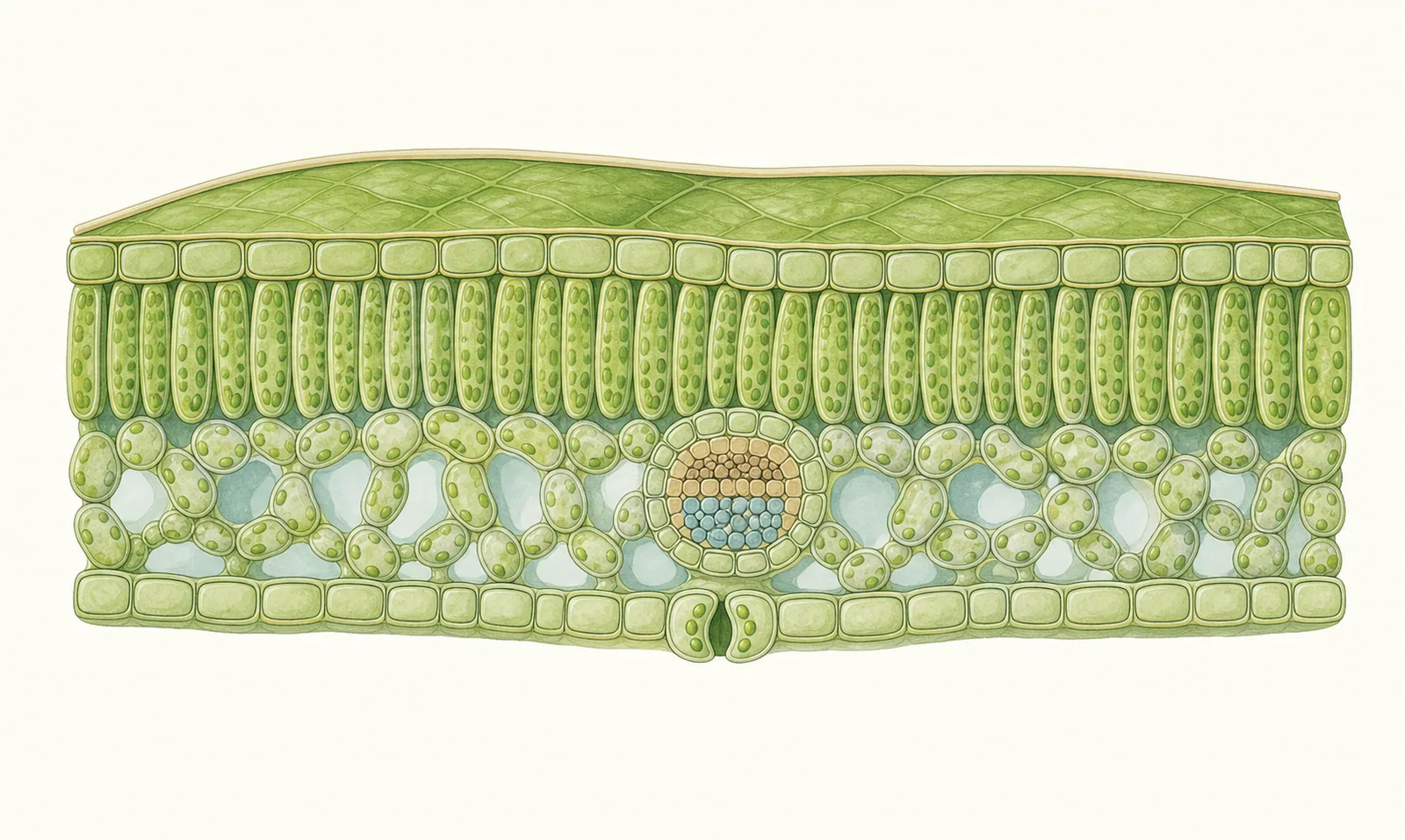
On a leaf, the epidermis works together with the cuticle, stomata, guard cells, and trichomes. Together, these structures handle several jobs that can pull in different directions: slowing water loss, protecting inner cells, and still allowing carbon dioxide, oxygen, and water vapor to move in or out when needed.
Epidermal cells and the cuticle are different
Epidermal cells are living cells. The cuticle is a thin, non-cellular covering formed at the outer surface of epidermal cells, commonly containing cutin and waxes. On leaves and young stems exposed to the air, the cuticle can slow the rate at which water leaves the surface.
So if a leaf looks shiny or feels smooth, do not automatically say, “That is the epidermis.” A more accurate distinction is this: the epidermis is cellular tissue, while the cuticle is a protective layer over the outside of the epidermis. The cuticle can reduce water loss, but it does not seal the leaf into a completely gas-tight bag. The leaf still needs to interact with air through stomata.
The thickness of the cuticle also varies with plant species, organ, and growing environment. Dry or high-light environments may be associated with stronger surface-protection traits.
Stomata balance epidermal protection with gas exchange
Leaf epidermis contains tiny openings called stomata. A typical stoma is bordered by a pair of guard cells. When the guard cells change shape, the pore can open wider or narrow.
When stomata open, carbon dioxide can enter the leaf more easily and support photosynthesis. Oxygen and water vapor can also move through the stomatal pathway. The movement of water vapor from a plant surface into the air is part of transpiration. Stomata are therefore not just tiny holes used for “breathing”; they are adjustable gateways in the epidermis.
There is an important trade-off here. Wider stomata make it easier for carbon dioxide to enter, but they may also allow water to escape more readily. Narrower stomata can reduce some water loss, but they also limit gas exchange. Many land plants have more stomata on the underside of their leaves, but that is a common pattern, not a fixed rule for every plant.
Trichomes give the epidermis additional surface functions
Some plants produce trichomes, which are hairs, bristle-like structures, or other outgrowths formed by epidermal cells. Trichomes are not one single kind of “plant hair.” Some can make it harder for small insects to move across a leaf, some can store or secrete substances, and some can change air movement near the leaf surface and may help reduce some water loss.

This also shows why the epidermis should not be imagined as a row of identical structures. Most epidermal cells form a continuous outer layer, guard cells regulate an opening, and trichomes are epidermal appendages found only in some plants. Together, they form an interface between the plant and its surroundings.
The epidermis works differently in leaves, roots, and older stems
The same word—epidermis—can describe tissues on different organs whose main jobs are not identical.
- Leaves and young stems: Their common priorities are protecting inner tissues, slowing rapid water loss, and regulating gas exchange through stomata.
- Roots: Root epidermis can protect the outer surface, but epidermal cells on young roots may form root hairs. These increase the surface area in contact with soil or potting media and help with water and mineral-nutrient uptake. The absorbing zone of a root should not be explained using the leaf’s cuticle-and-stomata model.
- Older stems with secondary growth: As a woody stem becomes thicker, its original epidermis may be disrupted. Periderm and other secondary protective tissues then take over much of the surface-protection role. Bark should not be treated as one enlarged layer of leaf epidermis.
For this reason, “the epidermis prevents water loss” is only a useful starting point for leaves and above-ground parts. It cannot summarize every plant organ. A better model is that the epidermis is the plant’s first interface with the environment, and its structure changes according to the work each organ needs to do.
Observe plant surfaces in gardening, but do not judge from appearance alone
On potted plants or a balcony, leaf gloss, roughness, hairiness, and the surface of young stems can be useful observation clues. They may be related to the cuticle, waxes, or trichomes. Knowing that the underside of many leaves has more tiny stomata than the upper surface can also help explain how a leaf balances gas exchange with reduced water loss.
Surface traits are still only clues for building a plant-science model. They cannot, by themselves, tell you whether a plant is short of water, has a disease, or what treatment to take. Leaf appearance is also affected by plant species, leaf age, light, temperature, humidity, and growth stage. When you are trying to understand a gardening phenomenon, observe the roots, potting media, and overall environment as well.
Common confusions
- ✕ The plant epidermis is just the cuticular film on the outside.
- ✓ The epidermis is cellular tissue; the cuticle is a non-cellular protective layer over the surface of some above-ground organs.
- ✕ The epidermis seals the plant completely, so gases cannot pass through it.
- ✓ It can include stomata and guard cells, allowing leaves to regulate gas exchange and water-vapor loss.
- ✕ Every plant has a single-layer epidermis, with stomata on the underside.
- ✓ A single layer is a common model, but epidermal thickness and stoma location vary with the plant and its environment.
- ✕ All the hairs on leaves are dust, mold, or roots.
- ✓ Some are trichomes formed by the epidermis; their form and function vary among plants.
- ✕ Root epidermis and leaf epidermis do exactly the same job.
- ✓ Root epidermis can form root hairs that increase surface area for water and mineral-nutrient uptake; the leaf-stoma model cannot be applied directly to roots.
Frequently Asked Questions
What is the plant epidermis?
The plant epidermis is the cellular tissue on the outside of a plant organ, where the plant meets its environment. It is common on leaves, young stems, and roots. It protects the tissues underneath and may include specialized structures such as stomata, guard cells, trichomes, or root hairs.
Is the cuticle the same as the epidermis?
No. The epidermis is a layer of cells, while the cuticle is a non-cellular covering over the outside of the epidermis. On leaves and young stems, the cuticle usually helps reduce water loss from the surface, but it is not the entire epidermis.
Do epidermal cells carry out photosynthesis?
Most leaf epidermal cells are not the main site of photosynthesis; mesophyll cells usually contain more chloroplasts. Guard cells are an important exception: in many plants, they contain chloroplasts. This detail is useful when you learn how stomata are regulated.
Why do roots have an epidermis but usually no stomata?
The root epidermis mainly interacts with soil or potting media, and young roots can form root hairs to increase their absorptive surface area. Leaves exchange gases with the air through stomata, but roots have a different surface environment and job. The leaf-stoma model therefore cannot be applied directly to roots.
Are all the hairs on plant leaves trichomes?
Not necessarily. A trichome is an outgrowth formed by the epidermis, but a white, gray, or fuzzy-looking surface seen without magnification may also involve wax, dust, or other factors. Confirming what it is usually requires closer morphological observation or microscopy.
Is the bark on a tree also epidermis?
As a mature woody stem becomes thicker, its original epidermis may be disrupted. Periderm and other secondary protective tissues then take over the outer protective role. Bark should therefore not be treated as the same thing as the epidermis of a young leaf.
Related Terms
- Epidermis: Cellular tissue on the outer surface of a plant organ, often involved in protection and interaction with the environment.
- Cuticle: A non-cellular protective layer over the epidermis of some above-ground organs; it can reduce water loss.
- Stoma (plural: stomata): A tiny opening in the epidermis that allows a leaf to regulate gas exchange.
- Guard cells: Cells surrounding a stoma that regulate the size of its opening.
- Trichome: A hair, bristle-like structure, or other outgrowth formed by the epidermis.
- Root hair: A slender outgrowth formed by a root epidermal cell that increases absorptive surface area.
- Periderm: Secondary protective tissue that forms in woody plants after secondary growth.
Read Next
Evidence
References
These sources were used to check the plant-science concepts and gardening context in this article.
View sources and further reading (11)
- openstax.org — 30 4 leaves
- openstax.org — 30 3 roots
- propg.ifas.ufl.edu — 04 celltypes cellepidermis.html
- botit.botany.wisc.edu — Dermal Tissue System.html
- open.lib.umn.edu — 6 1 plant cells and tissues
- organismalbio.biosci.gatech.edu — plant development i tissue differentiation and function
- organismalbio.biosci.gatech.edu — plant development ii primary and secondary growth
- lima.osu.edu — plant anatomy
- pubmed.ncbi.nlm.nih.gov — 23893170
- pubmed.ncbi.nlm.nih.gov — 32480505
- passel2.unl.edu — 6