
Juvenile and adult phases are developmental stages, not simple labels for a plant’s size. Each phase is associated with a set of morphological and physiological traits. Leaf shape and shoot habit can offer visible clues, while some physiological changes cannot be judged from appearance alone. These phases relate to flowering, but they do not by themselves tell you whether a plant can flower or has begun making flowers.
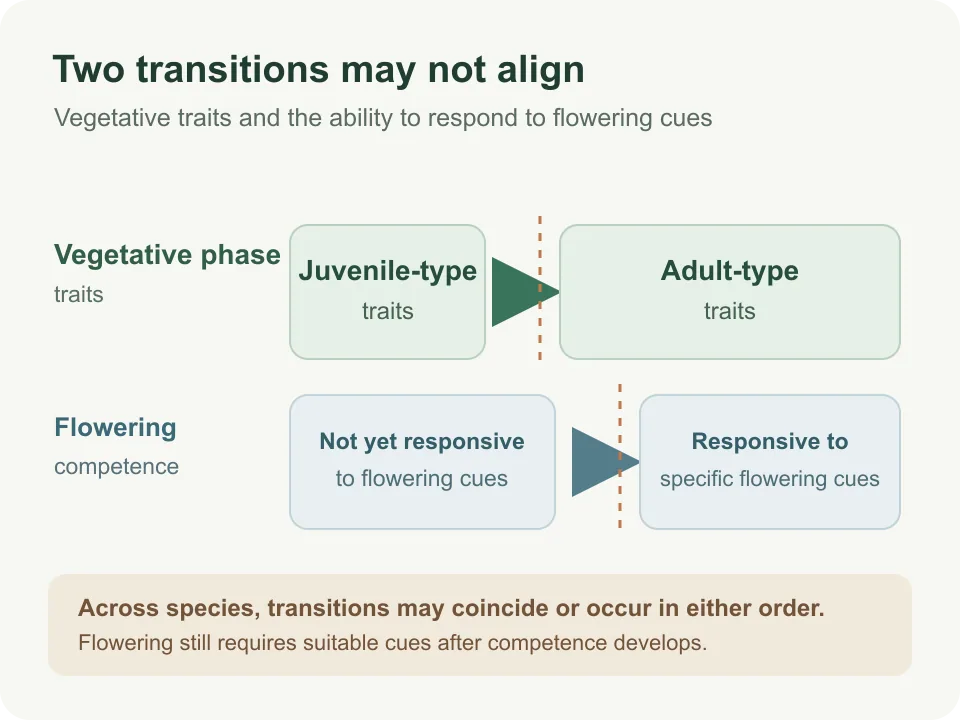
A phase is a developmental stage, not a size category
In plant development, a phase is a stage associated with morphological (structural) and physiological traits. Leaf shape and shoot habit are visible clues; other changes may not be obvious from appearance. As a plant produces new leaves, buds, and stem segments, some traits change gradually while others shift together. The change from juvenile vegetative growth toward adult vegetative growth is called vegetative phase change. It describes development during the growth of roots, stems, and leaves; it is not itself a transition to flowering.
In everyday gardening, “mature” may simply mean that a plant has grown large. In developmental biology, the adult vegetative phase refers to a later stage of vegetative development. The traits vary by species: some plants show clear changes between juvenile and adult growth, while others show only subtle differences. Even adult-looking shoots do not prove that a plant has flowering competence.
Flowering competence, induction, transition, and differentiation are distinct
Reproductive competence, also called floral competence in this context, is the developmental ability to respond to signals that can promote flowering. Many plants cannot respond to such signals during at least part of their juvenile phase. However, the change in vegetative traits and the acquisition of flowering competence do not always happen at the same time. In some species they may align; in others, one may come earlier than the other. An adult-looking leaf is not a universal test of flowering ability, and conspicuous adult leaf traits are not required in every species before it becomes competent.
Competence is an ability, not an event. Floral induction is the response to suitable internal or environmental cues that starts the physiological process leading toward flowering. Depending on the species, cues may include day length, temperature, or seasonal conditions. Induction does not mean that visible flower buds are already present.
The floral transition is the developmental change at the shoot tip—the growing point that produces new organs—from vegetative growth toward reproductive growth. Floral differentiation is the subsequent development of flower primordia and floral organs. Visible flowers appear later still. These processes are connected, but they are not interchangeable: a plant can be competent without having received an inductive cue, and induction does not mean the floral transition, flower differentiation, or visible flowering has already occurred.
Terminology and boundaries between these stages can vary among crops and sources. For this explanation, the useful distinction is between the physiological induction of flowering and the formation and development of flowers.
This distinction also explains why a plant may continue producing leaves after it has gained flowering competence: it may not have received suitable cues, or it may not yet have undergone the floral transition. A plant with no flowers cannot, on that fact alone, be identified as juvenile. There is no universal calendar age or height threshold for the juvenile phase. Plant size, time since planting, and flowering status must be understood in the context of the species and its development.
Ivy leaves and citrus thorns are species-specific clues
English ivy (Hedera helix) is a useful example because its phase-related shoot traits can be conspicuous. Juvenile shoots commonly have three- to five-lobed leaves and attachment roots; adult shoots usually have unlobed leaves and may bear clusters of small flowers. A single ivy plant can also carry shoots with different phase traits at the same time. This describes English ivy, not a general way to judge other plants.
Thorns can offer another developmental clue in citrus, but the pattern is species-specific. In pomelo, juvenile shoots commonly bear many thorns, while new shoots on mature trees usually have no thorns or have far fewer, shorter ones. Yet some four-year-old sour orange (Citrus aurantium) seedlings bearing fruit remained thorny, and lemons and limes often have thorns. Species and cultivars differ, so thorn presence alone cannot establish that a citrus plant is still juvenile.
Some species have striking juvenile and adult traits; in others, the differences are subtle. The relationship between vegetative traits and flowering competence can also differ by species. When observing a plant, first identify the species, then compare new growth over time with the traits known for that species. One leaf, plant height, a thorn, or a lack of flowers is not enough to determine its phase.
To see how these stages fit into the broader sequence of plant development, read “What Stages Are in a Plant Life Cycle?”. A seedling is a young plant shortly after germination; that early growth stage is related to, but not identical with, the developmental juvenile phase. See “What Is a Seedling?”.
Common points of confusion
- A tall or large plant must be in its adult vegetative phase. Size can be one observation, but there is no universal mature height for plants.
- Adult vegetative traits, flowering competence, and actual flowering are one transition. Vegetative traits, the ability to respond to cues, the floral transition, floral differentiation, and visible flowers can occur at different times.
- A plant that has not flowered must still be juvenile. It may already be competent but not have received suitable inductive cues, or it may not yet have undergone the floral transition.
- Adult-looking leaves prove that a plant can flower. Leaf form is a phase clue in some species, not a general test of flowering competence.
- Thorns prove that a citrus plant is juvenile. Thorniness often changes as many citrus plants develop, but the pattern varies by species and cultivar; lemons and limes often remain thorny.
- Every plant has obvious juvenile and adult leaves. Some species show marked differences; others show little visible change.
Frequently asked questions
Is the juvenile phase the same as the seedling stage?
No. A seedling is a young plant shortly after germination, while its roots, stem, and leaves are becoming established. The juvenile phase is a developmental stage that varies among species and can continue after a plant no longer looks like a small seedling.
How old does a plant have to be to count as mature?
There is no age threshold that works for every plant. The timing of adult vegetative traits and flowering competence differs among species, and environmental conditions also affect development. Months or years since planting alone cannot determine a plant’s phase.
If a plant never flowers, does that mean it is still juvenile?
Not necessarily. It may already have flowering competence but may not have received suitable inductive cues. Its vegetative traits and flowering competence may also have changed at different times. A lack of flowers alone cannot establish that the plant is juvenile.
Do adult-looking leaves mean a plant can flower?
Not always. Leaf shape is a useful phase clue in some plants, but it is not a universal test of flowering competence. The timing and relationship between vegetative traits and the ability to respond to flowering cues vary by species.
Can one plant have both juvenile and adult shoots?
English ivy can have shoots with different phase traits on the same plant. In this species, phase-related traits need not describe every shoot in the same way. This example should not be assumed to apply to all plants.
Do thorns on a citrus plant mean it is still juvenile?
No. Many citrus plants have thornier young shoots, and thorniness often decreases as they grow. The pattern varies by species and cultivar, and lemons and limes often remain thorny even when they are able to flower. Thorn presence alone cannot determine a plant’s phase.
Key terms
- Phase: A developmental stage associated with a combination of morphological and physiological traits; visible features can be clues but do not show every part of the phase.
- Vegetative phase change: The shift from juvenile toward adult vegetative development, during which traits of leaves, buds, and shoots change.
- Adult vegetative traits: Features of leaves or shoots associated with the adult vegetative phase in a particular species.
- Reproductive or floral competence: The developmental ability to respond to signals that can promote flowering.
- Floral induction: The response to suitable internal or environmental cues that starts the physiological process leading toward flowering.
- Floral transition: The developmental change at the shoot tip from vegetative growth toward reproductive growth.
- Floral differentiation: The subsequent development of flower primordia and floral organs.
- Vegetative growth: Growth that primarily forms vegetative organs such as roots, stems, and leaves.
Related reading
Evidence and attribution
Sources and image rights
These sources were used to check the plant-science concepts and gardening context in this article.
View sources and further reading (10)
- research-information.bris.ac.uk — temporal regulation of vegetative phase change in plants
- pmc.ncbi.nlm.nih.gov — PMC9905307
- frontiersin.org — full
- nph.onlinelibrary.wiley.com — j.1469 8137.2008.02681.x
- powo.science.kew.org — general information
- research.fs.usda.gov — hedhel
- tdr.lib.ntu.edu.tw — 66371
- kmweb.moa.gov.tw — theme data.php
- frontiersin.org — full
- hort.extension.wisc.edu — indoor citrus
Image sources and rights
- Plant Note project-made image · Created by Plant Note; no third-party image license applies — The project-made SVG was adapted as WebP for delivery.