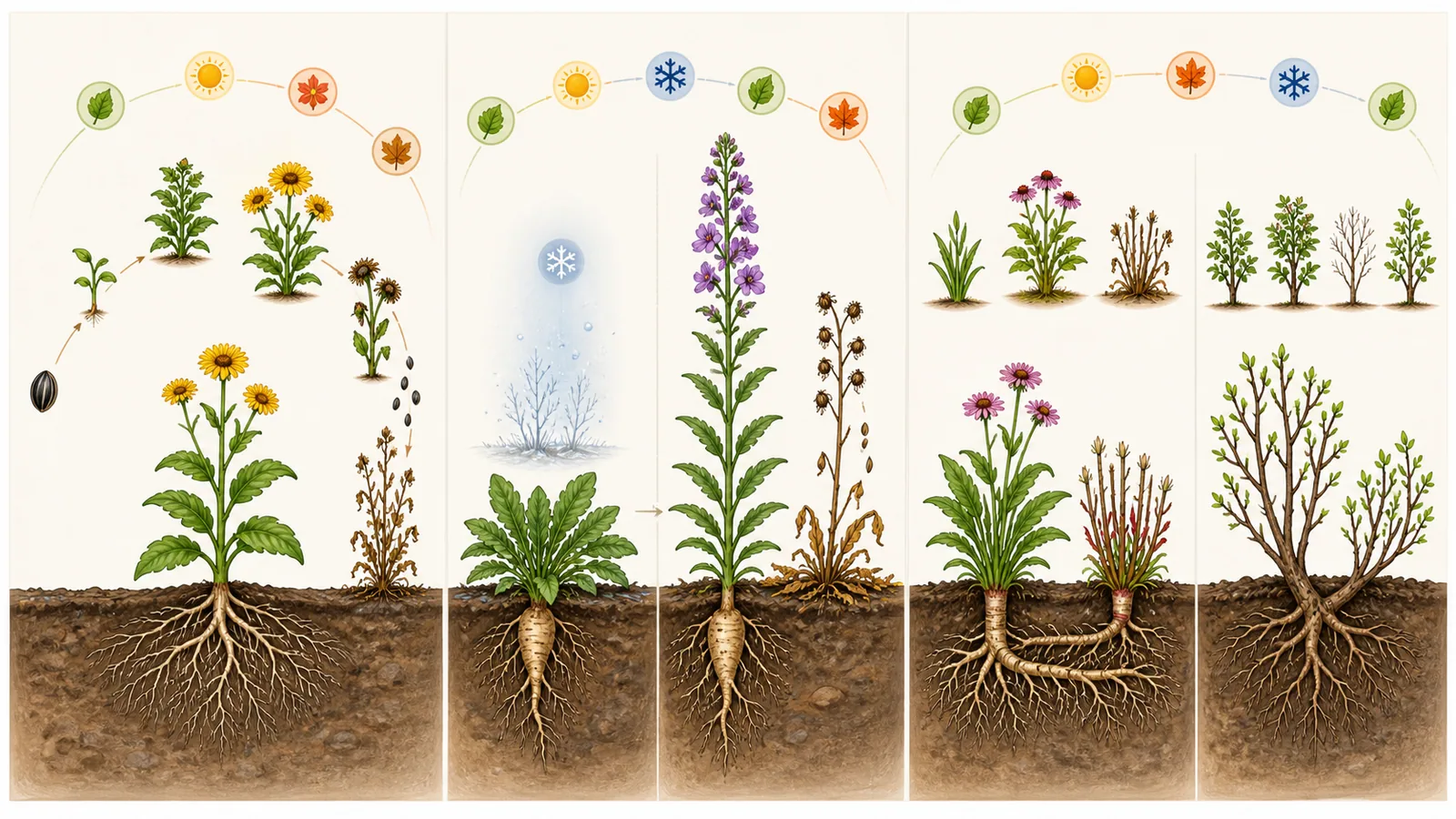
The difference between annual, biennial, and perennial plants is not whether a plant looks big, small, vigorous, or delicate. It is about life-cycle length: how long the plant takes to germinate, grow, flower, make seeds, and either die or continue living.
In plain language, an annual usually completes its life cycle in one growing season. A biennial usually spends the first season growing leaves and storing resources, then flowers and sets seed in the second season. A perennial can live for more than two growing seasons, surviving through roots, crowns, underground stems, woody stems, or other persistent structures.
Annuals complete one cycle quickly
An annual plant usually completes its life cycle in one year or one growing season, from seed germination to seed production. It produces roots, stems, and leaves, flowers, forms fruit or seeds, and then the original plant dies.
That does not mean annuals are weak, inferior, or less successful. It simply means their life strategy is short. Many annuals invest heavily in fast growth, flowering, and seed production.
“One year” should not always be read as exactly 365 days. Gardeners and botanists often speak in terms of a growing season, because climate, winter, dry seasons, and planting time all matter. Some winter annuals germinate and grow in cool seasons, then flower, set seed, and die when conditions change.
Biennials usually need two growing seasons
A biennial plant usually needs two growing seasons to complete its life cycle. A common pattern is that the plant first makes leaves, a short stem, roots, or storage structures. After an unfavorable season, it grows a flowering stalk, flowers, produces seeds, and then the original plant dies.
That is why many biennials look like they are “only growing leaves” in the first year. They are not failing to flower. They are building the vegetative body first. Vegetative growth means growth of roots, stems, and leaves: the parts that collect light, take up water, support the plant, and store resources.
Biennials do not always behave like a perfect textbook timeline. Climate, sowing time, temperature, and species differences can shift their pattern. Some may flower earlier under certain conditions, and some are grown as annuals in garden practice.
Perennials live beyond two growing seasons
A perennial plant can live for more than two growing seasons. It does not necessarily restart from seed every year. Instead, some part of the plant remains alive: roots, a crown, rhizomes, bulbs, woody stems, basal stems, or buds that can produce new growth when conditions improve.
Perennial does not mean immortal, evergreen, or always in bloom. Herbaceous perennials may die back above ground during cold or dry seasons while underground parts stay alive. Woody perennials may persist through trunks, branches, and buds; some are evergreen, while others are deciduous.
This matters because “perennial” is often misread as “green all year.” The safer meaning is that the plant individual can persist across multiple growing seasons. Whether it rests, drops leaves, dies back, or regrows depends on the plant and the environment.
Representative examples
Common annual examples include zinnias, marigolds, and morning glories. They are often used to explain the pattern of germinating, growing, flowering, producing seeds, and then ending the original plant within one growing season.
Common biennial examples include carrots, beets, parsley, foxglove, hollyhock, and sweet William. These are often used to explain the pattern of building leaves, roots, or storage structures in the first growing season, then flowering and producing seeds in the second growing season.
Perennials cover a much wider range. Hostas, coral bells, and moss phlox are examples of herbaceous perennials. Many trees and shrubs are also perennials, but they persist mainly through woody stems, branches, and buds, so gardeners would not usually call them herbaceous perennial flowers. These examples illustrate the classification; garden labels may still vary by region.
Garden labels can depend on climate
In garden centers, seed packets, and gardening articles, the same plant may be described differently in different regions. That does not always mean one source is wrong. Gardening language often includes local climate.
Some plants can behave as perennials in warm climates but fail to survive winter in colder places. In those colder regions they may be grown as annuals. English gardening often uses the phrase tender perennial for a plant that is perennial in suitable climates but not reliably winter-hardy in a particular region.
The difference becomes clearer when the same type of plant is shown in three steps under two climates: can its base survive, and does the local winter allow that to happen in the garden?
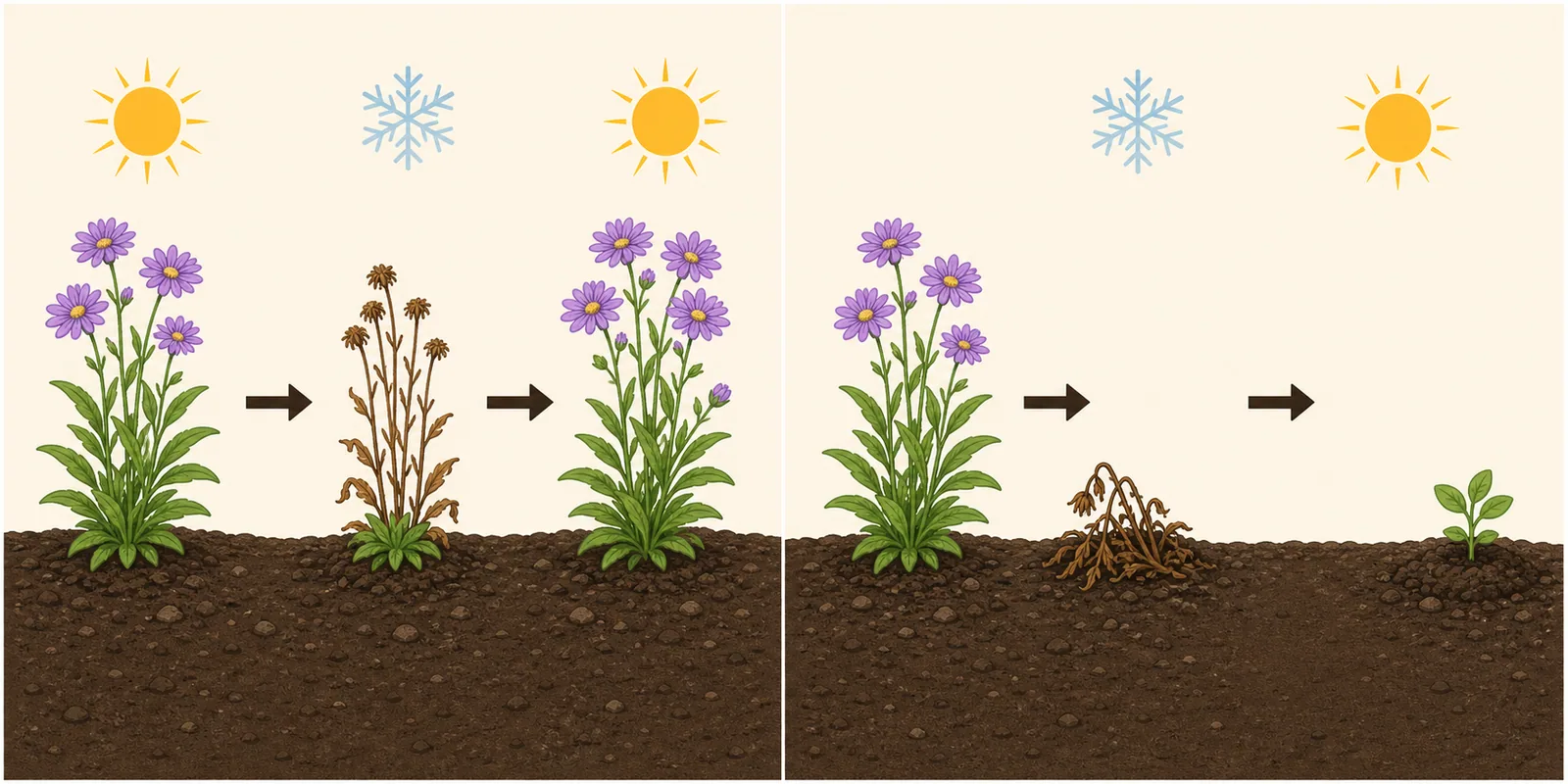
The seedling at the end of the right-hand sequence represents a separate individual, not regrowth from the original plant. For the early stage of a new plant, see What is a seedling?.
When you read a label, first ask whether it describes the plant’s biological life cycle or how gardeners commonly grow it in a particular climate. The first is a broad concept; the second depends on winter temperature, local conditions, and garden practice.
Where do herbaceous perennials, bulbs, and woody plants fit?
An herbaceous perennial is a perennial without a persistent woody trunk or large woody branches. Its top growth may die back, while roots, crowns, rhizomes, bulbs, or other underground parts survive and send up new growth later.
Bulbs, corms, tubers, rhizomes, and similar storage structures can also help plants survive unfavorable seasons. Many plants with these structures can be understood as perennials, but the details differ by species and climate. Seeing a storage organ is not enough to predict every garden behavior.
Woody plants are also perennials. Trees and shrubs may keep living through woody stems, branches, and buds. Some remain green year-round, while others shed leaves and restart growth in a later season.
The most useful question is still the same: does the original plant die after one seed-producing cycle, or can part of it remain alive and grow again in another season?
Common confusions
- ✕ Annual plants are weaker or less advanced.
- ✓ Annual describes a short life cycle, not plant quality.
- ✕ A biennial that does not flower in the first year is failing.
- ✓ Many biennials normally spend the first season making leaves and storage structures before flowering later.
- ✕ Perennial plants are always evergreen and always alive above ground.
- ✓ Perennial means the plant can live beyond two growing seasons; top growth may die back or go dormant.
- ✕ One plant species can have only one label everywhere.
- ✓ Some plants are biologically perennial but grown as annuals in climates where they cannot overwinter.
Frequently Asked Questions
Do annual plants live for exactly one year?
Not always in a strict calendar sense. An annual usually completes its life cycle in one year or one growing season: germination, growth, flowering, seed formation, and death of the original plant.
Are perennial plants immortal?
No. Perennial means the plant can live for more than two growing seasons. It can still die from age, stress, root problems, disease, climate, or other conditions. It also may not keep leaves or flowers all year.
Why do biennials often not flower in the first year?
Many biennials spend the first growing season building roots, leaves, and storage structures. Flowering and seed formation often happen in the second growing season.
Is an herbaceous perennial the same as a perennial?
It is one kind of perennial. Herbaceous perennials do not keep a large woody trunk, but their crowns, roots, rhizomes, bulbs, or other structures can survive and regrow. Perennial is the broader category and also includes many woody plants.
Why can a perennial look dead in winter?
Some herbaceous perennials let their aboveground parts die back during cold or dry seasons. The living part may be below ground or at the crown. When conditions improve, new shoots can grow again. That is different from the whole plant being dead, although the actual condition still depends on the plant and its roots.
Why is the same plant called annual in one place and perennial in another?
Climate is often the reason. A tender perennial may live for years in a warm climate but be killed by winter in a colder climate. Gardeners in the colder place may grow it as an annual.
Does flowering once and dying always mean a plant is annual?
No. Some plants may live for many years before flowering once and dying. Botany uses terms such as monocarpic and polycarpic for those patterns; they answer a different question from the annual–biennial–perennial time classification.
Related Terms
- Annual plant: a plant that usually completes its seed-to-seed life cycle in one year or one growing season.
- Biennial plant: a plant that usually needs two growing seasons to complete its life cycle.
- Perennial plant: a plant that can live for more than two growing seasons.
- Herbaceous perennial: a non-woody perennial that can regrow from roots, crowns, rhizomes, bulbs, or similar structures.
- Woody perennial: a perennial that persists through woody stems, trunks, or branches, such as many shrubs and trees.
- Tender perennial: a perennial that may not survive cold conditions in a particular region.
- Growing season: the part of the year when conditions allow noticeable plant growth.
- Life cycle: the sequence from germination through growth, reproduction, and the next generation.
- Life span: the length of time an individual plant lives.
Read Next
Evidence
References
These sources were used to check the plant-science concepts and gardening context in this article.